What Does “Where Are You” Mean in Morse Code?
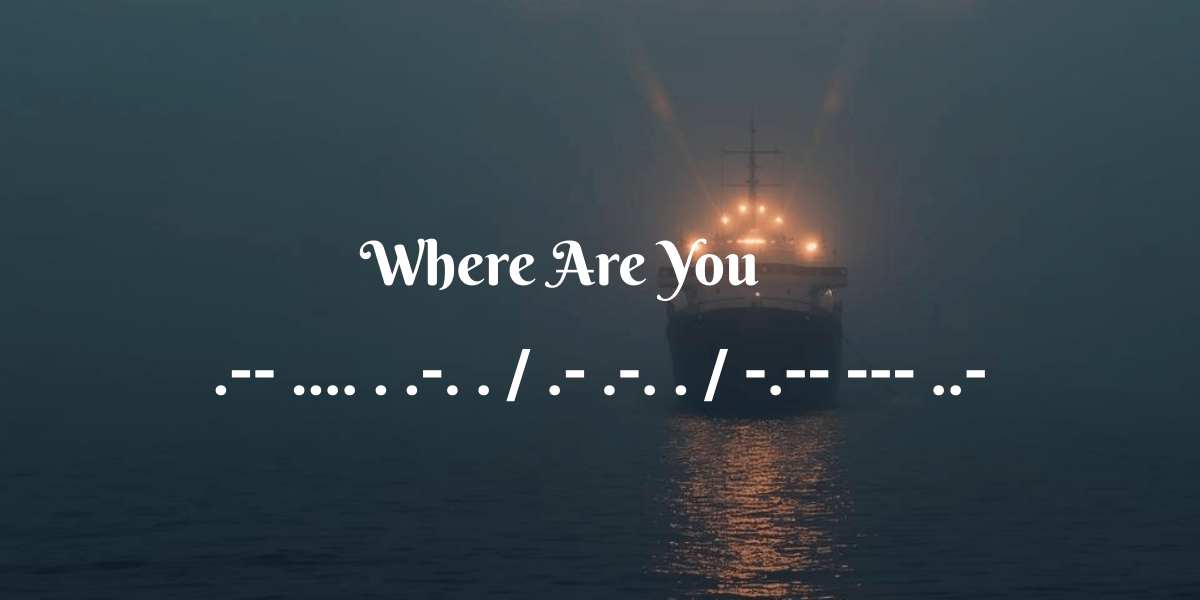
“Where are you” in Morse code is the Morse representation of the full phrase WHERE ARE YOU, commonly used to request someone’s location or response during communication. The phrase is translated letter by letter using international Morse code and is typically used in learning, practice, or radio-style messaging rather than as a standardized signal.
Morse Code Translation of Where Are You
Each word in the phrase is encoded separately, with clear spacing between letters and words for accurate decoding.
WHERE
W = .–
H = ….
E = ·
R = .-.
E = ·
ARE
A = .-
R = .-.
E = ·
YOU
Y = -.–
O = —
U = ..-
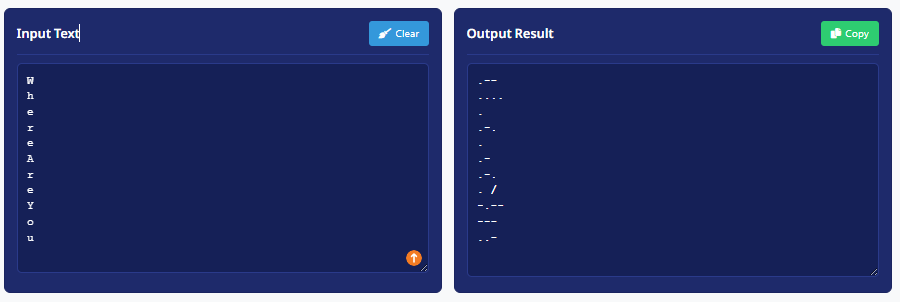
When written together, “Where are you” in Morse code appears as:
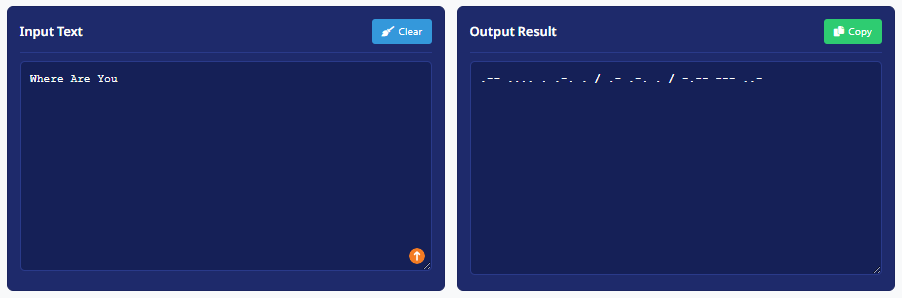
.– …. . .-. . / .- .-. . / -.– — ..- / .. -. / — — .-. … . / -.-. — -.. .
The slash ( / ) represents a space between words for visual clarity.
How “Where Are You” Is Used in Morse Communication
This phrase is often used to request confirmation, location, or presence during Morse code exchanges. In training or practice environments, it helps learners understand how multi-word phrases are structured and spaced in Morse code. It is also useful in simulated communication exercises where clarity is important.
Is “Where Are You” an Official Morse Signal?
No, “Where are you” is not an official or standardized Morse signal. It is a regular phrase encoded using standard Morse characters. Unlike SOS, which is reserved for emergencies, this phrase should only be used for general communication or learning purposes.
Sending “Where Are You” Using Sound
To transmit this phrase using sound, such as beeps or radio tones, each letter is sent in sequence with short pauses between letters and longer pauses between words. Maintaining correct timing ensures the message is easily understood by the receiver.
Sending “Where Are You” Using Light Signals
The phrase can also be sent visually using light signals. Short flashes represent dots and longer flashes represent dashes. A longer pause is used between words to separate “WHERE,” “ARE,” and “YOU,” making the message clear even at a distance.
Quick Reference: Where Are You in Morse Code
Where are you in Morse code is written as.– …. . .-. . / .- .-. . / -.– — ..- / .. -. / — — .-. … . / -.-. — -.. .
It is a standard phrase, not an emergency signal
Used mainly for practice, learning, and communication
Follows international Morse code rules
Written and Visual Morse Representation
In written Morse code, “Where are you” is displayed using dots, dashes, and spaces. This format is widely used in learning tools and translators to demonstrate proper word separation and phrase construction in Morse code.
Why This Phrase Is Useful for Learning Morse Code
“Where are you” contains a variety of Morse patterns, including short, long, and mixed signals. It helps learners practice rhythm, spacing, and decoding longer messages, making it a valuable phrase for intermediate Morse code practice.
Difference Between Location Queries and Distress Signals
While “Where are you” is a location-based question, it does not indicate danger or emergency. Distress signals such as SOS are reserved for urgent situations only. Using the correct type of message helps avoid confusion during Morse communication.
Can This Phrase Be Decoded Automatically?
Yes, when the Morse representation of “Where are you” is entered into a Morse code translator, it can be decoded back into plain text instantly. Proper spacing between letters and words is essential for accurate results.