What Does Emergency Mean in Morse Code?
“Emergency” in Morse code refers to communicating an urgent situation using internationally recognized Morse code signals. While the full word EMERGENCY can be spelled letter by letter in Morse code, true emergency communication typically relies on specific distress signals such as SOS or MAYDAY, which are faster and universally recognized.
Morse Code Representation of Emergency
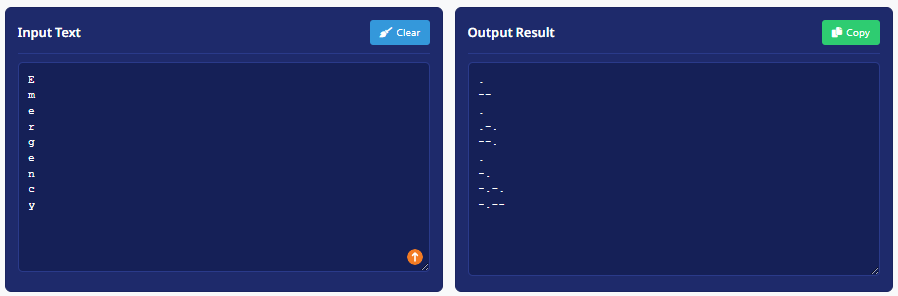
When written as a word, Emergency is translated into Morse code by encoding each letter individually according to international Morse standards:
E = ·
M = —
E = ·
R = .-.
G = –.
E = ·
N = -.
C = -.-.
Y = -.–
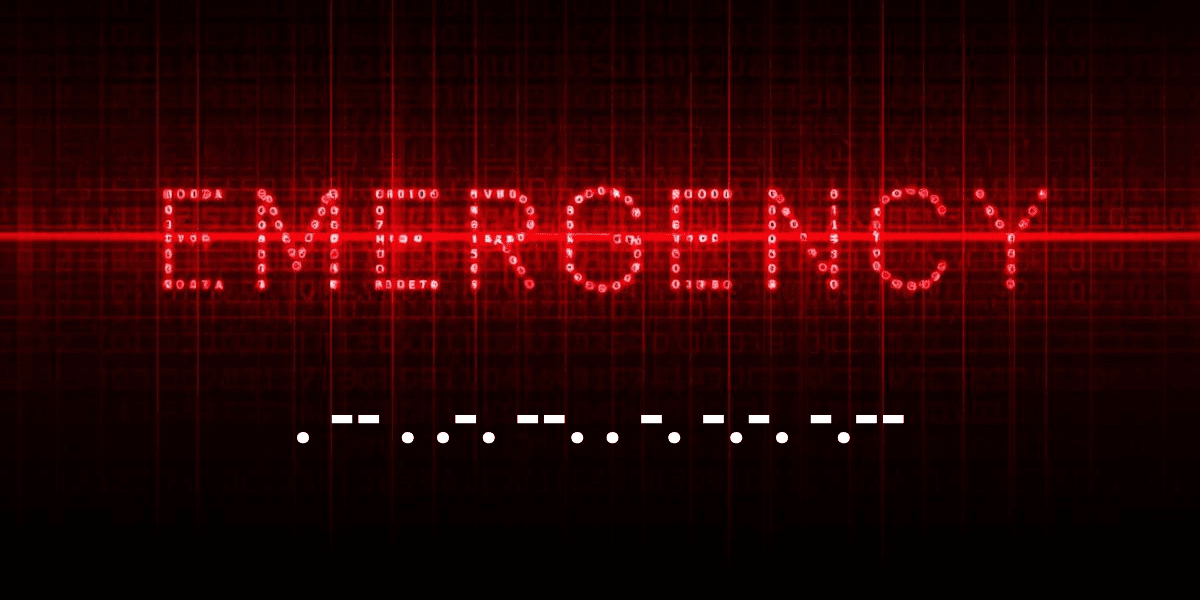
Combined, Emergency in Morse code appears as:
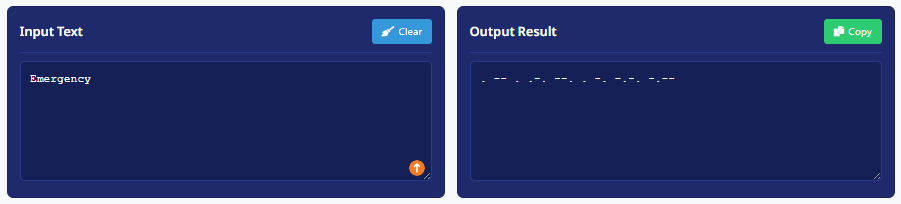
. — . .-. –. . -. -.-. -.–
Each letter is separated by a short pause to ensure accurate decoding.
What Is Morse Code and Why Does It Matter in Emergencies?
Morse code is a communication system developed in the 1830s by Samuel Morse and Alfred Vail. It represents every letter of the alphabet, every digit, and key punctuation marks as unique sequences of short signals (dots) and long signals (dashes). Those signals can be transmitted as sound, light, electrical impulses, or physical taps — which is precisely why Morse code is so powerful in emergencies.
When technology fails, Morse code survives. Here is why it remains one of the most important emergency communication tools in existence:
- No power required. A tapping finger, a reflected sunbeam, or a single flashlight can carry a Morse message for kilometers.
- Universally understood. Emergency responders, maritime services, military units, and rescue teams worldwide recognize standard Morse distress signals.
- Works through barriers. A survivor trapped under rubble can tap Morse code on a pipe. A hostage can blink it in an interrogation room. A diver can bang it on a hull.
- Requires no equipment. Your hands and any hard surface are enough to call for help.
The emergency communication signals you will learn in this guide are not just theoretical — they are life-saving tools that have been proven across two centuries of real-world crises.
What Does “Emergency” Mean in Morse Code?
The word EMERGENCY in Morse code is:
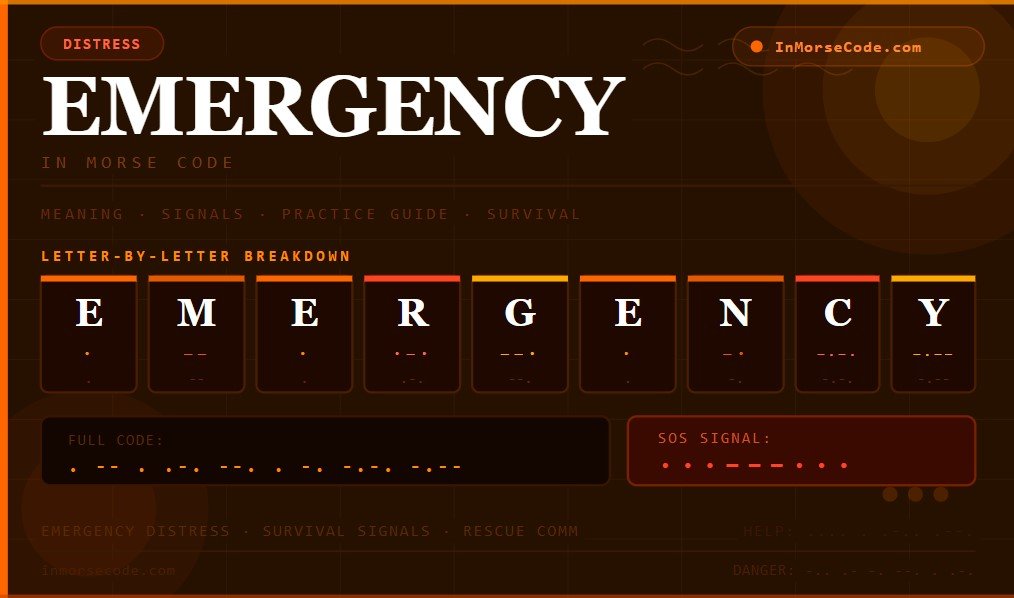
. -- . .-. --. . -. -.-. -.--It is a nine-letter word, which makes it one of the longer phrases you might need in a distress situation. Let us break it down completely so it is easy to learn and remember.
Letter-by-Letter Morse Code Breakdown for EMERGENCY
| Letter | Morse Code | How to Say It |
|---|---|---|
| E | . | dot |
| M | -- | dash – dash |
| E | . | dot |
| R | .-. | dot – dash – dot |
| G | --. | dash – dash – dot |
| E | . | dot |
| N | -. | dash – dot |
| C | -.-. | dash – dot – dash – dot |
| Y | -.-- | dash – dot – dash – dash |
Full Word in Morse Code
. -- . .-. --. . -. -.-. -.--Beginner Tip: Break It Into Three Groups
Nine letters at once is a lot. Split EMERGENCY into three groups of three:
- E-M-E:
. -- .— short, long, short - R-G-E:
.-. --. .— medium, medium-long, short - N-C-Y:
-. -.-. -.--— three dash-heavy letters
Master each group over two days, then chain them together. Within a week, you will have the full word committed to muscle memory.
Hear it for yourself: Use the free Morse Code Translator at InMorseCode.com to listen to EMERGENCY played back in real audio at any speed you choose.
The Most Important Emergency Morse Code Signals
While knowing EMERGENCY in full is valuable, the truth about crisis communication is that shorter signals are transmitted faster, decoded more reliably, and remembered under pressure. Here are the six most important emergency Morse code signals every learner should know — presented in order of priority.
1. SOS — The Universal Distress Signal
... --- ...| Symbol | Morse |
|---|---|
| S | ... |
| O | --- |
| S | ... |
Meaning: Immediate danger — help needed urgently.
When to use it: Any life-threatening emergency. SOS is the single most important signal in this entire guide. It does not stand for any specific phrase; it was chosen because its pattern — three dots, three dashes, three dots — is completely unmistakable, easy to transmit, and impossible to confuse with any other signal. Rescue services, coast guards, and maritime radio operators around the world monitor for SOS continuously.
Transmission tip: SOS is often sent as one continuous sequence without letter gaps: ...---.... This makes it even more distinctive.
2. HELP
.... . .-.. .--.| Letter | Morse Code |
|---|---|
| H | .... |
| E | . |
| L | .-.. |
| P | .--. |
Meaning: Requesting immediate assistance.
When to use it: When SOS alone needs reinforcement, or when you want to transmit a recognizable English word that even non-Morse operators might decode. HELP adds human context to a distress signal.
3. DANGER
-.. .- -. --. . .-.| Letter | Morse Code |
|---|---|
| D | -.. |
| A | .- |
| N | -. |
| G | --. |
| E | . |
| R | .-. |
Meaning: Warning of a hazardous situation — not necessarily personal, but threatening.
When to use it: When you need to warn others of incoming danger — a wildfire, flood, structural collapse, or hostile situation. DANGER alerts rescuers to approach with caution.
4. NEED HELP
-. . . -.. / .... . .-.. .--.The slash / represents a word-space pause. NEED HELP is a two-word phrase that communicates both urgency and helplessness — that you are unable to reach safety without external intervention.
When to use it: When you are immobile, injured, or pinned in place and cannot move toward rescuers.
5. INJURED
.. -. .--- ..- .-. . -..| Letter | Morse Code |
|---|---|
| I | .. |
| N | -. |
| J | .--- |
| U | ..- |
| R | .-. |
| E | . |
| D | -.. |
Meaning: A person has physical injuries requiring medical attention.
When to use it: After or alongside SOS to specify that the emergency is medical. This tells rescuers to bring first aid equipment and medical personnel, not just a search team.
6. MEDIC
-- . -.. .. -.-.| Letter | Morse Code |
|---|---|
| M | -- |
| E | . |
| D | -.. |
| I | .. |
| C | -.-. |
Meaning: A medical professional is needed immediately.
When to use it: MEDIC is shorter than INJURED and faster to transmit in a fast-deteriorating medical situation. It is particularly useful in military or multi-person scenarios where a trained medic may be nearby.
How Morse Code Is Used in Real Emergencies
Understanding the signals is only part of the picture. Knowing how and when Morse code has been — and continues to be — used in genuine emergencies makes the skill feel real and worth investing in.
Maritime Emergencies
The sea is where Morse code has saved the most lives. Before satellite communication became universal on ships, Morse code radio was the primary method of calling for rescue at sea. Even today, international maritime regulations require certain vessels to maintain equipment capable of transmitting the SOS signal. Stories of ships sending SOS in their final minutes — and being rescued because of it — number in the thousands across maritime history.
For recreational sailors and kayakers operating in areas with poor cellular coverage, a basic knowledge of Morse code light signals provides a critical backup.
Military Communication
Military operators have used Morse code in every major conflict since the American Civil War. In World War II, it was the backbone of both Allied and Axis communication networks. Today, certain special forces units still train in Morse code for covert signaling in situations where radio silence is required or electronic communication has been compromised. A tapped message leaves no electromagnetic signature.
Aviation Distress
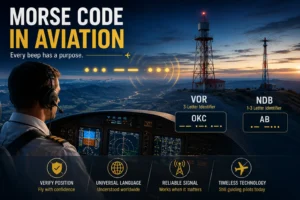
Aircraft navigation beacons — VORs, NDBs, and DMEs — still broadcast their identifiers in Morse code, which pilots learn as part of their training. In a forced landing or communication blackout, a pilot who knows Morse code can signal their location using the aircraft’s lights or a handheld device.
Survival Situations: Hiking, Camping, and Wilderness
This is the use case most relevant to everyday people. A hiker with a sprained ankle three days from the nearest trail head, a camper whose boat capsized in a remote lake, a climber pinned by a rockfall — in all of these situations, a flashlight or a rock against a tree can transmit SOS to a passing aircraft or a distant observer.
Emergency services in many countries now train their search-and-rescue teams specifically to watch for Morse light signals at night.
Natural Disasters
In earthquake and building collapse scenarios, rescue teams use acoustic sensors to detect tapping from survivors. A random, desperate banging rarely communicates anything useful. A rhythmic SOS signal tells rescuers that there is a conscious, thinking person inside — and the pattern tells them it is a deliberate signal, not structural movement.
The International Search and Rescue Advisory Group officially recognizes Morse tapping as a standard method of survivor communication in structural collapse scenarios.
Silent Communication
In situations where speaking aloud is dangerous — a hostage scenario, a situation with potential aggressors nearby, or a medical condition that prevents speech — Morse code allows communication through blinking, tapping, or minimal movement. There are documented cases of hostages and prisoners of war communicating entire conversations through tapped Morse code without their captors realizing.
How to Practice Emergency Morse Code — A Beginner’s Guide
Knowledge without practice is useless in an emergency. Here is a structured, practical approach to getting emergency Morse code signals into your long-term memory.
Step 1 — Start With SOS Only
Before you learn anything else, learn SOS: ... --- .... Three dots, three dashes, three dots. Practice it tapping on a table right now. Short-short-short, long-long-long, short-short-short. This alone could save your life.
Step 2 — Learn the Individual Letters in Your Priority Phrases
Focus on letters that appear in your most important signals (SOS, HELP, DANGER). Most of these letters are simple:
- E (
.) — one dot. The simplest letter in Morse code. - S (
...) — three dots. Fast to transmit, easy to remember. - O (
---) — three dashes. The heavy counterpart to S. - T (
-) — one dash. Just as simple as E. - A (
.-) — dot then dash. The pattern of “forward.”
Step 3 — Use the Tapping Method Daily
Pick a hard surface — your desk, your knee, a wall — and tap out your practice word five times slowly before moving on. The physical act of tapping builds motor memory that stays with you even under stress.
Step 4 — Add Flashlight Practice
Once tapping feels natural, translate it to a flashlight. Short flash for dot, long flash for dash. Practice SOS in a dark room. Then practice outside. The distance at which a Morse light signal can be seen at night — up to several kilometers in clear conditions — makes flashlight practice a genuinely life-relevant skill.
Step 5 — Use Audio Playback Tools
Visit the Morse Code audio and practice trainer at InMorseCode.com and listen to your target signals played back at adjustable speeds. Start at 5 WPM and increase gradually. Combine listening with tapping simultaneously — this dual-channel approach dramatically accelerates retention.
Step 6 — Test Yourself Under Pressure
Once you can tap SOS and HELP smoothly, simulate pressure. Set a two-minute timer. See how many times you can transmit SOS, HELP, and DANGER correctly before time runs out. Practice under artificial urgency — it prepares your mind for the real thing.
Daily Practice Routine
| Day | Activity |
|---|---|
| Day 1 | Learn and drill SOS only — 20 repetitions |
| Day 2 | Add HELP — alternate SOS and HELP |
| Day 3 | Add DANGER — three-phrase rotation |
| Day 4 | Flashlight practice for all three phrases |
| Day 5 | Add INJURED — listen with audio tools |
| Day 6 | Full vocabulary test from memory |
| Day 7 | Speed drill — increase to 10 WPM |
| Week 2 | Add EMERGENCY and NEED HELP as full phrases |
Practice Exercise — Try This Right Now
Exercise 1: Tap out SOS on your desk five times. Count your dots and dashes. Did you do short-short-short, long-long-long, short-short-short each time?
Exercise 2: Decode these Morse signals without looking at a table:
.... . .-.. .--.→ ___-.. .- -. --. . .-.→ ___-- . -.. .. -.-.→ ___
(Answers: HELP, DANGER, MEDIC)
Exercise 3 — Flashlight Challenge: Using a flashlight or your phone’s torch, transmit SOS toward a wall five times. Ask someone nearby to watch and see if they can identify the rhythmic pattern.
Emergency Morse Code Cheat Sheet
Keep this table saved or printed in your emergency kit. A laminated copy in your hiking bag weighs almost nothing and could be worth everything.
| Word / Phrase | Morse Code | When to Use |
|---|---|---|
| SOS | ... --- ... | Any life-threatening emergency |
| HELP | .... . .-.. .--. | Need immediate assistance |
| DANGER | -.. .- -. --. . .-. | Warning others of hazard |
| NEED HELP | -. . . -.. / .... . .-.. .--. | Immobile, cannot reach rescuers |
| INJURED | .. -. .--- ..- .-. . -.. | Medical attention required |
| MEDIC | -- . -.. .. -.-. | Medical professional needed urgently |
| EMERGENCY | . -- . .-. --. . -. -.-. -.-- | Full emergency declaration |
| FIRE | ..-. .. .-. . | Fire hazard |
| FLOOD | ..-. .-.. --- --- -.. | Flooding emergency |
| LOST | .-.. --- ... - | Navigation emergency |
Quick Memorization Hacks
Struggling to remember which signal is which? These proven memory tricks help patterns stick faster.
- SOS rhythm: Say “short-short-short LONG-LONG-LONG short-short-short” out loud while tapping. The contrast between S and O is dramatic and unforgettable once you feel it.
- HELP = H is four quick taps. H is
....— four dots. The letter with the most dots starts the most important word. Once you know H is four dots, HELP almost builds itself. - DANGER starts with D = “dah-dit-dit.” D is
-..— one long, two short. Think of a warning horn: one big blast followed by two small ones. - MEDIC is short and fast. Five letters, mostly simple patterns. Practice it until it feels automatic — you want to be able to transmit it in under ten seconds.
- Group letters by weight: Heavy letters (many dashes) like M, O, T tend to represent the “serious” sounds in distress words. Light letters (many dots) like E, S, H tend to be quick alerts.
Common Mistakes Beginners Make
Even motivated learners make predictable errors. Here is how to avoid them.
1. Wrong Spacing Between Letters and Words
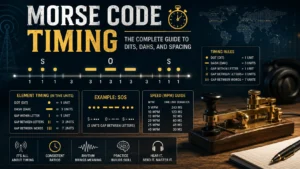
In Morse code, silence is part of the message. The pause between two letters must be three times the length of one dot. The pause between two words must be seven times the length of one dot. Ignoring this makes your transmission a blur of undifferentiated beeps that no one can decode.
Fix: Practice with a metronome, or use a digital Morse trainer that enforces timing automatically. The Morse practice tools at InMorseCode.com are built specifically for this.
2. Confusing Similar Letter Patterns
Several Morse code letters are dangerously similar, especially for beginners under stress:
| Confusing Pair | Letter 1 | Letter 2 | Difference |
|---|---|---|---|
| E vs I | . | .. | One dot vs two dots |
| D vs B | -.. | -... | Two dots vs three dots |
| N vs D | -. | -.. | One dot vs two dots after dash |
| S vs H | ... | .... | Three dots vs four dots |
| G vs O | --. | --- | Ends with dot vs all dashes |
Fix: Learn confusable pairs side by side, not separately. If you know G ends with a dot but O does not, you will never mix them up again.
3. Transmitting Too Fast Too Soon
Speed is appealing but accuracy is essential. At high speeds, a slightly-too-long dot becomes a dash, and the entire letter changes. HELP becomes MALP. SOS becomes a random noise burst.
Fix: Master each signal at 5 WPM with perfect timing before increasing speed. Speed follows accuracy — never the reverse.
4. Only Practicing Transmission, Never Reception
Many learners can send Morse code adequately but cannot decode what they receive. In a genuine emergency, rescuers may respond to your signal. If you cannot interpret their reply, you lose half the communication channel.
Fix: Use the audio decoder tools at InMorseCode.com regularly. Listen to random Morse playback and write down what you hear without looking at a reference.
5. Practicing Without Real-World Simulation
Tapping on a comfortable desk is very different from transmitting under stress, in the dark, with cold hands, or in a loud environment. Laboratory practice does not fully prepare you for field conditions.
Fix: Periodically practice in realistic conditions — outside at night with a flashlight, while tired, or with background noise. The occasional “stress test” dramatically improves real-world performance.
Best Tools for Learning Emergency Morse Code
You do not need expensive equipment. InMorseCode.com provides everything you need for free, directly in your browser:
- Morse Code Translator — Type any emergency phrase and instantly see the Morse code and hear real audio playback. Adjustable speed from 5 WPM to 50+ WPM. The fastest way to verify what you have learned.
- Audio Morse Converter — Designed for ear training. Play back random Morse signals and practice decoding them in real time — essential for building the reception skill that many learners overlook.
- Flashlight Morse Tool — Visualizes your Morse code as flashing light, helping you practice exactly the signaling technique you would use in a real outdoor emergency.
- Morse Practice Trainer — A structured learning environment that walks you through letters, common words, and full phrases at a pace calibrated to your level. Start as a complete beginner and progress to emergency-level fluency.
- Morse Code Learning Hub — A comprehensive resource covering the full International Morse Code alphabet, numbers, punctuation, and common emergency phrases, all in one organized location.
FAQ — Emergency Morse Code
Q: Is Morse code still used in real emergencies today?
Yes, actively. Maritime vessels still use SOS via radio in Morse code format. Search-and-rescue teams listen for Morse tapping in collapse scenarios. Amateur radio operators use Morse code during disaster response when digital infrastructure is down.
Q: Can anyone learn Morse code, or is it just for experts?
Anyone can learn the basic emergency signals. SOS alone — three dots, three dashes, three dots — takes about five minutes to learn and five days to make automatic. You do not need to learn the full alphabet to use Morse code in a survival situation.
Q: What is the best way to transmit Morse code without any equipment?
Tap on any hard surface with your knuckle or a rock. Bang on a pipe. Flash a phone screen. Scratch marks in sand or snow. Whistle short and long blasts. The versatility of Morse code is exactly why it remains relevant in a world of sophisticated technology.
Q: How far can a Morse code flashlight signal be seen?
In clear nighttime conditions, a standard flashlight signal can be seen from three to ten kilometers depending on terrain and atmospheric conditions. From a hilltop with a powerful torch, the range extends considerably further.
Q: Do rescue services actually watch for Morse code signals?
Yes. Search and rescue protocols in many countries explicitly include visual Morse code signal recognition. Aircraft rescue spotters are trained to identify SOS light patterns from the air.
Conclusion — Emergency Morse Code Could Save Your Life
Morse code is nearly two centuries old, and it still saves lives every year. In a world where we are so dependent on smartphones and wireless networks that we barely notice them until they fail, Morse code represents something rare and precious: a communication method that requires only a person, a signal source, and knowledge.
The single most important thing you can take from this guide is the SOS signal: ... --- .... Three short, three long, three short. Memorize it today. Practice it this week. That alone puts you ahead of the vast majority of people who would be completely silent in a genuine emergency.
Beyond SOS, building a working vocabulary of HELP, DANGER, INJURED, MEDIC, and EMERGENCY gives you a powerful suite of emergency communication signals that function anywhere, in any conditions, with no technology beyond your own body and whatever surface you can find.
Here is your action plan:
- Right now: Tap SOS on your desk three times. Feel the pattern.
- Today: Visit the Morse Code Translator at InMorseCode.com and listen to SOS, HELP, and DANGER.
- This week: Follow the seven-day practice routine above.
- This month: Build your full emergency Morse vocabulary using the Learning Hub at InMorseCode.com.
The few minutes you invest in practicing emergency Morse code signals now may one day be the most important communication you ever make. Do not wait until you need it to wish you had learned it.
Start your Morse code practice today — visit the free Morse Code Translator and audio tools at InMorseCode.com and type your first emergency signal.