What Is SOS in Morse Code?
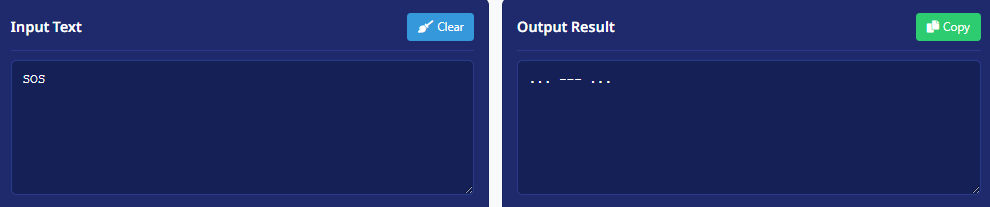
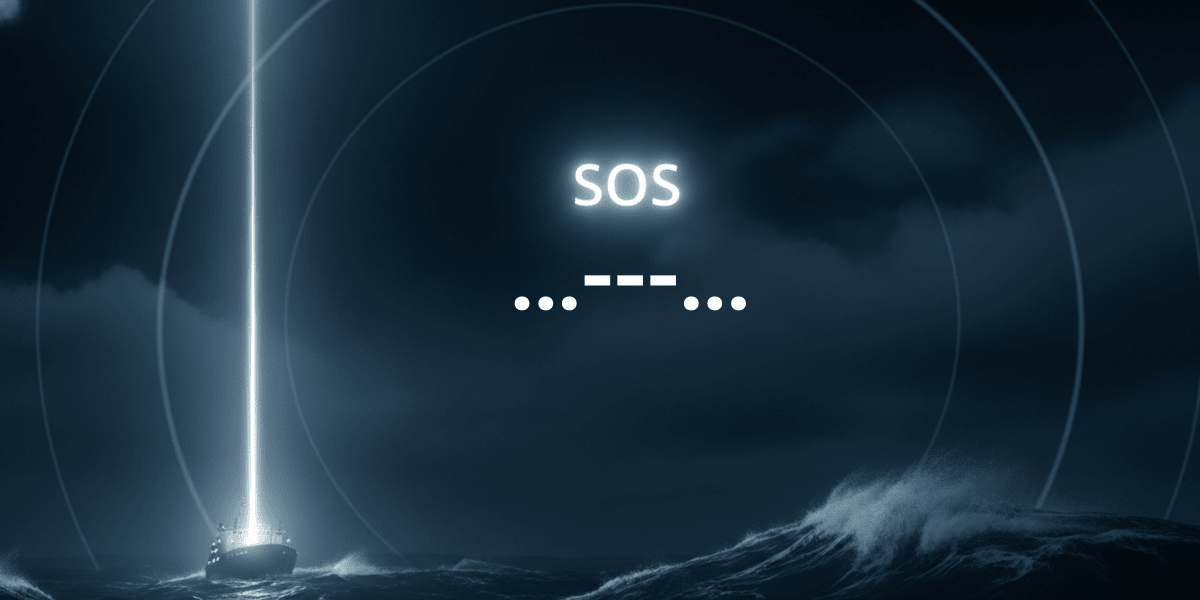
SOS in Morse Code is the international distress signal used to request immediate help during life-threatening emergencies. It is represented by a simple and highly recognizable signal pattern made up of three short signals, three long signals, and three short signals again. In Morse notation, this appears as … — …. The signal is globally understood and can be transmitted using sound, light, radio waves, or physical signaling methods.
Is SOS an Acronym?
Contrary to popular belief, SOS does not officially stand for “Save Our Souls,” “Save Our Ship,” or any other phrase. These interpretations came later as memory aids. SOS was selected purely because its Morse pattern is easy to send, easy to recognize, and hard to confuse with other signals, even under poor transmission conditions.
Why Was SOS Chosen as the Distress Signal?
SOS was chosen because of its simplicity and symmetry. The pattern reads the same forward and backward, which makes it recognizable even when signals are weak, interrupted, or distorted. In emergencies, clarity and speed matter more than linguistic meaning, and SOS delivers both with minimal effort from the sender.
Official Morse Code Pattern for SOS
The Morse code pattern for SOS is:
S = ···
O = –––
S = ···
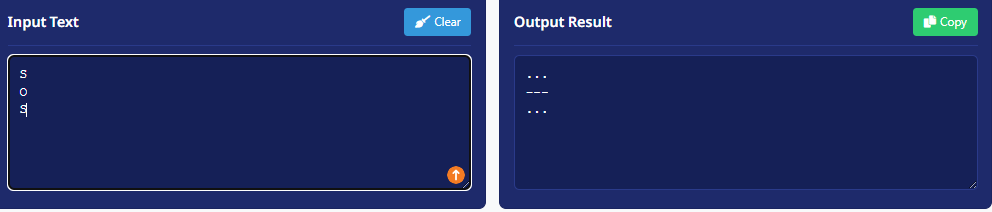
When used as a distress signal, SOS is often sent as a continuous sequence without pauses between letters, making it function as a single emergency signal rather than a spelled word.
When Was SOS Introduced?
SOS was officially adopted in the early 20th century. It became an international standard after the 1906 International Radiotelegraphic Convention, and its use was mandated globally starting in 1908. This standardization helped unify emergency communication across ships, coast stations, and later aviation systems.
How to Send SOS Using Sound
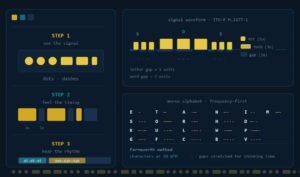
SOS can be transmitted audibly using whistles, horns, radios, or tapping sounds. The sender produces three short sounds, followed by three longer sounds, and then three short sounds again. This method is especially useful when visibility is poor but sound can travel, such as at sea or in mountainous terrain.
Quick Reference: SOS in Morse Code
- SOS is written as … — …
- It represents an international emergency signal
- It can be sent using sound, light, radio, or physical signals
- It does not stand for a specific phrase
- It is recognized worldwide
How to Send SOS Using Light Signals
Light-based SOS signaling is commonly done using flashlights, signal lamps, or reflected sunlight. Three short flashes are followed by three long flashes and then three short flashes again. This method is effective during nighttime or daylight conditions when sound transmission may not be reliable.
SOS in Visual and Physical Signaling
In survival situations without electronic devices, SOS can also be communicated visually. This includes drawing the SOS pattern on the ground, arranging stones or branches to form the letters, or tapping the pattern on walls or pipes. These methods are widely taught in survival training because they require no technology.
Is SOS Still Used Today?
Yes, SOS remains relevant even in the modern digital age. While emergency systems now rely heavily on GPS, satellites, and automated alerts, SOS is still taught and recognized as a universal fallback signal. It is embedded in emergency features of smartphones, marine radios, aviation procedures, and survival protocols worldwide.
Difference Between SOS and Mayday
SOS is a Morse-based distress signal primarily associated with telegraphy and signaling systems. Mayday, on the other hand, is a spoken distress call used in voice communication, especially in aviation and maritime radio. Both signals indicate extreme danger, but they are used in different communication formats.
Why Learning SOS in Morse Code Still Matters
Knowing SOS in Morse code can be critical when modern communication fails. In situations involving power loss, signal interference, or damaged equipment, the ability to signal distress using sound, light, or physical patterns can significantly increase survival chances. This is why SOS remains a core concept in emergency preparedness and Morse code education.