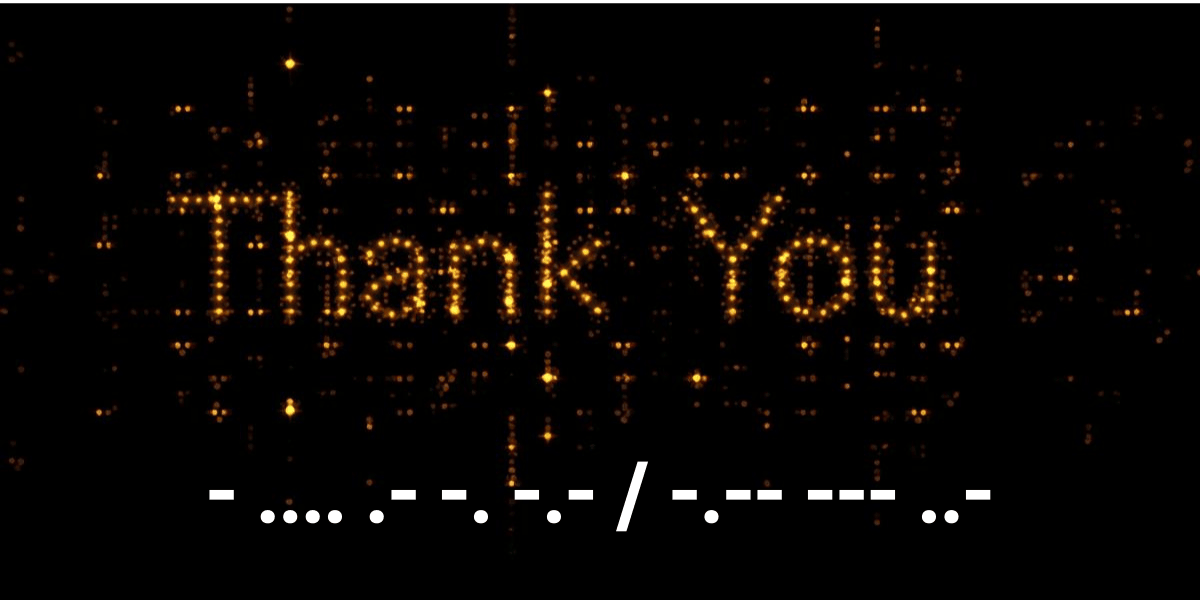
What Is “Thank You” in Morse Code?
“Thank You” in Morse code is the representation of the phrase used to express gratitude. Each letter of the words THANK YOU is translated individually into Morse code, following the international standard of dots and dashes. This makes it a practical phrase for Morse practice, polite communication, or demonstration purposes.
Morse Code Representation of Thank You
The phrase Thank You is encoded in Morse code as follows:
T = –
H = ….
A = .-
N = -.
K = -.-
Y = -.–
O = —
U = ..-
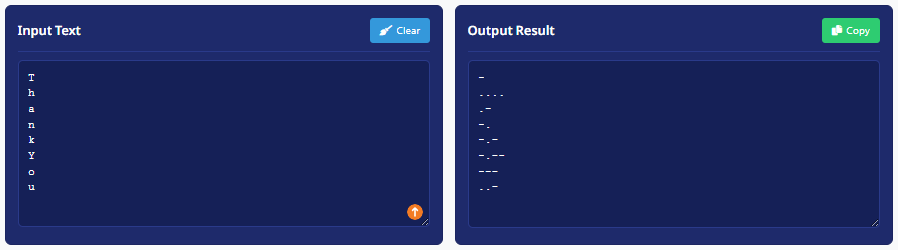
When combined, Thank You in Morse code appears as:
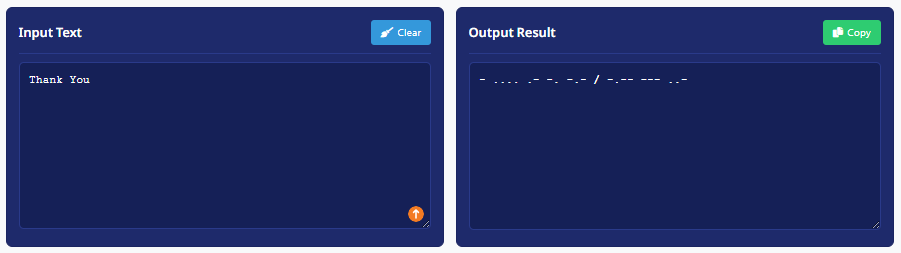
– …. .- -. -.- / -.– — ..-
A space separates each letter, while a slightly longer space separates the two words to ensure clarity during transmission.
How “Thank You” Is Used in Morse Communication
In Morse communication, “Thank You” can be sent as a polite response, acknowledgment, or sign-off message. It is commonly used in amateur radio exchanges, Morse code training, or educational exercises to demonstrate everyday phrases in a practical context.
Is “Thank You” a Standard Morse Signal?
“Thank You” is not an official or emergency signal. It is a regular phrase encoded letter by letter. Its significance lies in its everyday usage, making it ideal for practicing letter sequences, rhythm, and spacing while learning Morse code.
How to Send “Thank You” Using Sound
To send “Thank You” using sound, each letter’s dots and dashes are transmitted sequentially. Short sounds represent dots, long sounds represent dashes, and a short pause separates each letter. This ensures the receiver can decode the message accurately, whether on radio, tone devices, or tapping exercises.
How to Send “Thank You” Using Light Signals
“Thank You” can also be communicated visually using flashlights or signal lamps. Short flashes represent dots, long flashes represent dashes, and spacing between letters is maintained. This method is often used for practice, signaling over distance, or demonstrating Morse code in educational settings.
Quick Reference: Thank You in Morse Code
Thank You in Morse code is written as:
– …. .- -. -.- / -.– — ..-
It is a polite, non-emergency phrase
Each letter follows international Morse code standards
Commonly used for learning, practice, and communication
Written and Visual Morse Representation
In written form, “Thank You” is displayed with dots and dashes. This visual format allows learners to understand the construction of letters, the importance of spacing, and the sequence needed for accurate Morse transmission. It is widely used in online translators and Morse code lessons.
Why “Thank You” Is Popular for Learning
“Thank You” is a common practice phrase because it combines letters with different patterns of dots and dashes. This variety helps learners practice timing, letter recognition, and consistent spacing, all while using a phrase familiar in everyday communication.
Difference Between “Thank You” and Emergency Signals
Unlike SOS, “Thank You” is not a distress signal. Its purpose is everyday communication and learning, whereas SOS is reserved exclusively for emergencies. Understanding this distinction is important for anyone studying Morse code or participating in signaling exercises.
Can “Thank You” Be Decoded from Morse Code?
Yes, when the Morse code for “Thank You” is entered into a Morse code translator, it can be decoded back into plain text instantly. Accurate spacing between letters and words ensures the translation is correct and easily readable.