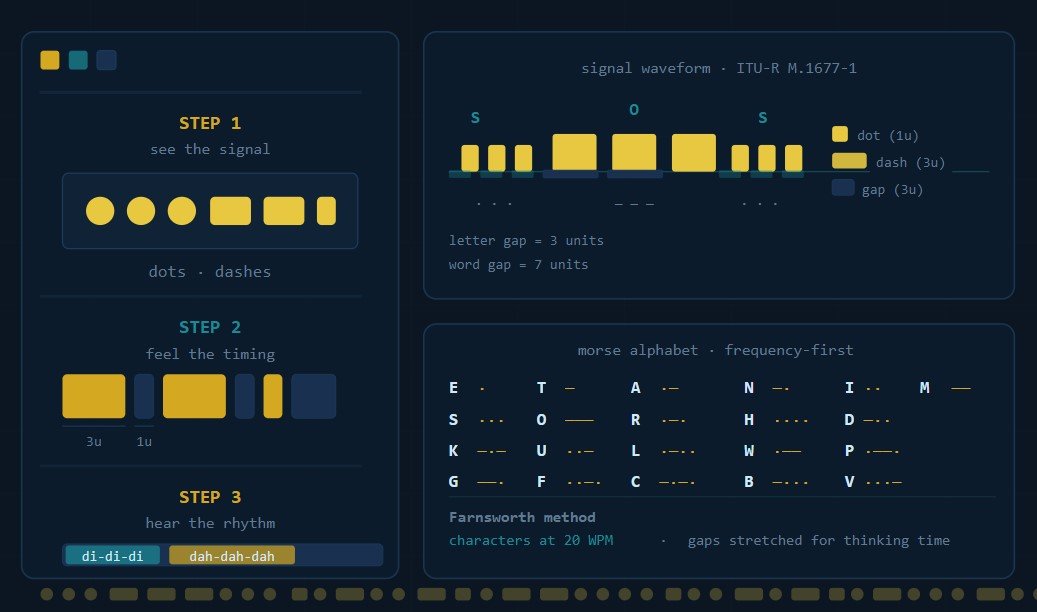
Reading Morse code means recognising sequences of short signals (dots) and long signals (dashes) as letters, numbers, and words. Each character has a unique dot-dash pattern defined by the ITU-R M.1677-1 international standard. With the right method — starting with rhythm rather than memorisation — most beginners can decode their first words within an hour.
This step-by-step guide walks you through everything: how timing works, how to decode individual letters, how to build up to full sentences, which learning methods work fastest (Farnsworth and Koch), and how to use InMorseCode.com‘s free Morse code translator, Morse code generator, and audio decoder as your daily practice tools.
Step 1 — Understand the Two Signals
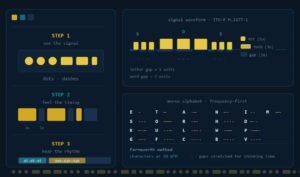
Before learning a single letter, you need to understand the only two building blocks in Morse code: the dot (dit) and the dash (dah). Everything else — every letter, number, and punctuation mark — is just a combination of these two signals in sequence.
| Signal | Also called | Duration | What it sounds like |
| Dot · | Dit | 1 time unit | A quick, short tap — “di” |
| Dash — | Dah | 3 time units | A held, longer tone — “dah” |
| 🔑 The single most important rule A dash lasts exactly three times as long as a dot. That ratio — 1:3 — is the foundation of every Morse code signal. If your dashes are not longer than your dots, your Morse code is unreadable. |
The words “dit” and “dah” are the spoken names for dot and dash. Saying them aloud as you decode — “dit-dah” for the letter A, “dah-dit-dit-dit” for the letter B — is the fastest way to build pattern memory. Professional CW operators still use this technique.
Step 2 — Learn the ITU Timing Rules
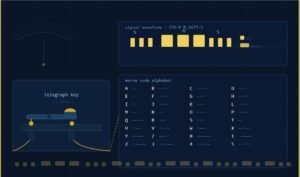
Morse code is not just a sequence of dots and dashes — it is a timing system. The gaps between signals carry as much meaning as the signals themselves. The ITU-R M.1677-1 standard defines five timing rules that all compliant tools, including InMorseCode.com, follow precisely:
| Element | Duration | What it means in practice |
| Dot (dit) | 1 unit | The shortest possible signal |
| Dash (dah) | 3 units | Hold three times longer than a dot |
| Gap within a letter | 1 unit | The brief silence between dots/dashes in the same character |
| Gap between letters | 3 units | The pause between two characters in the same word |
| Gap between words | 7 units | The longer pause that separates one word from the next |
| 💡 Practical timing example at 20 WPM At 20 words per minute — the international benchmark — a dot lasts 60 milliseconds. A dash lasts 180 ms. The gap between letters is 180 ms. The gap between words is 420 ms. The InMorseCode.com Morse code generator reproduces these exact ratios at any speed from 5 to 60 WPM. |
Why this matters for reading: When you hear Morse code, you identify letters by listening for the silent gap of 3 units between characters — that pause tells your brain “a new letter is starting.” The longer 7-unit gap signals a word boundary. Beginners who ignore timing gaps misread letters constantly.
Step 3 — Learn the Morse Code Alphabet by Rhythm Groups
The most common beginner mistake is trying to memorise every letter at once. Competitors and experienced instructors all agree: group letters by rhythm, not alphabetically. Hear each letter as a single sound pattern — not a sequence of separate clicks.
Start with the highest-frequency letters first
ITU optimised Morse code so the most common English letters have the shortest codes. These eight letters cover roughly 70% of ordinary English text — master them first:
| Letter | Code | Rhythm sound | Letter | Code | Rhythm sound |
| E | · | “di” | T | — | “dah” |
| I | ·· | “di-di” | M | —— | “dah-dah” |
| S | ··· | “di-di-di” | O | ——— | “dah-dah-dah” |
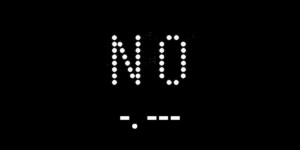
| A | ·— | “di-dah” | N | —· | “dah-dit” |
Learn letters in rhythm pairs (not alphabetically)
Group letters that are mirror images or length contrasts — your brain will remember opposites far better than random sequences:
| Pair type | Letter 1 | Code | Letter 2 | Code | Notes |
| Mirror pair | K | —·— | R | ·—· | Exact reverse rhythm |
| Mirror pair | D | —·· | U | ··— | Dot-dash reversed |
| Length contrast | H | ···· | B | —··· | All dots vs leading dash |
| Length contrast | 5 | ····· | 0 | ————— | All dots vs all dashes |
👉 The complete interactive reference chart for all 26 letters, 10 numbers, and 18 punctuation marks is available on the InMorseCode.com Learn page. Use it alongside audio practice, not as a substitute for it.
Step 4 — Decode Your First Words (Practice Sequence)
Once you know the 8 high-frequency letters, you can decode real words. Follow this progressive practice sequence — each stage takes 10–15 minutes:
| # | Practice target | Morse sequence to decode | What to listen for |
| 1 | Single letters | · —— ··· —— | 4 separate letters: E, M, S, M |
| 2 | Two-letter pairs | ·— —· ·· —— | Four letters: A, N, I, M |
| 3 | First word | ··· —— ··· | SOS (3 letters, 2 gaps between them) |
| 4 | Short word | — ·— ··· — | TEST — feel the word gap between letters |
| 5 | Two words | ·· —— / ··· ·— —— | IM SAM — hear the 7-unit word gap |
| 🎧 Use the InMorseCode.com Morse code generator for this exercise Type each word from the table above into the Morse Machine at inmorsecode.com, set speed to 10–12 WPM, and press Play. Close your eyes. Listen for the rhythm of each letter, then the gap, then the next letter. Do NOT look at the output — let your ear do the work. |
Step 5 — Use the Farnsworth Method to Build Speed
Every expert and competing platform — Morse Code Ninja, MorseFree, Google’s Morse trainer — recommends the same approach: the Farnsworth method, named after amateur radio operator Donald R. Farnsworth (W6TTB). It is the single most effective way to build reading speed without developing bad counting habits.
What Farnsworth timing does
In standard Farnsworth training, each individual character is sent at full target speed — for example 20 WPM — but the gaps between characters and words are stretched significantly. This means you hear the true rhythm of every letter (not a slowed-down imitation), but you have extra thinking time between each character to process what you just heard.
| Setting | Standard timing | Farnsworth timing |
| Character speed | 20 WPM | 20 WPM (unchanged — full speed) |
| Letter gap | 3 units (normal) | 6–10 units (stretched for thinking time) |
| Word gap | 7 units (normal) | 14–20 units (stretched for thinking time) |
| Effective WPM | 20 WPM | 5–8 WPM (slower overall, faster characters) |
| Why it works | — | Brain hears true rhythms, not slowed-down approximations |
The InMorseCode.com Advanced Morse Code Machine includes Farnsworth spacing controls — set the character WPM separately from the overall WPM to practise exactly this method. Start at character speed 20 WPM, overall speed 5 WPM. Increase overall speed as your accuracy rises above 90%.
The Koch method: one letter at a time
The Koch method (developed by German engineer Ludwig Koch in 1935) pairs well with Farnsworth spacing. Start with just two characters at full target speed — traditionally K and M. Once you can copy a string of those two characters with 90% accuracy, add a third. Never slow down the character speed; only add spacing time between them.
| ✅ The right progression for beginners Week 1: Learn E, T, A, N, I, M at 15–20 WPM character speed with wide Farnsworth gaps. Week 2: Add S, O, R, H, D, L, U. Week 3: Add remaining letters. Week 4: Tighten gaps and increase overall WPM. Accuracy above 90% before each step up — never rush. |
Step 6 — Decode Morse Code by Sight (Written Input)
Reading written Morse code — dots and dashes on a screen or page — uses a different skill from listening to audio. The process is the same (recognise each letter’s pattern), but you scan left to right, using spacing to identify letter and word boundaries.
The standard written input format
When entering Morse code into a Morse code decoder or reading it from a written source, the spacing rules are:
- Use . (full stop) for a dot and – (hyphen) for a dash
- Leave a single space between letters within the same word
- Use a forward slash / to separate words
- The letter A written correctly: .- (one dot, one dash, no space between them)
- The word HI written correctly: …. .. (H = 4 dots, space, I = 2 dots)
- The phrase HI MOM written correctly: …. .. / — — —
Worked decoding example
Decode this: … — … (a sequence every beginner should know)
| # | Morse sequence | Letter | How to recognise it |
| 1 | ··· | S | Three short dots — the shortest three-element code. Sound: di-di-di |
| 2 | (3-unit gap) | — | Letter boundary — a new character is starting |
| 3 | ——— | O | Three long dashes — one of the longest common codes. Sound: dah-dah-dah |
| 4 | (3-unit gap) | — | Letter boundary again |
| 5 | ··· | S | Same pattern as character 1 — di-di-di |
Result: SOS — the universal distress signal · · · — — — · · ·. You can verify this instantly using the Morse code converter at InMorseCode.com — paste in … — … and press Translate.
Step 7 — Decode Morse Code Audio (Using an Audio Decoder)
For real-world Morse code — from a radio broadcast, audio file, or recorded transmission — audio decoding is the ultimate skill. There are two approaches: training your ear to decode in real time, and using an automatic audio decoder tool to verify your copies.
Using the InMorseCode.com Audio Decoder
The Audio to Morse decoder accepts audio file uploads and microphone input. It analyses the timing of audio tones and converts them to text automatically, following the ITU-R M.1677-1 standard. This is useful for:
- Verifying that your own sending (tapping a key) is correctly timed
- Decoding recorded amateur radio CW transmissions for practice review
- Checking your manual copy against a machine decode to find errors
- Decoding Morse in audio from films, games, or escape room recordings
Training your ear for real-time copy
The goal is instant character recognition (ICR) — hearing the pattern and knowing the letter simultaneously, without consciously counting dots and dashes. This is achieved by:
- Practising at 15–20 WPM character speed with Farnsworth spacing, so each letter is heard at its true rhythm
- Never counting dots and dashes in real time — listen to the shape of the sound, not the components
- Practising daily in 10–15 minute sessions rather than longer irregular sessions
- Using the Repeat function on the
- Using the Repeat function on the Morse Machine to loop a word until its rhythm feels automatic
- Graduating from words to Q-codes and common phrases once individual letters are solid
Common Beginner Mistakes (and How to Fix Them)
Competitor research across the top Morse code learning platforms consistently identifies the same errors. Avoid these and your progress will be significantly faster:
| Mistake | Why it happens | How to fix it |
| Counting dots and dashes in real time | Treating Morse as visual not auditory | Practise with eyes closed; hear letters as whole rhythms |
| Practising too slowly from the start | Fear of making mistakes | Use Farnsworth: keep character speed at 15–20 WPM minimum |
| Learning the alphabet in A–Z order | Logical but inefficient | Start with E, T, A, N, I, M, S, O — the 8 highest-frequency letters |
| Ignoring letter and word gaps | Focusing only on the signals | Train with audio — gaps are as informative as the signals themselves |
| Using a chart as a crutch | Quicker than memorising | Cover the chart during practice; only check after each session |
| Long infrequent sessions | Treating it like reading practice | 10–15 min daily is more effective than 90 min once a week |
Frequently Asked Questions
These Q&A pairs are formatted for FAQPage structured data, Google featured snippets, AI Overviews, and voice search.
| Question | Direct answer |
| How do you read Morse code? | Read Morse code by identifying each dot-dash sequence as a letter using the ITU character table. A dot (·) is a short signal, a dash (—) is a long signal lasting three times a dot. A 3-unit gap separates letters; a 7-unit gap separates words. Practise hearing patterns as whole sounds rather than counting individual signals. |
| What does each dot and dash mean in Morse code? | Each unique combination of dots and dashes represents one character. For example: E = · (one dot), T = — (one dash), A = ·— (dot-dash), S = ··· (three dots), O = ——— (three dashes). The full table follows ITU-R Recommendation M.1677-1 and is available at InMorseCode.com/learn. |
| How long does it take to learn to read Morse code? | Most beginners can decode SOS and common letters within one hour. Reaching a working reading speed of 10–15 WPM typically takes 4–8 weeks of 10–15 minute daily practice using the Farnsworth method. Conversational speed of 20+ WPM usually requires 3–6 months of consistent practice. |
| What is the Farnsworth method for reading Morse code? | The Farnsworth method plays each Morse code character at full target speed (e.g. 20 WPM) but stretches the gaps between characters and words to give thinking time. This trains instant character recognition at correct rhythms, rather than slow slurred patterns that are hard to speed up later. InMorseCode.com’s Advanced Morse Machine supports Farnsworth spacing. |
| Can I use a Morse code decoder to read Morse code? | Yes. A Morse code decoder converts dots and dashes — either typed or from an audio file — back into plain text automatically. InMorseCode.com’s main translator decodes typed Morse instantly, and its Audio to Morse tool decodes recorded audio. Decoders are useful for practice verification but should not replace learning to read Morse manually. |
| What is the spacing format when typing Morse code? | When typing Morse code into a decoder: use . for dot and – for dash, leave a single space between letters, and use / between words. Example: SOS is typed as … — … and HI MOM is typed as …. .. / — — –. |
| What is the best way to learn to read Morse code for beginners? | The best method for beginners is to: (1) learn the 8 most common letters first (E, T, A, N, I, M, S, O), (2) use the Farnsworth method at 15–20 WPM character speed, (3) listen to audio rather than reading visual dots and dashes, (4) practise 10–15 minutes daily, and (5) use a free Morse code generator like InMorseCode.com to create practice audio at adjustable speeds. |
| How do I decode Morse code from audio? | To decode Morse code audio manually, listen for the rhythm of short and long tones, identify letter gaps (a 3-unit silence) and word gaps (a 7-unit silence), and match each tone pattern to the ITU character table. For automatic audio decoding, use InMorseCode.com’s Audio to Morse converter, which analyses audio files and microphone input to produce text output. |
Start Reading Morse Code Today — Free Tools at InMorseCode.com
Reading Morse code is a learnable skill that most people can begin practising immediately — no equipment needed beyond a free browser. The method is clear: understand the two signals, master the timing rules, learn letters by rhythm groups using the Farnsworth approach, and practise with audio daily.
InMorseCode.com provides every tool you need in one place, all free, all in-browser, and all built to the ITU-R M.1677-1 international standard:
- Morse Machine — Type any text, generate audio at any WPM, practice listening
- Advanced Morse Code Machine — Farnsworth spacing controls for structured CW training
- Audio to Morse Decoder — Upload audio or use your microphone to decode real Morse
- Morse Code Light Translator — Visual flashing practice for light-signal decoding
- Full Learn Page — Complete reference chart, timing guides, and phrase library
| Practice Reading Morse Code Now — Free Morse Translator · Farnsworth Practice Machine · Audio Decoder · Learn Page → inmorsecode.com |
Related articles on InMorseCode.com
📖 What Is Morse Code? A Complete Beginner’s Guide
🔤 The Morse Code Alphabet: Every Letter, Number & Symbol
🔊 Advanced Morse Code Machine — Farnsworth CW Practice