The Koch method is the most widely recommended technique for learning Morse code among amateur radio operators, ARRL instructors, and CW training programmes worldwide. Developed by German psychologist Ludwig Koch in the 1930s, it solves the single biggest problem with traditional Morse learning: the speed plateau that forms when characters are first learned slowly then have to be sped up.
This guide explains exactly how the Koch method works, why it produces faster results than traditional slow-learning approaches, the specific character sequence to follow, and how to practice it using InMorseCode tools.
What Is the Koch Method?
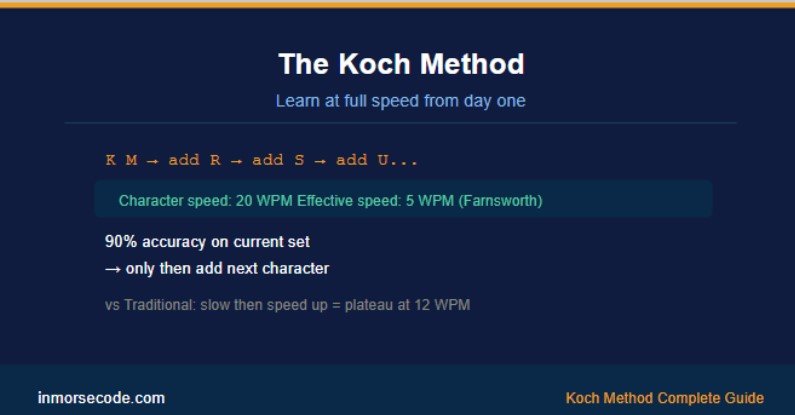
The Koch method teaches Morse code at full character speed from the very first session. There is no slow version to learn and then speed up. The characters always sound exactly as they will when you operate on the air.
The method works in two rules:
- Rule 1: Set character speed high (18–25 WPM) and never lower it. This forces the brain into pattern recognition mode immediately — dots and dashes are too fast to count, so the ear learns to recognise complete character sounds from day one.
- Rule 2: Introduce characters one at a time, starting with just 2. Only add the next character after you reach 90% copy accuracy with your current set. Progress is gated by accuracy, not time.
Why the Koch Method Beats Traditional Learning
| Factor | Koch Method | Traditional Slow Learning |
| Character speed | Full speed (18–25 WPM) from day 1 | Slow (5–8 WPM) initially |
| Learning mode | Pattern recognition — hear the whole sound | Analytical — count dots and dashes |
| Speed plateau | Rarely encountered | Very common at 10–12 WPM |
| Time to basic fluency | 4–8 weeks with daily practice | 3–12 months to plateau point |
| Character at operating speed | Immediate — no re-learning | Must re-learn at higher speeds |
| Long-term ceiling | No ceiling — recognition scales naturally | Hard ceiling at counting speed |
The Koch Method Character Sequence
The original Koch sequence was: K, M, R, S, U, A, P, T, L, O, W, I, . (period), N, J, E, F, 0, Y, V, , (comma), G, 5, /, Q, Z, H, 3, 8, B, ?, 4, 2, 7, C, 9, 6, 1, X, D. Modern programmes sometimes adjust this slightly.
The key insight in the sequence: K and M are always first. Koch chose these because they are acoustically very distinct (K = −·−, M = −−) and both contain dashes, training the ear for long tones from the first session. The gradual introduction prevents overload — you never have more characters than you can handle.
| Stage | Characters Introduced | Target Accuracy |
| Start | K, M | 90% on K and M before adding anything |
| Early | R, S, U, A, P | 90% on cumulative set |
| Midpoint | T, L, O, W, I, N | 85% on growing set |
| Later | E, F, Y, V, G, Q, Z, H | 85% on full alphabet in progress |
| Complete | Numbers 0–9 | Full copy at operating speed |
How to Practice the Koch Method Using InMorseCode.com
- Open the Advance Morse Code Machine at InMorseCode.com
- Set the WPM slider to 20 WPM and leave it there for all sessions
- Set the effective speed (Farnsworth gap) to 5–7 WPM to give yourself time between characters while keeping character sounds authentic
- Type only the characters in your current Koch set into the input field — e.g., “KMKMKMKMKM” for the first session
- Play the sequence and try to copy it on paper without looking at the screen
- Check your copy against the input. Calculate accuracy. If 90%+ — add the next character
The Koch Method and Farnsworth Timing Together
The Koch method specifies what to practice (character sequence). Farnsworth timing specifies how to practice (character speed vs effective speed). They are designed to work together:
- Koch handles character introduction: introduces one character at a time in an optimised sequence
- Farnsworth handles speed management: keeps characters fast while slowing the gaps to give processing time
- Combined result: the brain builds real-speed pattern recognition for each character as it is introduced, with sufficient pause between characters to write down the answer
Frequently Asked Questions: The Koch Method
What is the Koch method for Morse code?
The Koch method teaches Morse code at full operating speed from the first session, introducing characters one at a time in a specific sequence. Each new character is only added after 90% accuracy is achieved with the current set. It prevents the speed plateau that forms when slow-speed learning must be unlearned.
Is the Koch method the best way to learn Morse code?
It is the most widely recommended method among experienced CW operators and formal training programmes (ARRL, LCWO.net, CW Academy). Combined with Farnsworth timing, it produces reliable results with daily practice. The main alternative is the Farnsworth method alone without the Koch character sequence, which also works but may introduce characters in a less acoustically optimal order.
How long does the Koch method take?
With 15–20 minutes of daily practice, most learners complete the full alphabet introduction in 4–8 weeks. Speed development (closing the Farnsworth gap to reach standard timing) then takes a further 4–12 weeks depending on target speed.
Can I use InMorseCode.com for Koch method practice?
Yes. The Advance Morse Code Machine supports the Farnsworth timing that pairs with the Koch sequence. Set character speed to 20 WPM, adjust the effective speed gap for your current stage, and use the text input to practice only characters in your current Koch set.