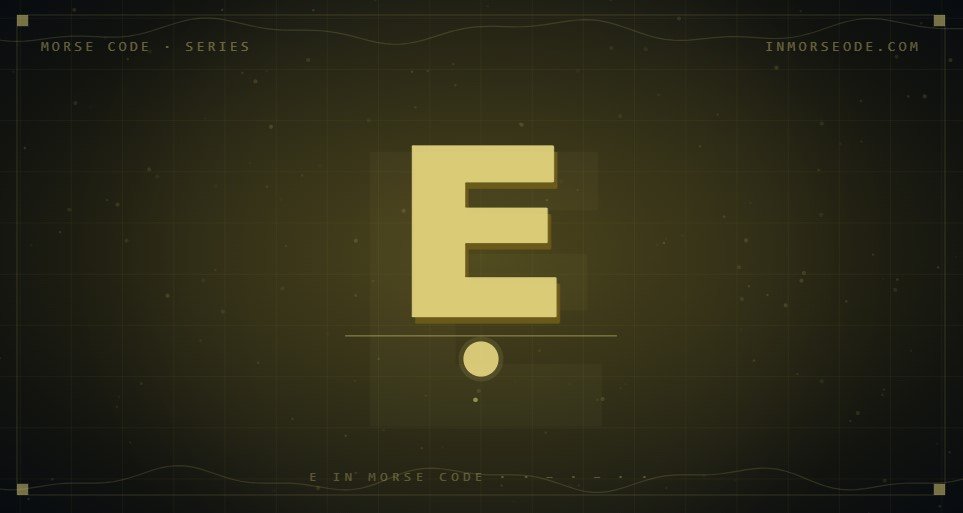
E in Morse code is a single dot: ·. Spoken as “dit”, it is the shortest possible signal in the entire International Morse Code system, one brief beep, lasting just 60 milliseconds at 20 WPM. It is also the first character taught in every Morse learning programmer, because E is both the simplest to transmit and the most frequently occurring letter in the English language.
Samuel Morse and Alfred Vail designed the code with efficiency in mind: the most common letters got the shortest codes. E, as the most used letter in English, received the ultimate short code a single dot. This design principle means that a skilled operator sending typical English text spends less time on E than on any other letter, giving Morse code a natural efficiency advantage over equal-length encoding systems.
What Is E in Morse Code?
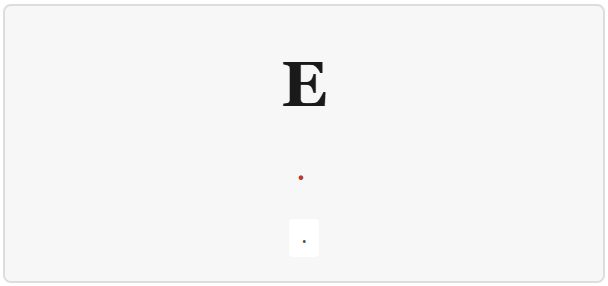
| Letter | Morse Code | Visual (dots and dashes) | Pattern |
|---|---|---|---|
| E | . | · | single dot |
One dot. One beep. “Dit.” That is the complete Morse code representation of E. There is no dash, no second element, no complexity. It is the atomic unit of Morse communication.
| Why E gets the single dot: In 1840s American telegraph usage, Morse and Vail analysed a printer’s type case to count letter frequency in English text. E appeared most often, so it was assigned the shortest possible code. This frequency-based design is what makes International Morse Code efficient, common letters are quick to send, rare letters are longer. |
How E Sounds in Morse Code
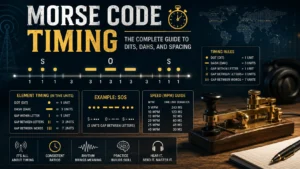
At 20 WPM, E lasts exactly 60 milliseconds shorter than the blink of an eye. At 5 WPM (beginner speed), it lasts 240 ms still very brief. Because E is so short, it is the character most commonly missed by beginners. Training your ear to catch the single “dit” in a stream of other characters is one of the core skills developed in early Morse practice.
Practical tip: in fast CW (continuous wave) radio transmission, single-dot letters like E can blur into background noise or inter-character gaps. Experienced operators recognize E by its position and context in words rather than counting the single element, another reason why pattern recognition matters more than element counting as speeds increase.
E in Morse Code; Timing Table
| Letter | Morse Code | Sound |
| E | · (1 unit) | dit; one short beep only |
| Comparison: T | − (3 units) | dah; one long beep only |
| Comparison: A | · − (4 units) | dit dah; short + long |
| Comparison: I | · · (3 units) | dit dit; two short beeps |
Common Words Containing E in Morse Code
E appears in almost every English word. Here are simple common words where E is prominent, showing how the single dot fits into the surrounding Morse pattern:
| Letter | Morse Code | Sound |
| THE | − ···· · | dah · dit-dit-dit-dit · dit |
| ARE | · − ·−· · | dit-dah · dit-dah-dit · dit |
| HELP | ···· ·−·· ·−·· ·−−· | H E L P |
| SEE | ··· · · | S(3 dots) + E(dot) + E(dot) |
| NEED | −· · ·−·· −·· | N E E D |
Names That Feature E in Morse Code
E appears in the majority of English names. Here are popular names where the letter E plays a prominent role:
- Emma: · − −− −− · − → E prominent at start and end
- Eve: · ···− · → E · V · E — two single dots bookending V
- Ellie: · ·−·· ·−·· ·· · → E L L I E
- Ethan: · − ···· · −− → E T H A N
- Elena: · ·−·· · −· · − → E L E N A
E vs Other Single-Element Letters
E and T are the two single-element letters in International Morse Code and they are mirror opposites. E is a single dot; T is a single dash. Together they are always taught first because they demonstrate the entire dot-dash system in its simplest possible form:
| Letter | Morse Code | Sound |
| E | · | dit; single short signal |
| T | − | dah; single long signal |
In the Koch method of Morse learning, E and T are often the very first pair introduced though some programmed start with K and M. The E+T pair is preferred by beginners because both characters are immediately recognizable in any transmission context.
Practising E in Morse Code
- Type a series of Es into the InMorseCode.com translator E E E E E and play it. Listen carefully to the rhythm of single dots.
- Practice words with lots of E: SEE, BEEN, FREE, THREE. Each E appears as a single isolated beep between longer character sequences.
- Use the Advance Morse Code Machine to hear E in context with real words at Farnsworth spacing. Start at 5 WPM effective speed with 20 WPM character speed.
Real-Life Usage of E
E is the most common letter in the English language, appearing in an enormous number of words. In early telegraph communication, assigning E to a single dot made the entire system faster since operators were sending it constantly. In Morse code transmissions, speed is everything, and E being one dot keeps messages moving quickly.
Example Words Using the Letter E
Here are some common words that start with or contain the letter E:
- Every
- Echo
- Enter
- Easy
- Earth
- Edge
- Else
- Even
- Earn
- End
Practising Morse code using real words is much more effective than repeating single letters. Try spelling two or three of these words using what you know so far.
Practice: Sending E in Morse Code
Practice sending E by tapping once on a desk or using a Morse key. It is so simple that you can practice it anywhere without any equipment. Try spelling out the word “ESSE” in Morse code: dot, dot dot dot, dot dot dot, dot. That spells E-S-S-E using only dots. This is a great early exercise for beginners.
You can also use the Morse Code Translator on this site to hear how E sounds at different speeds. Listening to the correct rhythm is just as important as tapping it yourself.
Ready to practise E and other letters together?
Try the Free Morse Code Translator Tool ›
Browse all Morse Code learning guides ›
Related Letters to Learn Next
Once you are comfortable with E in Morse code, these letters are good next steps because of their related patterns:
Frequently Asked Questions: E in Morse Code
What is E in Morse code?
E in Morse code is a single dot: ·. It is pronounced “dit” and is the shortest character in the entire International Morse Code system.
Why is E just one dot?
Because E is the most frequently used letter in English. Morse code was designed so that common letters have shorter codes, making typical English transmissions faster. E being the most common letter received the ultimate shortest code: one dot.
Is E easy to learn in Morse code?
Yes; E is the simplest character to transmit. A single short tap, beep, or flash is all it takes. However, it is one of the trickier characters to recognize by ear at speed, because the single dot is brief and can be confused with gaps between elements of adjacent characters.
What names start with E in Morse code?
Many popular names begin with E, all starting with a single dot: Emma, Elijah, Ethan, Elena, Eve, Ella, Emily. Type any of these into the InMorseCode.com translator to see and hear the complete Morse code.
Conclusion
The letter E in Morse code is ., represented visually as ·. Whether you are a complete beginner or brushing up on forgotten knowledge, learning one letter at a time is the most reliable way to build a solid Morse code foundation. E is a letter you will encounter often as your practice progresses, and knowing it well will serve you across words, names, and real transmissions.
Keep practising a little every day. Even five minutes of tapping rhythms or listening to Morse audio will build your skills faster than you expect. Use the Morse Code Translator to test yourself, explore the full learning guide, and keep going through the rest of the alphabet one letter at a time.