The most complete, interactive guide to “Stop” in Morse code. Master the timing, learn each letter, hear real audio playback, test yourself with our multi-mode quiz, and discover why “Stop” is one of the most historically significant commands ever transmitted in Morse.
Letter-by-Letter Breakdown
Each letter in “STOP” has its own Morse signature:
| Letter | Morse Code | Sound Pattern |
|---|---|---|
| S | ··· | dit-dit-dit |
| T | − | dah |
| O | −−− | dah-dah-dah |
| P | ·−−· | di-dah-dah-dit |
How “STOP” Sounds in Morse Code
Morse code is a rhythmic language. Understanding the precise timing rules is what separates a beginner who counts dots from an operator who hears words.
01: THE UNIT SYSTEM
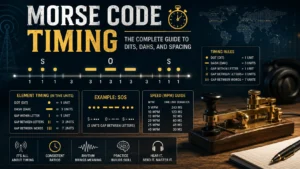
All Morse timing is based on a single “unit.” A dot = 1 unit ON. A dash = 3 units ON. The gap between elements within the same letter = 1 unit OFF. The gap between letters = 3 units OFF. The gap between words = 7 units OFF. Everything in Morse code derives from these proportions.
DOT = 1 unit ON
DASH = 3 units ON
GAP (intra-letter) = 1 unit OFF
GAP (inter-letter) = 3 units OFF
GAP (word) = 7 units OFF
02 STOP’S RHYTHM
“Stop” has a very distinctive profile: it opens with a rapid S (di-di-dit) three quick dots then a single T (dah) which is the simplest letter in Morse. Then a dramatic triple dash O (dah-dah-dah), and finally P (di-dah-dah-dit) which bookends with dots. Operators often describe it as “fast-pause-slow-complex.”
S: ··· → quick rapid burst
T: − → single long tone
O: −−− → three long tones
P: ·−−· → dot-heavy wrapper
| Speed (WPM) | Dot Duration | Dash Duration | “STOP” Total Time | Level |
|---|---|---|---|---|
| 5 WPM | 240ms | 720ms | ~2.4 sec | Beginner |
| 12 WPM | 100ms | 300ms | ~1.0 sec | Amateur |
| 20 WPM | 60ms | 180ms | ~0.6 sec | Expert |
| 30 WPM | 40ms | 120ms | ~0.4 sec | Contest Grade |
Real-World Applications
📟 Telegram Communication
Used instead of punctuation to save cost:
ARRIVING TUESDAY STOP MEET AT PLATFORM STOP
⚓ Maritime Signals
Critical for ship operations:
ALL ENGINES STOP
📻 Amateur Radio (CW)
Used in formal transmissions and pauses.
🪖 Military Operations
Vital in wartime communication:
ADVANCE HALTED STOP
🚂 Railway Systems
Used to prevent collisions:
HOLD TRAIN STOP
🌦 Emergency Weather Nets
Controls communication flow in crises.
“STOP” in Different Languages (Morse Variations)
| Language | Word | Morse Code |
|---|---|---|
| Spanish | Detente | −·· · − · −· − · |
| French | Arrête | ·− ·−· ·−· · − · |
| Portuguese | Pare | ·−−· ·− ·−· · |
| German | Stopp | ··· − −−− ·−−· ·−−· |
| Hindi | Ruko | ·−· ··− −·− −−− |
| Japanese | Tomare | − −−− −− ·− ·−· · |
| Russian | Stoy | ··· − −−− −·−− |
Expert Advice
Pro Tips for Memorizing “STOP”
- Lock in “T” First, It’s Your Anchor
- Group S and O Together as Sound Opposites
- Use the Telegram Method for Context Learning
- Hear the Shape, Not the Symbols
- Record Yourself and Replay at Double Speed
Related Morse Commands
| Command | Morse Code |
|---|---|
| GO | −−· −−− |
| REPEAT | ·−· · ·−−· · ·− − |
| WAIT | ·−− ·− ·· − |
| START | ··· − ·− ·−· − |
| SLOW | ··· ·−·· −−− ·−− |
Quick Alphabet Reference
Highlighted letters:
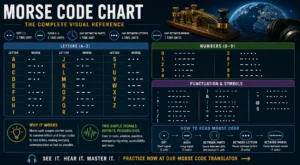
- S: ···
- T: −
- O: −−−
- P: ·−−·
Key Questions Answered
What Is the Morse Code for “Stop”?
The Morse code for Stop is ··· − −−− ·−−·. This four-letter command is formed by the Morse codes for each individual letter: S (···), T (−), O (−−−), and P (·−−·). When sent at the standard beginner speed of 5 words per minute, “Stop” takes approximately 2.4 seconds to transmit.
You can practise this and any other command word using the interactive Morse code translator on InMorseCode.com, which provides real-time audio playback and visual signal display.
Why Is “Stop” One of the Most Important Morse Commands?
“Stop” holds a unique place in Morse code history. In the age of telegraph communication, operators used the word “STOP” at the end of sentences as a full stop because the punctuation mark itself cost extra in telegram billing. This gave rise to the iconic telegram style: “ARRIVING TUESDAY STOP MEET AT STATION STOP.” Learning Morse code commands like Stop, Go, Wait and Repeat is foundational to understanding how communication worked before digital technology.
How Do You Recognize “Stop” by Sound?
The auditory signature of “Stop” in Morse is distinctive:
- S (···); a quick triple-dit: “di-di-dit.” Fast and light.
- T (−); a single long dah: the simplest letter in all of Morse code.
- O (−−−); three long dahs in a row: a heavy, commanding triple pulse.
- P (·−−·); a dot-dash-dash-dot pattern: it opens and closes with dots, giving it a “wrapped” feel.
Together, the word sounds like a rapid burst, a pause, a slow triple thud, and then a complex closure making it highly identifiable even to beginner operators after a few hours of practice.
Is “Stop” Used in Amateur Radio Today?
Yes; the word “Stop” and its abbreviation “STP” appear in amateur radio CW (Continuous Wave) transmissions in emergency nets, weather reporting, and formal traffic handling. The Morse code commands section on InMorseCode.com covers all common procedural words used in modern ham radio operation, including official ARRL Net operating procedures.
What Are the Related Letters in “Stop” in Morse?
The four letters of “Stop” cover an interesting cross-section of the Morse alphabet: S is one of the easiest (three dots), T is the very easiest (one dash), O is one of the most distinct (three dashes), and P is moderate complexity. Practising these four letters individually before combining them into the full word is the recommended approach for beginners.
Conclusion
“STOP” is more than just a Morse code word it is a cornerstone of communication history. From telegrams to military operations, its role has shaped how messages were sent across the world.
Mastering it builds a strong foundation for learning Morse code and understanding its real-world applications.