Communication is one of the most powerful tools a human being has — and nowhere is that more true than during a medical emergency. When someone is injured, ill, or in critical need of care, getting the right message to the right people can mean the difference between life and death. But what happens when you cannot speak? What if there is no phone signal, no internet, and no way to call for help through conventional means?
That is exactly where Morse code steps in.
Morse code is a time-tested system of communication that uses short and long signals — dots and dashes — to represent letters, numbers, and phrases. It has been used for nearly two centuries by military operators, sailors, pilots, and survivalists to send messages when no other method is available. And while many people associate it only with telegraphs and radio transmissions, Morse code is far more flexible than that. You can communicate using sound, light, tapping, or even blinking your eyes.
In this guide, you will learn exactly how to express the word “medicine” in Morse code, explore related emergency medical phrases, and discover practical techniques to practice and memorize this life-saving skill. Whether you are a beginner curious about Morse code, a hiker preparing for the unexpected, or someone who simply wants to add a valuable survival tool to their knowledge, this article is for you.
What Is Morse Code and Why Does It Still Matter?
Developed in the 1830s by Samuel Morse and Alfred Vail, Morse code assigns every letter of the alphabet and every digit a unique pattern of dots (short signals) and dashes (long signals). Originally designed for electrical telegraph systems, it quickly spread to maritime communication, aviation, and military operations.
Today, Morse code remains relevant for several compelling reasons:
- It requires zero technology. No battery, no Wi-Fi, no phone — just a surface to tap, a light to flash, or a whistle to blow.
- It is universally recognized. Emergency services, coast guards, and rescue teams worldwide are trained to identify Morse code distress signals.
- It is compact and efficient. A skilled operator can send a complex message in seconds.
- It is discreet. In dangerous situations, Morse code can be transmitted silently and invisibly, without alerting others.
For medical emergencies specifically, knowing key Morse code phrases like “medicine,” “doctor,” “injured,” and “SOS” provides a silent but powerful way to communicate your needs when no other option exists.
Medicine in Morse Code – The Complete Translation
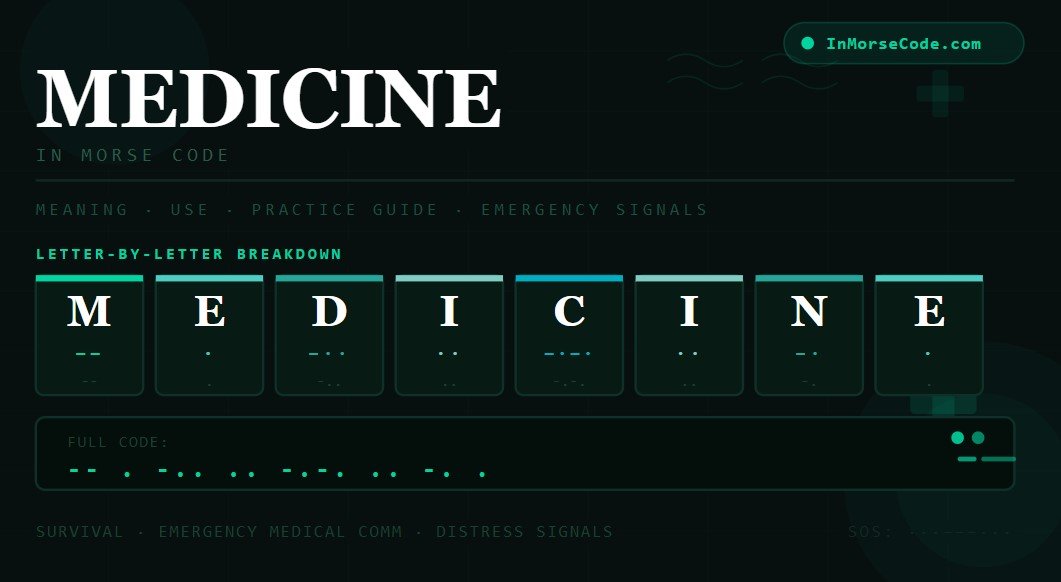
The word MEDICINE in Morse code is:
-- . -.. .. -.-. .. -. .This eight-letter word breaks down clearly and is not as difficult to learn as it might first appear. Let us go through it one letter at a time.
Letter-by-Letter Morse Code Breakdown for MEDICINE
| Letter | Morse Code | How to Read It |
|---|---|---|
| M | -- | dash – dash |
| E | . | dot |
| D | -.. | dash – dot – dot |
| I | .. | dot – dot |
| C | -.-. | dash – dot – dash – dot |
| I | .. | dot – dot |
| N | -. | dash – dot |
| E | . | dot |
Full Word in Morse Code
-- . -.. .. -.-. .. -. .When transmitting, each letter is separated by a brief pause equal to three dot lengths. The full word MEDICINE, when spoken aloud in Morse rhythm, sounds like:
- M: dah dah
- E: dit
- D: dah dit dit
- I: dit dit
- C: dah dit dah dit
- I: dit dit
- N: dah dit
- E: dit
A Beginner-Friendly Way to Approach MEDICINE
For beginners, eight letters can feel overwhelming. The trick is to break MEDICINE into two halves and master each separately:
- First half: M-E-D-I →
-- . -.. .. - Second half: C-I-N-E →
-.-. .. -. .
Practice the first half for two days, then the second half, then combine them. By day five, you should be able to transmit the full word from memory.
Tip: Use the free Morse Code Translator at InMorseCode.com to hear MEDICINE played back in real audio. Listening while reading dramatically speeds up memorization.
Meaning and Practical Use of “Medicine” in Morse Code
Emergency Medical Situations
In a genuine emergency — a wilderness injury, a natural disaster, or a remote accident — the ability to communicate “I need medicine” silently and from a distance can alert rescuers to exactly what kind of help is needed. Search-and-rescue teams are trained to interpret Morse code signals, and transmitting MEDICINE alongside HELP or SOS tells them to bring medical supplies immediately.
Requesting Help Silently
There are situations where speaking loudly is not safe. An injured hiker on a mountain ledge may not want to trigger a rockfall with a shout. A person in a dangerous or hostile situation may not be able to speak at all. In these cases, a flashlight, a mirror reflecting sunlight, or even a repeated tapping on a pipe can transmit MEDICINE with complete silence.
Military, Rescue, and Survival Scenarios
In military operations, Morse code has historically been used to communicate behind enemy lines where radio silence is essential. A soldier injured and unable to speak can tap a medical distress signal on a hard surface to communicate with nearby teammates. In civilian survival scenarios, the same logic applies: if you are lost, trapped, or incapacitated, even partial Morse knowledge can save your life.
Communication in Restricted Environments
Medical facilities, hostage situations, and isolated disaster zones all share one thing: conventional communication often fails. A patient with limited mobility, a survivor trapped under rubble, or a person in a restricted environment can use Morse code to communicate through walls, pipes, or any conductive surface. Knowing how to transmit “medicine” or “injured” can be the message that changes everything.
Related Medical and Emergency Morse Code Phrases
Building a vocabulary of medical Morse code phrases gives you a powerful toolkit for emergencies. Here are the most important ones to learn alongside MEDICINE.
SOS – The Universal Distress Call
... --- ...Three dots, three dashes, three dots. SOS is the most recognized signal on the planet. No translation needed — it communicates immediate danger and the need for rescue to anyone trained in Morse code. Learn this first, above everything else.
HELP
.... . .-.. .--.| Letter | Morse Code |
|---|---|
| H | .... |
| E | . |
| L | .-.. |
| P | .--. |
HELP is four letters and relatively simple to memorize. It is slightly less universal than SOS, but combined with SOS it reinforces the severity of the situation.
DOCTOR
-.. --- -.-. - --- .-.| Letter | Morse Code |
|---|---|
| D | -.. |
| O | --- |
| C | -.-. |
| T | - |
| O | --- |
| R | .-. |
Transmitting DOCTOR after SOS tells rescuers that your emergency is medical in nature — not mechanical or geographical. This directs the right type of first responder to your location.
INJURED
.. -. .--- ..- .-. . -..| Letter | Morse Code |
|---|---|
| I | .. |
| N | -. |
| J | .--- |
| U | ..- |
| R | .-. |
| E | . |
| D | -.. |
INJURED combined with your location signal tells rescuers that someone is physically hurt and immobile — an important distinction that affects how quickly they mobilize.
NEED MEDICINE
-. . . -.. / -- . -.. .. -.-. .. -. .The slash / represents a word space — a longer pause between the two words. NEED MEDICINE as a combined phrase is one of the most complete medical distress messages you can send without voice communication. It specifies both the situation (need) and what is required (medicine).
EMERGENCY
. -- . .-. --. . -. -.-. -.--| Letter | Morse Code |
|---|---|
| E | . |
| M | -- |
| E | . |
| R | .-. |
| G | --. |
| E | . |
| N | -. |
| C | -.-. |
| Y | -.-- |
EMERGENCY is a longer word and harder to transmit under pressure, but it is worth practicing because it communicates urgency without ambiguity. Use it when SOS alone may not be sufficient context.
Practice all of these phrases interactively using the audio and visual translator tools at InMorseCode.com. Type any word or phrase and hear it in real Morse audio, adjusting the speed to match your comfort level.
How to Practice “Medicine” in Morse Code – A Step-by-Step Guide
Step 1 – Master the Individual Letters
Before tackling the full word, learn each letter in MEDICINE independently. Use the table above and practice each one five times in sequence. Pay special attention to:
- C (`-.-.’) — this is a four-element pattern and one of the trickier ones for beginners. Remember: dah-dit-dah-dit, it alternates.
- M (
--) — the simplest letter in the word: just two dashes. - D (`-..’) — starts with a dash, followed by two dots. Dah-dit-dit.
Step 2 – Tap It Out
Use two fingers on a hard surface, a pen on a desk, or even your knuckle on a wall. Practice tapping each letter using a short tap for dots and a longer press for dashes. The timing ratio matters: a dash should be held approximately three times longer than a dot.
Step 3 – Split the Word and Conquer
As mentioned above, divide MEDICINE into two four-letter groups:
- M-E-D-I:
-- . -.. .. - C-I-N-E:
-.-. .. -. .
Drill each half for two days before combining them. When you can transmit each half smoothly from memory, chain them together with a brief letter-gap pause.
Step 4 – Listen Actively
Visit the Morse code audio tools at InMorseCode.com and listen to MEDICINE played back at 10 WPM (words per minute). As you listen, tap along on a surface. This combines auditory and kinesthetic (tactile) memory, which research shows is far more effective for retention than reading alone.
Gradually increase the speed to 15 WPM, then 20 WPM, as your confidence builds.
Step 5 – Practice Light Signals
Once you can tap MEDICINE comfortably, translate that to a flashlight. Use short flashes for dots and longer flashes (roughly triple the duration) for dashes. Practice in a darkened room, then try signaling from a distance to a friend who decodes what they see. This mimics real emergency conditions and builds practical muscle memory.
Step 6 – Test Yourself Without References
Cover your cheat sheet. Transmit MEDICINE from memory. Make note of which letters you hesitate on or get wrong, then go back and drill only those letters. Targeted practice on weak points is far more efficient than repeating the whole word from scratch every time.
Daily Practice Routine for Beginners
| Day | Activity |
|---|---|
| Day 1 | Learn M, E, D, I individually — tap each 10 times |
| Day 2 | Learn C, I, N, E individually — tap each 10 times |
| Day 3 | Combine M-E-D-I as a group — practice 10 slow repetitions |
| Day 4 | Combine C-I-N-E as a group — practice 10 slow repetitions |
| Day 5 | Transmit full MEDICINE slowly — focus on timing |
| Day 6 | Listen to MEDICINE in audio and tap along simultaneously |
| Day 7 | Test from memory, then add SOS, DOCTOR, and HELP |
| Week 2 | Practice NEED MEDICINE as a full phrase; increase speed |
Practice Exercise Section
Try these exercises to test and reinforce what you have learned.
Exercise 1 – Decode This
What letter does each of these Morse codes represent?
--→ ___-..→ ___-.-.→ ___-.→ ___
(Answers: M, D, C, N)
Exercise 2 – Tap and Transmit
Tap out the word MEDICINE on a table. Record yourself (use your phone’s voice memo) and listen back. Does the rhythm sound clear? Are the dots noticeably shorter than the dashes?
Exercise 3 – Build the Emergency Message
Using what you have learned, write out the Morse code for this phrase from memory:
NEED DOCTOR
Check your answer:
-. . . -.. / -.. --- -.-. - --- .-.Mini Challenge
How quickly can you transmit SOS followed by MEDICINE? Time yourself. Aim for under 30 seconds at a comfortable, accurate pace.
Real-Life Use Cases
Outdoor Survival: Hiking and Camping
Hikers venturing into remote areas without reliable cellular coverage should consider Morse code part of their standard safety preparation — just like a first aid kit or emergency whistle. A flashlight or a signal mirror can transmit HELP or NEED MEDICINE across a kilometer of open terrain, reaching fellow hikers or a distant road before traditional communication could even begin.
Disaster Situations: Earthquakes and Collapsed Structures
In earthquake or building collapse scenarios, survivors have historically used tapping to communicate with rescuers through rubble. Rescue teams specifically listen for rhythmic tapping patterns — and a structured SOS signal followed by INJURED or MEDICINE tells them exactly where to dig and what to bring. This is not theory; there are documented rescues where tapping saved lives.
Communication Without Speaking
For patients in medical facilities with temporary or permanent voice impairment — post-surgery patients, those with tracheotomies, or individuals with neurological conditions — Morse code provides a precise, learnable way to communicate specific needs. Medical teams in some specialized care environments use basic Morse signaling as a supplemental communication tool. Knowing how to tap MEDICINE gives such a patient a concrete way to request what they need.
Morse Code as a Safety Skill for Everyone
You do not have to be an adventurer or a military operator to benefit from knowing medical Morse code phrases. Travelers in remote areas, sailors, pilots, amateur radio hobbyists, and anyone who spends time outdoors benefits from having a backup communication method. Just as you would learn CPR without expecting to use it every day, learning MEDICINE and SOS in Morse code prepares you for the rare but critical moment when it matters.
Tools and Resources on InMorseCode.com
You do not need expensive equipment or a formal course to learn Morse code. InMorseCode.com offers everything you need for free, directly in your browser:
- Morse Code Translator — Type MEDICINE or any other word and instantly see the Morse code, hear the audio playback, and adjust the speed from beginner to expert level. This is the fastest way to verify what you have learned.
- Audio Morse Code Converter — Designed specifically for ear training. Listen to randomly generated Morse code and try to decode it in real time — this builds the skill of receiving messages, not just sending them.
- Image-to-Morse Converter — Upload a photograph containing text or Morse patterns and the tool automatically extracts and converts it using OCR technology. Useful for decoding printed Morse code from reference materials.
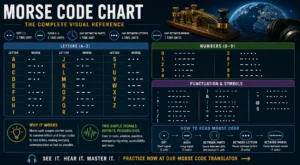
- Morse Code Learning Hub — A structured, beginner-friendly resource covering the complete alphabet, numbers, common phrases, and practice exercises. If you want to go beyond individual words and build a full Morse vocabulary, start here.
Common Mistakes to Avoid
1. Confusing Dots and Dashes in Similar Letters
Several Morse code letters look deceptively alike, especially for beginners:
| Easy to Confuse | Letter 1 | Letter 2 |
|---|---|---|
| E vs I | . | .. |
| D vs B | -.. | -... |
| N vs K | -. | -.- |
| M vs O | -- | --- |
| C vs F | -.-. | ..-. |
Fix: Learn letters in pairs. If you know that E is one dot and I is two dots, you will never mix them up. Same with M (two dashes) and O (three dashes).
2. Incorrect Spacing Between Letters and Words
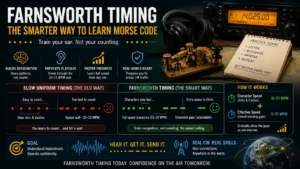
In Morse code, spacing is not optional — it is part of the code. The gap between two letters must be three times the length of one dot. The gap between two words must be seven times the length of one dot. Ignoring these ratios makes your transmission impossible to decode, even if every individual symbol is correct.
Fix: Practice with a metronome or use a digital Morse key that enforces timing automatically.
3. Rushing to Increase Speed Too Early
Speed is meaningless without accuracy. A fast but sloppy transmission is unreadable. Beginners who jump to high WPM speeds before the patterns are solid end up reinforcing incorrect habits that are very hard to unlearn.
Fix: Master each word at 5 WPM with perfect timing before moving to 10 WPM. Speed follows accuracy — never the other way around.
4. Only Practicing Transmission and Neglecting Reception
Many learners can send Morse code reasonably well but cannot decode what they receive. In a real emergency, you may need to do both. If rescuers send a response to your SOS signal, you need to understand it.
Fix: Use the audio tools at InMorseCode.com regularly. Listen to Morse code played back at random and write down what you hear without looking at a reference sheet.
5. Cramming Instead of Daily Short Sessions
Studying Morse code for two hours once a week is far less effective than five minutes every single day. The brain consolidates motor and auditory memory during sleep, meaning daily short sessions produce dramatically faster long-term retention.
Fix: Set a five-minute daily reminder. Consistency is the single most powerful tool in Morse code learning.
Quick Reference Table: MEDICINE in Morse Code
| # | Letter | Morse Code | Pattern Description |
|---|---|---|---|
| 1 | M | -- | dash dash |
| 2 | E | . | dot |
| 3 | D | -.. | dash dot dot |
| 4 | I | .. | dot dot |
| 5 | C | -.-. | dash dot dash dot |
| 6 | I | .. | dot dot |
| 7 | N | -. | dash dot |
| 8 | E | . | dot |
Full word: -- . -.. .. -.-. .. -. .
Emergency Medical Morse Code Cheat Sheet
| Word | Morse Code |
|---|---|
| SOS | ... --- ... |
| HELP | .... . .-.. .--. |
| MEDICINE | -- . -.. .. -.-. .. -. . |
| DOCTOR | -.. --- -.-. - --- .-. |
| INJURED | .. -. .--- ..- .-. . -.. |
| EMERGENCY | . -- . .-. --. . -. -.-. -.-- |
| NEED MEDICINE | -. . . -.. / -- . -.. .. -.-. .. -. . |
Keep this cheat sheet saved to your phone or printed in your emergency kit. A laminated card in your hiking pack or survival bag takes up almost no space and could be exactly what you need in a crisis.
Conclusion – Why “Medicine” in Morse Code Is Worth Learning
Morse code is 180 years old and still saving lives. In an era of satellites, smartphones, and instant messaging, it can be tempting to dismiss it as outdated — but that is precisely what makes it so valuable. It requires nothing but a person, a signal source, and knowledge. When every piece of modern technology fails, Morse code works.
Learning to transmit medicine in Morse code — -- . -.. .. -.-. .. -. . — is a small investment of time and attention with a potentially enormous return. Pair it with SOS, DOCTOR, INJURED, and HELP, and you have a complete emergency medical communication vocabulary that works in the wilderness, in a disaster, or in any situation where silence or distance makes speech impossible.
The key takeaways from this guide:
- MEDICINE in Morse code is
-- . -.. .. -.-. .. -. .— eight letters, each learnable in minutes. - Split the word into two halves (M-E-D-I and C-I-N-E) to make memorization manageable.
- Practice using tapping, audio listening, and flashlight signals for maximum retention.
- Know your emergency medical vocabulary: SOS, HELP, DOCTOR, INJURED, NEED MEDICINE, and EMERGENCY.
- Avoid common mistakes: respect spacing, prioritize accuracy over speed, and practice reception as much as transmission.
- Use the free, browser-based tools at InMorseCode.com to listen, practice, and test yourself daily.
Start your practice today. Five minutes with the Morse Code Translator is all it takes to begin. The knowledge you build now may one day be the most important message you ever send.