What is “Help Me” in Morse Code?
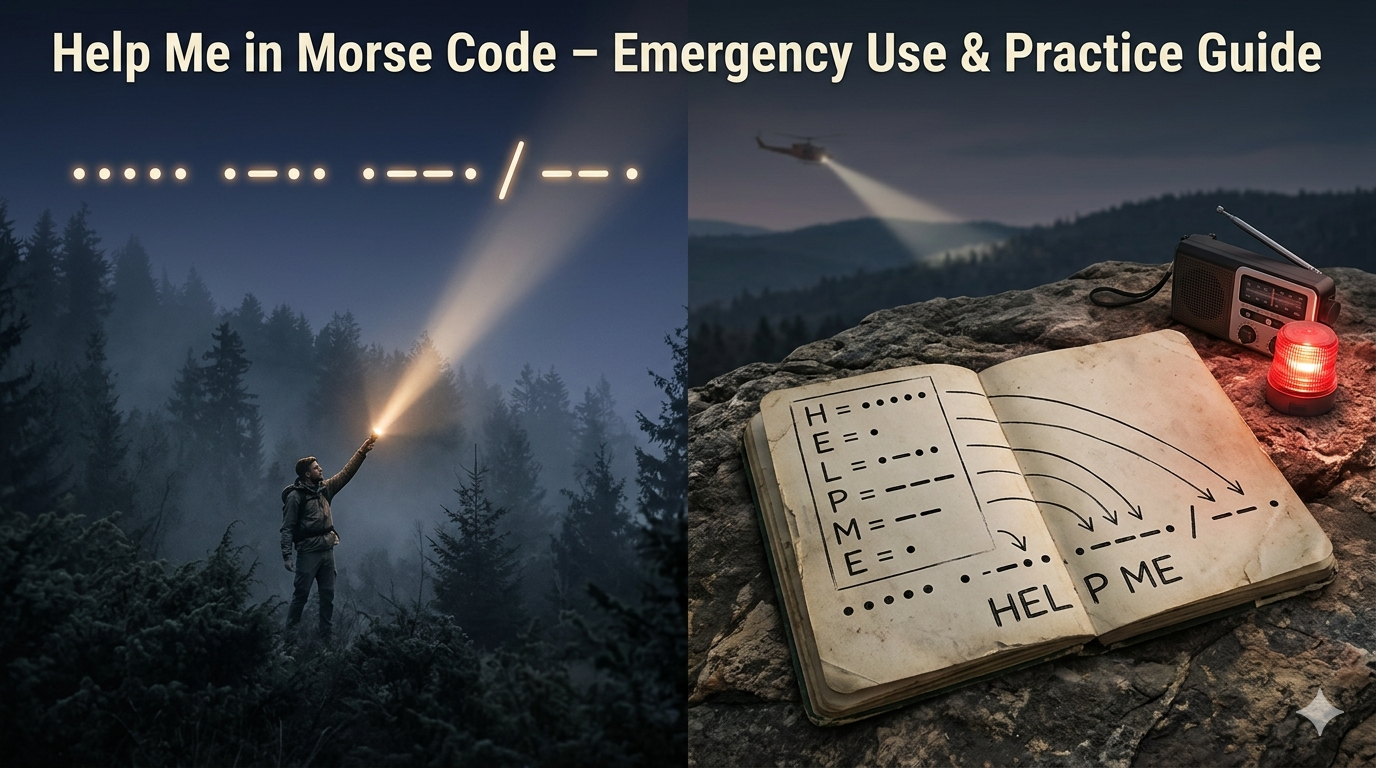
The phrase “Help Me” in Morse code is:
···· · ·−·· ·−−· / −− ·
This phrase is one of the most critical emergency communications used in Morse code. It combines two simple words—“Help” and “Me”—to clearly signal distress and request immediate assistance.
Letter-by-Letter Breakdown
HELP
- H → ····
- E → ·
- L → ·−··
- P → ·−−·
ME
- M → −−
- E → ·
Why “Help Me” is Important
“Help Me” is widely recognized as a universal distress phrase. While SOS (··· −−− ···) is the official emergency signal, “Help Me” provides clearer human context.
It is used in:
- Survival situations
- Rescue operations
- Medical emergencies
- Remote communication (radio, light signals)
Because of its simplicity, it is easy to learn and transmit even under stress.
Real-Life Use Cases
You can use “Help Me” in Morse code in scenarios like:
- Being lost in a forest or desert
- Signaling rescuers with a flashlight
- Communicating during power outages
- Emergency training and drills
- Amateur radio distress messages
Even beginners can quickly memorize this phrase due to its repetitive pattern.
How to Practice “Help Me” in Morse Code
To master this phrase:
- Start by learning each letter individually
- Practice the rhythm using sound (short vs long beeps)
- Write it repeatedly from memory
- Use a Morse code translator tool for verification
- Try decoding it without looking
👉 Practice using tools on InMorseCode learning platform
Audio Learning Tip
- Dot (·) = short beep
- Dash (−) = long beep
Listening to the pattern regularly helps you recognize it instantly, even in noisy environments.
Common Mistakes to Avoid
- Confusing L (·−··) with other similar patterns
- Skipping the space between words (/)
- Relying only on visual memorization
- Not practicing audio recognition
Final Thoughts
“Help Me” in Morse code is one of the first phrases every learner should master. It is practical, easy to remember, and highly useful in real-world emergency situations.
Once you are comfortable with it, you can expand your learning to other emergency phrases like “Doctor,” “Injury,” and “Emergency.”