You are on a hiking trail three hours from the nearest road. Your friend has taken a serious fall. Their breathing is labored, their leg is bent at a wrong angle, and you have no cellular signal. You have a flashlight and a mirror. You know that a rescue plane has been doing search patterns overhead since morning.
Do you know how to signal that you need a hospital?
This is not a scene from a survival film. Situations like this happen every year — on mountains, in forests, at sea, and in disaster zones around the world. In every one of them, Morse code provides a communication channel that works when nothing else does. It requires no battery, no network, no internet connection, and no sophisticated equipment. A rock against a pipe. A flashlight pointed at the sky. A whistle with a breath.
In this guide, you will learn how to express “hospital” in Morse code, discover the most important medical emergency Morse phrases, and get a practical, beginner-friendly system for committing them to memory. By the time you finish reading, you will have a meaningful emergency communication skill that most people never take the time to learn.
What Is Morse Code and Why Does It Still Matter?
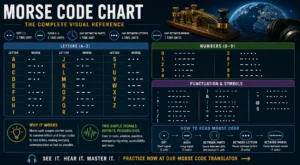
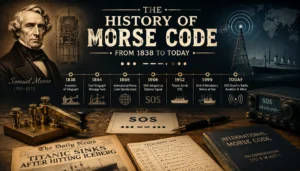
Morse code is a character encoding system developed in the 1830s by Samuel Morse and Alfred Vail. It translates every letter of the alphabet, every digit, and key punctuation marks into sequences of short signals (dots) and long signals (dashes). Those signals can be transmitted as sound, light, electrical pulses, radio waves, or physical taps on a surface.
What makes Morse code uniquely powerful in emergencies is its sheer versatility. The same message that a sailor transmits by radio can be flashed by a stranded hiker with a flashlight, tapped by an earthquake survivor on a collapsed wall, or scratched into sand by someone too weak to stand. No other widely recognized communication system is this adaptable.
Here is why Morse code remains relevant in the 21st century:
- Zero dependency on technology. No phone tower, no satellite signal, no battery required beyond the most basic light source or the strength to tap.
- Globally recognized. SOS, the most famous Morse signal, is understood by emergency services on every continent and in every ocean.
- Works through barriers. A person trapped under rubble, behind a wall, or underwater can transmit Morse code when voice communication is impossible.
- Trained into rescue services. Search and rescue teams, coast guards, amateur radio operators, and military units worldwide recognize standard Morse signals.
For medical emergencies specifically, knowing how to signal for a hospital, a doctor, or emergency medical assistance could be the most valuable practical skill you ever develop.
Hospital in Morse Code – The Complete Translation
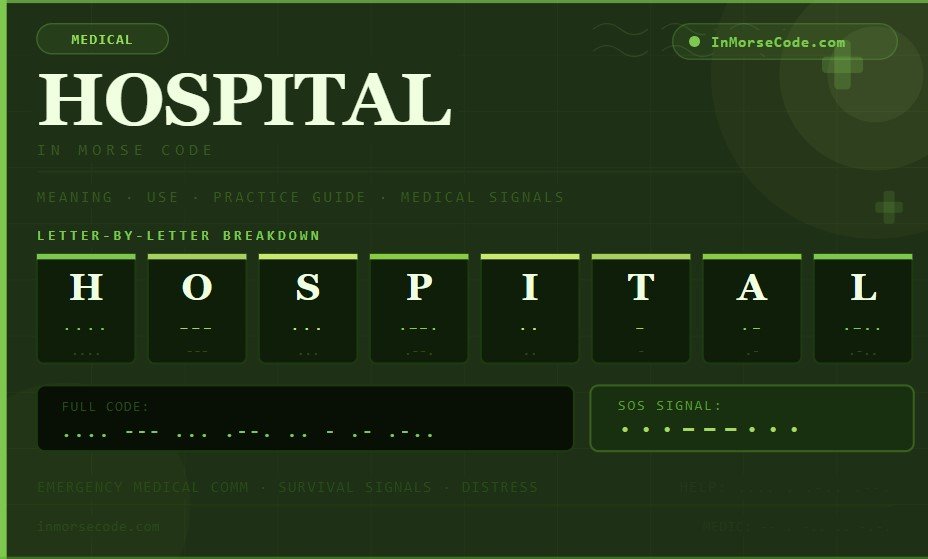
The word HOSPITAL in Morse code is:
.... --- ... .--. .. - .- .-.Eight letters. Each one is learnable in minutes, and the full word — once practiced — can be transmitted in under fifteen seconds by a beginner.
Letter-by-Letter Morse Code Breakdown for HOSPITAL
| Letter | Morse Code | How to Read It |
|---|---|---|
| H | .... | dot – dot – dot – dot |
| O | --- | dash – dash – dash |
| S | ... | dot – dot – dot |
| P | .--. | dot – dash – dash – dot |
| I | .. | dot – dot |
| T | - | dash |
| A | .- | dot – dash |
| L | .-.. | dot – dash – dot – dot |
Full Word in Morse Code
.... --- ... .--. .. - .- .-..How to Read This as a Beginner
Each group of dots and dashes above represents one letter. When you transmit HOSPITAL, you produce the signal for H, pause briefly, produce O, pause briefly, and so on through all eight letters. A word-length pause separates HOSPITAL from whatever comes before or after it in your message.
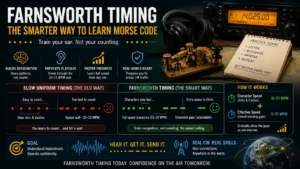
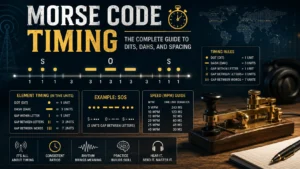
The timing rules are simple:
- A dot is the shortest signal — one unit of time
- A dash is three times as long as a dot
- The gap between symbols in the same letter is one dot long
- The gap between letters is three dots long
- The gap between words is seven dots long
The most important letters to master first are H (four dots — the heaviest letter), O (three dashes — the backbone of SOS), and S (three dots — the other half of SOS). Together, H, O, and S appear in some of the most critical emergency signals you will ever need.
Tip: Use the free Morse Code Translator at InMorseCode.com to hear HOSPITAL played back in real audio at adjustable speeds. Listening while reading the table above makes the patterns stick dramatically faster.
Meaning and Use of “Hospital” in Morse Code
Medical Emergencies in the Field
In an emergency where someone is critically injured and cannot be moved, signaling for a hospital — rather than just generic help — tells rescuers that the situation requires serious medical infrastructure, not just a search team. A mountain rescue helicopter dispatched to a “hospital needed” signal arrives prepared with trauma equipment and a plan to transport directly to a medical facility.
Search and Rescue Communication
Search and rescue protocols rely on interpreting signals quickly under pressure. When a rescue team picks up a Morse signal that includes HOSPITAL or NEED HOSPITAL, they immediately elevate the priority of the response and notify medical teams before they even reach the scene. This advance communication saves critical minutes.
Disaster Response
In earthquakes, floods, and building collapses, standard communication infrastructure fails completely. Emergency response teams in these scenarios use radio Morse as a fallback and train their personnel to recognize medical distress signals. Survivors who know how to tap HOSPITAL on a pipe or beam give rescuers precise information about the kind of assistance needed.
Silent Communication
There are situations where speaking is impossible or dangerous. A person with a throat injury cannot shout. Someone in a hostile environment cannot call out. An individual experiencing a severe medical event may have limited motor function but can still tap, blink, or flash. Morse code adapts to every one of these situations.
Military and Survival Situations
Military personnel in the field have used Morse code medic signals since World War I. Even in modern combat environments, units operating with radio silence can use tapped or light-flashed Morse to communicate casualty status to nearby allies without revealing their position electronically. The signal for HOSPITAL or MEDIC in such contexts can redirect an entire team’s priorities.
Transmission Methods
The word HOSPITAL can be transmitted through any of the following methods — all of which work without advanced equipment:
- Tapping: Knock on a wall, pipe, rock, or any hard surface. Short knock = dot, long knock = dash.
- Flashlight: Short flash = dot, long flash = dash. Visible for kilometers at night.
- Whistle: Short blast = dot, long blast = dash. Carries further than voice.
- Mirror: Reflect sunlight in short and long flashes. Visible from aircraft at enormous distances.
- Radio: Transmitted as audio beeps on any frequency, including amateur radio bands.
- Writing or scratching: Mark dots and dashes in sand, soil, or snow as a visual ground signal for overhead aircraft.
Related Medical and Emergency Morse Code Phrases
Knowing HOSPITAL gives you one important tool. Knowing these seven additional phrases gives you a complete emergency medical vocabulary.
SOS – The Universal Distress Signal
... --- ...Use it when: Any life-threatening situation. SOS (three dots, three dashes, three dots) is the most universally recognized signal on Earth. Every rescue service in the world monitors for it. Learn this before anything else.
HELP
.... . .-.. .--.| Letter | Morse Code |
|---|---|
| H | .... |
| E | . |
| L | .-.. |
| P | .--. |
Use it when: You need immediate assistance and want to transmit a recognizable English word that even non-Morse-trained observers might decode.
MEDIC
-- . -.. .. -.-.| Letter | Morse Code |
|---|---|
| M | -- |
| E | . |
| D | -.. |
| I | .. |
| C | -.-. |
Use it when: Someone needs urgent medical attention from a trained first responder. Shorter and faster to transmit than HOSPITAL, making it ideal when time is critical.
DOCTOR
-.. --- -.-. - --- .-.| Letter | Morse Code |
|---|---|
| D | -.. |
| O | --- |
| C | -.-. |
| T | - |
| O | --- |
| R | .-. |
Use it when: The emergency requires medical diagnosis or treatment beyond basic first aid. DOCTOR specifically signals that a licensed medical professional is needed.
INJURED
.. -. .--- ..- .-. . -..Use it when: You need to convey that someone has a physical injury requiring medical attention. Combine with SOS for maximum urgency: ... --- ... .. -. .--- ..- .-. . -..
NEED HOSPITAL
-. . . -.. / .... --- ... .--. .. - .- .-..The slash / represents a word-space pause. NEED HOSPITAL as a combined phrase conveys both the action required (need) and the specific destination (hospital). It tells rescuers to prepare transportation to a medical facility, not just to reach your location.
EMERGENCY
. -- . .-. --. . -. -.-. -.--Use it when: The situation is critical and deteriorating. EMERGENCY combined with HOSPITAL creates one of the most informative distress combinations you can transmit.
How to Practice “Hospital” in Morse Code
Step 1 – Split the Word in Half
HOSPITAL has eight letters. Before tackling it as a whole word, split it into two groups:
- H-O-S-P:
.... --- ... .--. - I-T-A-L:
.. - .- .-..
Practice each half for two days, then combine them. This phased approach prevents overwhelm and builds the kind of layered memory that holds up under stress.
Step 2 – Learn the Anchor Letters First
Three letters in HOSPITAL are foundational to emergency Morse code:
- H (
....) — Four quick dots. This is also the first letter of HELP. - O (
---) — Three heavy dashes. The center of SOS. - S (
...) — Three quick dots. The start and end of SOS.
Once you know H, O, and S, you effectively already know half of SOS and the first three letters of HOSPITAL.
Step 3 – The Tapping Method
Choose a hard surface — a desk, your knee, a wall. Use a short press for dots and a longer press (three times as long) for dashes.
Practice sequence:
- Tap H five times:
.... .... .... .... .... - Tap O five times:
--- --- --- --- --- - Tap S five times:
... ... ... ... ... - Tap H-O-S together as a group five times
- Add P, I, T, A, L one at a time over the next two days
Step 4 – Flashlight Practice
Take your flashlight outside at night. Flash HOSPITAL toward a wall, tree, or open sky. Short flash for dots, long flash for dashes. This is the exact technique you would use in a real outdoor emergency and builds the most practically relevant muscle memory.
Step 5 – Audio Listening and Repetition
Visit the Morse Code audio tools at InMorseCode.com and listen to HOSPITAL at 5 WPM (words per minute). As the audio plays, tap along on a surface. Then increase to 8 WPM, then 12 WPM. The combination of hearing, seeing, and physically tapping builds three memory pathways simultaneously — far more durable than any single method alone.
Step 6 – Self-Test Without References
After three days of practice, cover your reference sheet and try to transmit HOSPITAL from memory. Note any letters you hesitate on. Go back and drill only those specific letters. Targeted practice on weak spots is five times more efficient than repeating the whole word from scratch.
Daily Practice Routine for Beginners
| Day | Focus |
|---|---|
| Day 1 | Learn H, O, S individually — 10 reps each |
| Day 2 | Learn P, I, T individually — 10 reps each |
| Day 3 | Learn A, L individually — then combine H-O-S-P |
| Day 4 | Practice I-T-A-L as a group — 10 reps |
| Day 5 | Combine full HOSPITAL — slow and deliberate |
| Day 6 | Flashlight practice for HOSPITAL |
| Day 7 | Add SOS and MEDIC — full emergency rotation |
| Week 2 | Increase to 10 WPM; add NEED HOSPITAL phrase |
Practice Exercises — Try These Now
Exercise 1 – Decode These Letters
Without looking at the table, identify each letter:
....→ ___---→ ___.--.→ ___.-..→ ___
(Answers: H, O, P, L)
Exercise 2 – Tap and Count
Tap out HOSPITAL on your desk right now. Count your taps: how many dots did you produce total? How many dashes? (Answer: H=4 dots, O=3 dashes, S=3 dots, P=1 dot+2 dashes+1 dot, I=2 dots, T=1 dash, A=1 dot+1 dash, L=1 dot+1 dash+2 dots.)
Exercise 3 – Emergency Combination
Transmit this complete emergency message from the table: SOS + NEED HOSPITAL. Time yourself. Practice until you can do it in under 45 seconds at a beginner’s slow pace.
Real-Life Uses of Morse Code in Medical Situations
Wilderness Survival
National parks and wilderness rescue operations regularly involve days-long search patterns. A hiker who knows how to flash SOS and HOSPITAL from a clearing gives rescue aircraft specific, actionable information. The rescue team can then radio ahead to a hospital, prepare the right medical equipment, and potentially have a surgical team standing by before the helicopter even lands.
Earthquakes and Building Collapses
The International Search and Rescue Advisory Group recognizes Morse code tapping as an official method of survivor communication in structural collapse scenarios. Survivors who tap rhythmically — especially in recognizable patterns like SOS or HOSPITAL — are prioritized in rescue operations because their signals suggest both consciousness and a need for specific medical care.
Communication When Speaking Is Impossible
Post-surgical patients, individuals with severe laryngitis, trauma victims with jaw injuries, and people in shock may all be temporarily or permanently unable to speak. In medical or emergency contexts, the ability to tap a simple Morse signal on a surface or blink it with their eyes gives these individuals a communication channel that voice-dependent methods cannot provide.
Emergency Preparedness Training
A growing number of wilderness first aid courses, outdoor leadership programs, and emergency preparedness organizations now include basic Morse code as part of their curriculum. Knowing HOSPITAL, SOS, and HELP is increasingly considered a fundamental safety skill for anyone who spends time in remote areas.
Morse Code Cheat Sheet – Quick Medical Reference
Save this table or print it for your emergency kit. A laminated copy in your hiking pack or go-bag weighs almost nothing.
| Word / Phrase | Morse Code | When to Use |
|---|---|---|
| SOS | ... --- ... | Any life-threatening emergency |
| HELP | .... . .-.. .--. | Need immediate assistance |
| HOSPITAL | .... --- ... .--. .. - .- .-.. | Need transport to medical facility |
| MEDIC | -- . -.. .. -.-. | Need urgent medical professional |
| DOCTOR | -.. --- -.-. - --- .-. | Need licensed medical care |
| INJURED | .. -. .--- ..- .-. . -.. | Physical injuries present |
| NEED HOSPITAL | -. . . -.. / .... --- ... .--. .. - .-.. | Cannot reach hospital without help |
| EMERGENCY | . -- . .-. --. . -. -.-. -.-- | Critical, urgent situation |
| PAIN | .--. .- .. -. | Communicating presence of pain |
| FIRE | ..-. .. .-. . | Fire hazard present |
Common Mistakes Beginners Make
1. Incorrect Timing Ratios
The most common error: dots and dashes are the same length. A dash must be held exactly three times as long as a dot. When they are the same duration, receivers cannot distinguish letters — your HOSPITAL becomes an unintelligible blur.
Fix: Practice against a metronome or use the digital Morse trainer at InMorseCode.com, which enforces correct timing automatically.
2. Missing Pauses Between Letters
Beginners often run letters together without adequate gaps, turning HOSPITAL into one long undivided stream. Without the three-dot pause between each letter, the receiver cannot tell where one letter ends and the next begins.
Fix: Exaggerate the pauses at first. Deliberately count to three (in dot-lengths) between every letter until the rhythm becomes natural.
3. Confusing Similar-Looking Letters
Several letters in HOSPITAL have patterns that beginners frequently mix up:
| Confusing Pair | Letter 1 | Letter 2 | How to Distinguish |
|---|---|---|---|
| H vs S | .... | ... | H = four dots; S = three dots |
| O vs T | --- | - | O = three dashes; T = one dash |
| A vs N | .- | -. | A = dot first; N = dash first |
| I vs E | .. | . | I = two dots; E = one dot |
| L vs F | .-.. | ..-. | L = dot-dash-dot-dot; F = dot-dot-dash-dot |
Fix: Learn confusable pairs side by side from the start. If you know H is four dots and S is three, you will never confuse them — but only if you learned them as a pair.
4. Increasing Speed Too Quickly
Speed is appealing but accuracy is essential. A fast, sloppy transmission is impossible to decode. At high speeds, a slightly-too-long dot becomes a dash, and the letter changes completely. A fast HOSPITAL could arrive as GTRXBAH.
Fix: Master each signal perfectly at 5 WPM before increasing. Accuracy first, speed second — always.
5. Skipping Reception Practice
Many learners practice sending only. In a real emergency, rescuers may respond to your signal. If you cannot decode their reply, you lose half the communication.
Fix: Use the audio decoder tools at InMorseCode.com regularly. Listen to random Morse playback and write down what you hear before checking the answer.
Best Tools to Learn Morse Code
You do not need expensive equipment to become proficient. InMorseCode.com provides everything you need, completely free:
- Morse Code Translator — Type HOSPITAL, SOS, MEDIC, or any word and instantly see the Morse code and hear real audio playback. Adjustable from beginner pace to expert speed. The fastest verification tool available.
- Audio Morse Converter — Designed for ear training and reception practice. Listen to randomly generated Morse signals and decode them without references. This builds the skill most beginners neglect.
- Flashlight Morse Code Tool — Visual Morse playback that mimics real light-signal conditions. Practice exactly how you would signal in an outdoor emergency.
- Morse Practice Trainer — A structured learning environment that progresses from individual letters through common words to full emergency phrases. Calibrated for beginner, intermediate, and advanced users.
- Morse Code Learning Hub — Comprehensive guides covering the complete International Morse Code alphabet, numbers, emergency phrases, and structured practice programs. If you want to go from zero to confident, start here.
FAQ – Hospital in Morse Code
Q: What is hospital in Morse code?
HOSPITAL in Morse code is .... --- ... .--. .. - .- .-.. — eight letters, each with a simple dot-dash pattern. The full sequence takes about 10–15 seconds to transmit at beginner speed.
Q: How do you signal for medical help in Morse code?
The most effective approach is to transmit SOS (... --- ...) followed by HOSPITAL (.... --- ... .--. .. - .-..) or MEDIC (-- . -.. .. -.-.). This tells rescuers both that you need emergency help and that it is medical in nature.
Q: Is Morse code still used in actual emergencies today?
Yes, actively. Maritime vessels still use SOS via radio in Morse format. Search-and-rescue teams monitor for Morse tapping in building collapse scenarios. Amateur radio operators provide Morse code communication during disaster response when digital infrastructure is down. The International Search and Rescue Advisory Group formally recognizes Morse tapping as a survivor communication method.
Q: What is the Morse code for SOS?
SOS is ... --- ... — three dots, three dashes, three dots. It is often transmitted as one continuous sequence without letter gaps, making it even more distinctive and unmistakable.
Q: Can anyone learn Morse code, or is it only for professionals?
Absolutely anyone can learn the basic emergency signals. SOS takes about five minutes to learn. HOSPITAL takes about a week of five-minute daily sessions to make automatic. You do not need to learn the full 26-letter alphabet to use Morse code effectively in a survival situation.
Q: What is the easiest way to transmit Morse code without equipment?
Tap on any hard surface with your knuckle or a rock. Short tap = dot, long tap = dash. This requires nothing beyond your hand and a surface, making it the most universally accessible method.
Q: How far can a flashlight Morse signal be seen?
In clear nighttime conditions, a standard flashlight signal is visible from three to ten kilometers depending on terrain. From an elevated position with a powerful torch, the range extends considerably further, especially to aircraft overhead.
Conclusion – Why Learning “Hospital” in Morse Code Is Worth Your Time
Medical emergencies do not schedule themselves. They happen on mountain trails and at sea, in remote cabins and during natural disasters, in places where your phone has no signal and your voice cannot carry far enough. In every one of those situations, a person who knows how to signal HOSPITAL, SOS, or MEDIC in Morse code has a communication option that most people simply do not have.
HOSPITAL in Morse code: .... --- ... .--. .. - .- .-..
That sequence of dots and dashes, committed to your muscle memory through a week of five-minute daily practice, could one day direct a rescue helicopter to your exact location with the right medical team already briefed on what is needed.
Here is your three-step action plan starting today:
- Right now: Visit the Morse Code Translator at InMorseCode.com and listen to HOSPITAL and SOS in real audio. Let the patterns register.
- Today: Tap out SOS on your desk until it feels natural. Short-short-short, long-long-long, short-short-short.
- This week: Follow the seven-day practice routine in this guide and add HOSPITAL to your emergency vocabulary.
The Morse Code Learning Hub at InMorseCode.com has everything you need to go further — from the complete alphabet through full emergency communication fluency, at your own pace, completely free.
Do not wait until you need it. Learn it now.
Start practicing right now — visit the free Morse Code audio tools and translator at InMorseCode.com and type your first medical emergency signal.