Morse code is one of the oldest and most reliable forms of communication ever invented. Long before smartphones, radios, and the internet, people used a simple system of dots and dashes to send messages across vast distances. Today, Morse code is not just a relic of history — it is still actively used by amateur radio operators, military personnel, pilots, hikers, and survivalists around the world.
One of the most important things you can ever communicate — especially in a crisis — is that you are in pain or that you need help. Knowing how to express “pain” in Morse code could literally save your life or someone else’s. Whether you are deep in the wilderness with no phone signal, stranded at sea, or in a situation where speaking aloud is not possible, Morse code gives you a silent, universal language to call for help.
In this guide, you will learn exactly how to say “pain” in Morse code, how to use it in emergency situations, related distress phrases, and how to practice it so the knowledge sticks when you need it most.
What Is Morse Code and Why Does It Still Matter?
Morse code was developed in the 1830s by Samuel Morse and Alfred Vail. It assigns each letter of the alphabet, each number, and several punctuation marks a unique sequence of short signals (dots) and long signals (dashes). These signals can be transmitted as sound, light, electrical pulses, or even physical taps.
Here is why Morse code remains relevant today:
- It works without technology. You do not need a battery, an internet connection, or a screen.
- It is universal. Rescue teams, coast guards, and military units around the world recognize standard Morse code signals.
- It is versatile. You can transmit it by tapping, flashing a flashlight, using a whistle, or blinking your eyes.
- It saves lives. The international distress signal SOS (· · · — — — · · ·) is recognized globally and has rescued thousands of people.
Learning even a handful of key Morse code phrases — like “pain,” “help,” or “SOS” — adds a powerful tool to your survival and communication toolkit.
Pain in Morse Code – The Full Breakdown
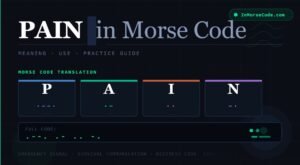
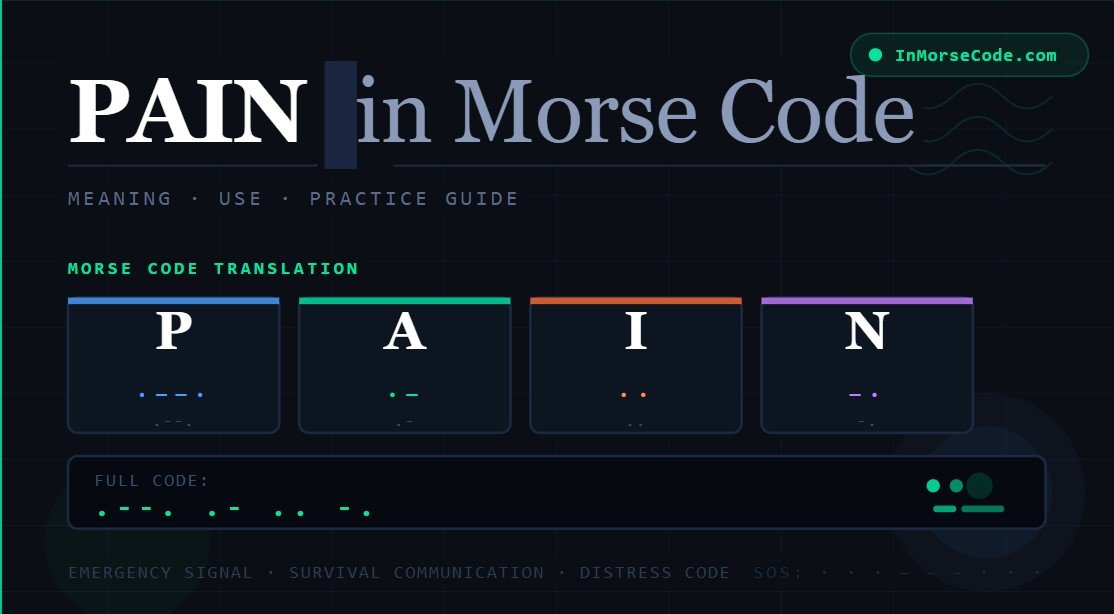
The word PAIN in Morse code is written as:
.--. .- .. -.Let’s break it down letter by letter so it is easy to learn and remember.
Letter-by-Letter Morse Code Breakdown for PAIN
| Letter | Morse Code | Description |
|---|---|---|
| P | .--. | dot – dash – dash – dot |
| A | .- | dot – dash |
| I | .. | dot – dot |
| N | -. | dash – dot |
How to Read and Transmit PAIN
Each letter is separated by a short pause (the length of one dot). Each word is separated by a longer pause (the length of seven dots). So when you transmit PAIN, it sounds like:
- P: dit dah dah dit
- (pause)
- A: dit dah
- (pause)
- I: dit dit
- (pause)
- N: dah dit
Written out in full text format:
.--. .- .. -.If you are tapping it out — on a rock, a pipe, or a hard surface — think of a short tap for a dot and a long tap (roughly three times as long) for a dash. Two short taps and you have the letter I. A long-short combination gives you N. Practice these individually before chaining them together.
Quick tip: To hear exactly how PAIN sounds in Morse code audio, use the Morse Code Translator on InMorseCode.com — it plays back any word you type in real-time audio.
Meaning and Use of “Pain” in Morse Code
Emergency Communication
When someone is injured and unable to speak loudly or clearly, communicating the word “pain” can alert rescuers to their condition quickly. In emergency situations, every second counts. Morse code allows a person who is trapped, partially unconscious, or in a noisy environment to signal their distress through a simple, repeatable pattern.
Imagine a hiker who has fallen and broken a leg. They cannot shout loudly enough to be heard, but they have a flashlight. Flashing .--. .- .. -. in a steady rhythm could alert a search-and-rescue team to their exact location and condition.
Military and Aviation Scenarios
Military personnel have used Morse code for covert communication since World War I. Even today, certain branches of the armed forces train soldiers in basic Morse code for situations where radio silence is necessary or electronic communication has been jammed. Being able to tap “pain” or “injured” on a surface silently, without giving away your position, can be a critical skill.
In aviation, Morse code identifiers are still broadcast by navigational aids called VORs (VHF Omnidirectional Range beacons). Pilots learn to recognize Morse code patterns as part of their training. While you wouldn’t normally transmit the word “pain” over an aviation frequency, understanding Morse code in this context demonstrates just how deeply embedded it is in life-critical systems.
Silent Communication Methods
One of Morse code’s greatest strengths is its adaptability. You can communicate the word “pain” — and any other Morse code message — through:
- Sound: Tapping on a wall, pipe, or hard surface
- Light: Flashing a flashlight, phone screen, or mirror
- Breath: Using short and long exhales or whistle blasts
- Touch: Tapping on someone’s hand (used in medical settings with non-verbal patients)
- Radio: Transmitting on amateur radio frequencies
This makes Morse code far more flexible than voice communication in dangerous, silent, or low-visibility environments.
Related Emergency Morse Code Phrases You Should Know
Knowing just one word is a start, but a true emergency may require you to string together a distress message. Here are the most important emergency Morse code phrases every learner should memorize.
SOS – The Universal Distress Signal
... --- ...SOS is the most recognized distress signal on Earth. It does not stand for any specific phrase — it was chosen because it is simple and unmistakable: three dots, three dashes, three dots. If you can only learn one Morse code signal, make it this one.
HELP
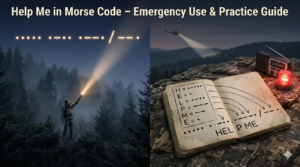
.... . .-.. .--.| Letter | Morse Code |
|---|---|
| H | .... |
| E | . |
| L | .-.. |
| P | .--. |
NEED HELP
-. . . -.. / .... . .-.. .--.The slash / represents a word space. Transmitting “NEED HELP” gives rescuers more context than SOS alone — it tells them the situation requires immediate human assistance.
DANGER
-.. .- -. --. . .-.| Letter | Morse Code |
|---|---|
| D | -.. |
| A | .- |
| N | -. |
| G | --. |
| E | . |
| R | .-. |
HURT
.... ..- .-. -| Letter | Morse Code |
|---|---|
| H | .... |
| U | ..- |
| R | .-. |
| T | - |
PAIN (for reference)
.--. .- .. -.Knowing all of these phrases together gives you a basic emergency Morse code vocabulary. Practice them in the order above — SOS first, then HELP, PAIN, HURT, and DANGER — so you can recall any of them under stress.
Practice all these phrases interactively using the audio and visual tools available at InMorseCode.com. The platform lets you type any word and hear it played back in real Morse code audio.
How to Practice “Pain” in Morse Code – Step-by-Step Guide
Learning Morse code is like learning a new language or a musical instrument. Consistent, structured practice beats long infrequent study sessions every time. Here is a practical guide to get “PAIN” — and related distress phrases — locked into your memory.
Step 1 – Learn Each Letter Individually
Start with the four letters in PAIN:
- P (`.–.’) — Think of it as: short-long-long-short. Some learners remember this as a “picture frame” shape — enclosed on both ends.
- A (
.-) — The simplest dash combo. Short-long. It is one of the first letters beginners learn. - I (`..’) — Two quick dots. Fast and simple. Short-short.
- N (`-.’) — Long-short. The opposite of A. Remember: N is negative, it starts with the heavy dash.
Step 2 – Tap It Out by Hand
Use a pen on a desk or two fingers on your thigh. Tap each letter of PAIN with a short tap for dots and a longer press for dashes. Repeat each letter five times before moving on. Then chain them together:
P – pause – A – pause – I – pause – NStep 3 – Use Audio Tools
Hearing Morse code is just as important as tapping it. Your brain builds a second memory path when it processes sound. Visit the Morse Code audio translator at InMorseCode.com and listen to PAIN played back at different speeds. Start slow, then gradually increase the WPM (words per minute).
Step 4 – Practice with Light Signals
Once you know the tap pattern, grab a flashlight and practice flashing PAIN in the dark. This is not just a fun exercise — it is the exact method you would use to signal from a distance in a real emergency. Use a short flash for dots and a longer flash for dashes.
Step 5 – Test Yourself
Cover your reference sheet and try to transmit PAIN from memory. Then move on to HELP, HURT, and SOS. Mix them up. Ask a friend to quiz you by tapping or flashing, and you decode what they are sending. This two-way practice dramatically speeds up retention.
Memorization Tips
- Create a story or image. Visualize a person stubbing their toe — they say a short word (P), a sigh (A), a sharp inhale (I), and groan (N). Map each sound to the dots and dashes.
- Use the rhythm. Morse code has a natural rhythm. “Pain” in Morse has a bouncy, percussive feel. Hum it or tap it to music.
- Five minutes a day. Daily short sessions are far more effective than weekly long ones. Five minutes of Morse tapping every morning builds deep muscle memory.
- Use flashcards. Write the letter on one side, the Morse code on the other.
Beginner Exercise Routine
| Day | Focus |
|---|---|
| Day 1 | Learn P and A individually |
| Day 2 | Learn I and N individually |
| Day 3 | Combine: tap PAIN five times slowly |
| Day 4 | Practice with flashlight, then audio |
| Day 5 | Add SOS and HELP to your session |
| Day 6 | Mix all five phrases: PAIN, SOS, HELP, HURT, DANGER |
| Day 7 | Test from memory; note gaps and revisit |
Real-Life Use Cases for Morse Code Pain Signals
Survival Situations
Search and rescue teams responding to wilderness emergencies are trained to look for Morse signals — particularly SOS and distress patterns. If you are injured and immobile, flashing or tapping PAIN, HURT, or SOS could direct rescuers to your exact position and alert them to your medical needs before they even reach you.
Outdoor Adventures
Hikers, campers, divers, and mountaineers regularly venture into areas with no cellular coverage. A small knowledge of Morse code turns an ordinary flashlight or whistle into a long-range emergency communication device. Diving flags and underwater torch signals have historically used Morse-like patterns; knowing PAIN and SOS adds real value to your safety toolkit.
Communication Without Speaking
There are situations — medical emergencies, hostage scenarios, situations where speaking would attract danger — where voice communication is impossible or unsafe. Morse code tapped on a surface, blinked with eyes, or scratched into a surface can communicate critical information silently. This is why some medical facilities have explored Morse code as an assistive communication method for patients with locked-in syndrome or severe movement limitations.
Tools and Resources to Learn Morse Code Faster
You do not have to rely on paper flashcards alone. InMorseCode.com offers several free, browser-based tools that make learning Morse code fast and fun:
- Morse Code Translator — Type any word or phrase and instantly see its Morse code equivalent. You can also listen to it played back in audio.
- Audio Morse Code Tool — Hear your Morse code at adjustable speeds, from beginner-friendly slow pace to expert-level rapid transmission.
- Image-to-Morse Converter — Upload any image containing text or Morse patterns and the tool extracts and converts it automatically using built-in OCR technology.
- Learn Morse Code — A structured learning hub with guides, the full alphabet, number codes, and common phrases for beginners and intermediate learners alike.
Using these tools alongside this guide gives you a complete learning system: read, listen, practice, and test — all in one place.
Common Mistakes to Avoid When Learning Morse Code
Even enthusiastic learners make predictable mistakes. Being aware of them in advance will save you weeks of frustration.
1. Confusing Similar Patterns
Several Morse code letters look deceptively similar:
| Letter | Code | Common Confusion |
|---|---|---|
| N | -. | Easily confused with D (-..) |
| A | .- | Confused with N (-.) in reverse |
| I | .. | Confused with E (.) and S (...) |
| U | ..- | Confused with V (...-) |
Solution: Always learn letters in pairs of opposites — A and N, E and T, I and S — so your brain can distinguish them clearly.
2. Going Too Fast Too Soon
Many beginners rush to increase their speed before the patterns are fully memorized. This leads to sloppy transmission and misreading. At high speeds, a slightly-too-long dot becomes a dash, and the entire word changes meaning.
Solution: Start at 5 WPM or slower. Speed comes naturally with repetition. Accuracy first, speed second.
3. Skipping the Listening Phase
Some learners focus entirely on transmitting — tapping and flashing — without practicing decoding incoming signals. Real emergencies require you to both send and receive messages.
Solution: Regularly listen to Morse code audio at random and write down what you hear. The audio tools on InMorseCode.com are ideal for this.
4. Inconsistent Timing
Morse code relies on precise timing ratios: a dash is exactly three times the length of a dot; a letter gap equals three dots; a word gap equals seven dots. Inconsistent timing makes your signals impossible to decode.
Solution: Practice with a metronome or use a digital Morse key tool that enforces correct timing automatically.
5. Cramming Instead of Spacing Practice
Studying Morse code for two hours once a week is far less effective than five minutes every day. The brain consolidates motor and auditory memory during sleep, which means daily practice leads to dramatically faster retention.
Solution: Set a daily reminder for a five-minute Morse practice session. Consistency beats intensity.
Conclusion – Why Learning “Pain” in Morse Code Is Worth It
Morse code is a 180-year-old technology that still saves lives today. In a world increasingly dependent on battery-powered devices and wireless networks, knowing how to communicate without them is a genuinely valuable skill.
Learning how to say pain in Morse code — .--. .- .. -. — is a small investment of time with a potentially enormous payoff. Pair it with SOS, HELP, HURT, and DANGER, and you have a compact emergency vocabulary that works anywhere, any time, with nothing more than your hands, a light, or your voice.
The key takeaways from this guide:
- PAIN in Morse code is
.--. .- .. -.— four letters, each simple to learn individually. - Morse code distress signals like SOS are universally recognized and actively monitored by rescue services.
- You can transmit Morse code through sound, light, tapping, or touch — making it one of the most adaptable communication methods in existence.
- Daily practice of just five minutes using audio tools, tapping, and flashlight drills will build lasting memory.
- Resources at InMorseCode.com give you everything you need to practice for free.
Start today. Learn PAIN. Learn SOS. Learn HELP. The few minutes you spend practicing Morse code now could be the most important minutes you ever invest in your own safety — or someone else’s.