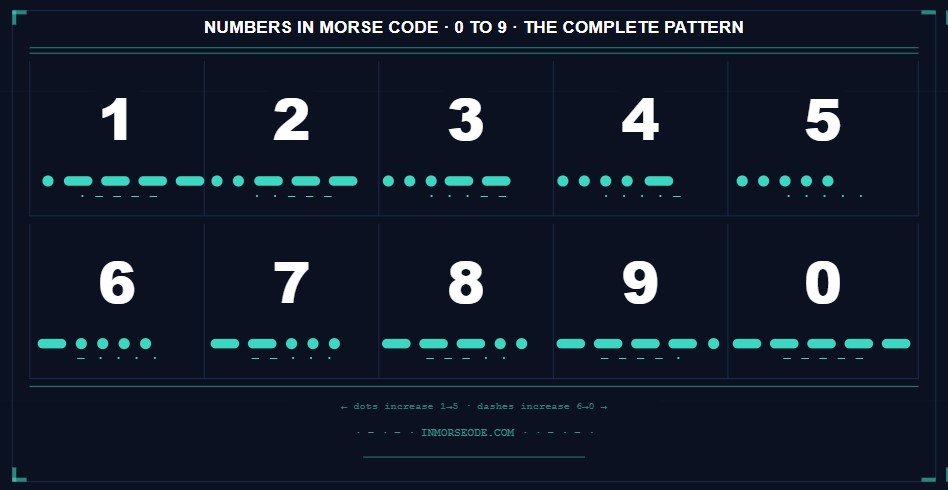
Numbers in Morse code follow one of the most satisfying patterns in the entire system: each digit from 1 to 5 is encoded using a specific number of dots followed by dashes, while 6 through 0 reverse this, using dashes followed by dots. Once you see the pattern, you can derive any number from memory without looking it up.
This guide covers all 10 digits in detail the Morse symbol, how it sounds, how to remember it, and how numbers are used in real Morse communication. It is the hub page for the InMorseCode.com numbers cluster, linking to individual pages for each digit.
The Key Pattern: How Numbers Work in Morse Code
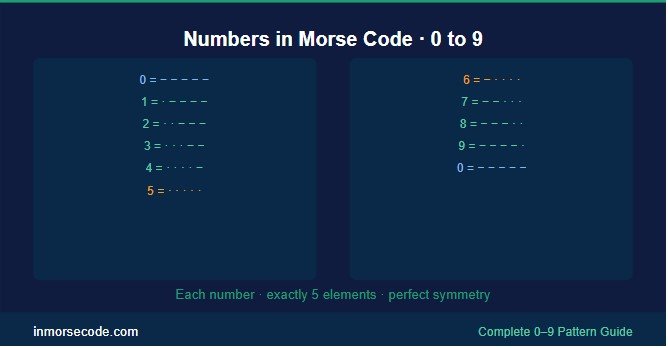
Unlike letters, which were assigned codes based on frequency in English text, numbers follow a completely regular, symmetrical pattern. Every number uses exactly 5 elements (5 dots and/or dashes). This predictability is what makes numbers easier to learn as a group than letters:
| Letter | Morse Code | Sound |
| 1 | · − − − − | 1 dot + 4 dashes |
| 2 | · · − − − | 2 dots + 3 dashes |
| 3 | · · · − − | 3 dots + 2 dashes |
| 4 | · · · · − | 4 dots + 1 dash |
| 5 | · · · · · | 5 dots; all dots |
| 6 | − · · · · | 1 dash + 4 dots |
| 7 | − − · · · | 2 dashes + 3 dots |
| 8 | − − − · · | 3 dashes + 2 dots |
| 9 | − − − − · | 4 dashes + 1 dot |
| 0 | − − − − − | 5 dashes — all dashes |
| The pattern in one sentence: Start at 1 with one dot and four dashes. Add one more dot (remove one dash) for each number up to 5. At 5 you have five dots. Then reverse: 6 has one dash and four dots. Add one more dash (remove one dot) up to 0, which is five dashes. |
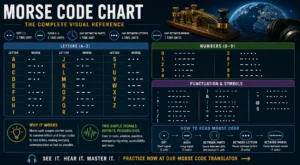
Complete Morse Code Numbers Chart with Audio
Each number below links to its dedicated page at InMorseCode.com, where you can hear the audio and practise individually. To hear any number, type it into the InMorseCode Morse Translator and click Play:
| Letter | Morse Code | Sound |
| 0 | − − − − − | dah dah dah dah dah — the ‘all dashes’ number |
| 1 | · − − − − | dit dah dah dah dah |
| 2 | · · − − − | dit dit dah dah dah |
| 3 | · · · − − | dit dit dit dah dah |
| 4 | · · · · − | dit dit dit dit dah |
| 5 | · · · · · | dit dit dit dit dit — the ‘all dots’ number |
| 6 | − · · · · | dah dit dit dit dit |
| 7 | − − · · · | dah dah dit dit dit |
| 8 | − − − · · | dah dah dah dit dit |
| 9 | − − − − · | dah dah dah dah dit |
How Numbers Are Used in Real Morse Communication
Ham Radio Signal Reports: RST System
The most common use of numbers in ham radio Morse code is the RST signal report: Readability (1–5), Strength (1–9), Tone (1–9). A perfect signal is reported as 599 spoken/sent as “five nine nine” in Morse. Contest operators send 599 (sometimes 5NN where N = 9) thousands of times per hour in major CW contests.
Callsigns
Amateur radio callsigns contain both letters and numbers (e.g. W5ABC, G4XYZ, VK3PQ). Operators must be able to send and receive numbers accurately as part of their callsign. This is why number proficiency is required for amateur radio licensing in most countries.
73 and 88 The Famous Ham Radio Abbreviations
In ham radio tradition, 73 means “best regards” and is sent at the end of virtually every contact. 88 means “love and kisses” and is used between operators who know each other. Knowing 7 (−−···) and 3 (···−−) and 8 (−−−··) is therefore essential for any operator who wants to sound natural on the air.
Frequencies, Dates, and Contest Exchanges
Numbers appear in frequency information (7.030 MHz), date exchanges, serial numbers in contesting (001, 002…), and in many common Q-code abbreviations. Number proficiency is not optional for practical operating it is as fundamental as letter proficiency.
How to Memorise Morse Code Numbers
Because numbers use only 5 elements each and follow the dot-to-dash progression, they can be memorised as a group in a single session:
- Write out 1–5 in a column: ·−−−− ··−−− ···−− ····− ·····. Notice each row gets one more dot and one fewer dash.
- Write 6–0 below: −···· −−··· −−−·· −−−−· −−−−−. Mirror image of 1–5.
- Practise by sending your phone number in Morse. Familiar digits in a personal sequence fix the patterns in memory quickly.
- Use the InMorseCode.com translator to enter any number and hear the audio. Hearing and sending simultaneously accelerates retention.
Numbers for Morse Code Tattoos and Jewellery
Dates and years are increasingly popular for Morse code tattoos encoding a birth date, wedding anniversary, or significant year. A date like 12/06/1998 in Morse code produces a long sequence of 5-element digit patterns. Always verify the complete code using the InMorseCode.com translator before any permanent application.
For a birth year bracelet, the year (e.g. 2001) in Morse code would be: ··−−− −−−−− −−−−− ·−−−−. At 5 elements per digit with 4 digits, this is a 20-element sequence a full bracelet worth of beads without the date and month!
| Tip for date jewellery: Consider encoding just the year (4 digits = 20 elements) rather than the full date (8 digits = 40 elements) for a more wearable bracelet length. Alternatively, the day and month without the year creates a shorter, more manageable pattern. |
Ready to practise Numbers and other letters together?
Try the Free Morse Code Translator Tool ›
Browse all Morse Code learning guides ›
Frequently Asked Questions: Numbers in Morse Code
Do all numbers in Morse code use 5 elements?
Yes. Every digit from 0 to 9 in International Morse Code uses exactly 5 elements a combination of dots and dashes. This makes numbers longer to transmit than most letters but easy to learn as a logical group.
What is the number 5 in Morse code?
5 in Morse code is five dots: · · · · ·. It is the all-dots number, symmetric with 0 (five dashes). This makes 5 visually distinctive a rapid five-dot burst unlike anything else in the number set.
What does 73 mean in Morse code?
73 is the traditional ham radio abbreviation for “best regards” or “best wishes”. In Morse, 7 = −−··· and 3 = ···−−. Together: −−··· ···−−. It is the standard farewell at the end of nearly every amateur radio contact.
Can I use numbers for a Morse code tattoo?
Yes; numbers are among the most popular content for Morse code tattoos because birth years, anniversaries, and special dates carry deep personal meaning. Always verify the complete number sequence using the InMorseCode.com translator before your appointment.
How are numbers different from letters in Morse code?
Letters use 1–4 elements (with a few using 5) and were assigned based on English frequency. Numbers always use exactly 5 elements and follow a regular dot-to-dash pattern. Numbers are therefore more predictable to learn but slower to transmit than common letters.