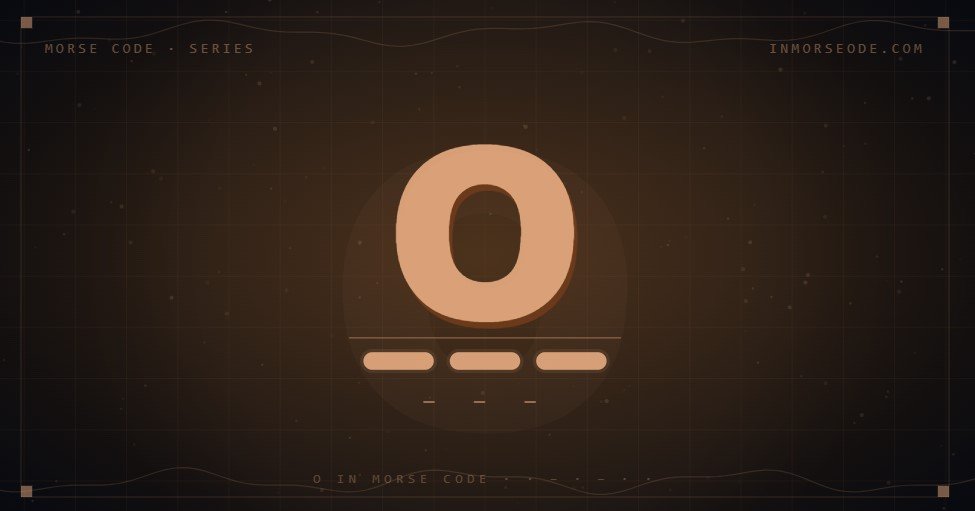
O in Morse code is three dashes: − − −. Spoken as “dah dah dah”, it is the unmistakable deep three-beat pattern that forms the middle of the SOS distress signal and one of the most frequently occurring vowels in the English language.
Alongside S (· · ·) and E (·), the letter O is part of the earliest vocabulary every Morse learner builds. Its three-dash pattern is easier to remember than many four or five element characters, and its role in SOS gives it immediate practical meaning from the first day of learning.
What Is O in Morse Code?

| O − − − |
Three dashes. Three equal long tones. At 20 WPM, each dash lasts 180 ms with 60 ms gaps between them. The full character O lasts approximately 540 milliseconds — noticeably longer than most short characters, which is part of what makes it so distinctive by ear.
| Letter | Morse Code | Visual (dots and dashes) | Pattern |
|---|---|---|---|
| O | - - - | − − − | three dashes |
How it sounds
The letter O is pronounced “OH” /oʊ/ in English. In Morse code, you send it as – – –. In audio terms, the pattern sounds like “dah-dah-dah”. Beginners should start by tapping the pattern on a desk or table before moving to a Morse key or practice app. Consistent rhythm matters more than speed when you are just starting out.
Memory Trick for O in Morse Code
O in Morse code is three dashes. Think of the shape of the letter O itself: it is round and complete, just like three dashes lined up in a row forming a solid, full sound. Say “dah-dah-dah” three times in an even rhythm and that is the letter O. You can also remember it by linking it to SOS: the middle part, three dashes, is the O. It sounds deeper and heavier than the three dots of S on either side.
O in the SOS Signal
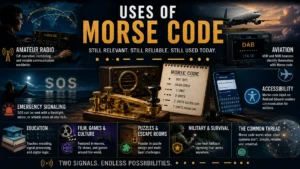
SOS — the international distress signal — consists of S (· · ·), O (− − −), S (· · ·). The contrast between three rapid dots and three long dashes, repeated, creates the most recognisable signal pattern in the history of human communication:
| Letter | Morse Code | Sound |
| S | · · · | three dots — rapid short tones |
| O | − − − | three dashes — three long tones |
| S | · · · | three dots — rapid short tones |
Common Words Starting With O in Morse Code
| Letter | Morse Code | Sound |
| OK | −−− −·− | O K |
| OUT | −−− ··− − | O U T |
| OVER | −−− ···− · ·−· | O V E R |
| OFF | −−− ··−· ··−· | O F F |
Common Names Starting With O in Morse Code
- Olivia: − − − · −·· · · ···− · · · − → O L I V I A
- Oliver: − − − · − · · · · · −·· · −· → O L I V E R
- Oscar: − − − · · · −·−· · − · − · → O S C A R
- Owen: − − − · − − · · −· → O W E N
Practising O in Morse Code
- Contrast O and S side by side: type SOS into the translator and listen. Three dots vs three dashes vs three dots.
- Practice the word OK — O K — a very common Morse acknowledgement. At 20 WPM, this takes under a second to send.
- Contrast O (three dashes) with M (two dashes): − − vs − − −. Distinguishing these by ear at speed is an important drill.
Memory Trick for O in Morse Code
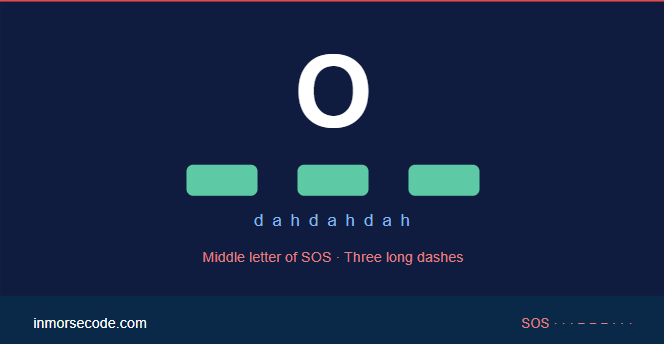
O in Morse code is three dashes. Think of the shape of the letter O itself: it is round and complete, just like three dashes lined up in a row forming a solid, full sound. Say “dah-dah-dah” three times in an even rhythm and that is the letter O. You can also remember it by linking it to SOS: the middle part, three dashes, is the O. It sounds deeper and heavier than the three dots of S on either side.
Real-Life Usage of O
O is one of the five vowels and appears in a massive number of English words. In Morse code, O is particularly well-known as the central letter of SOS, the international distress signal. The signal was chosen in 1908 partly because O’s three dashes are unmistakable and hard to confuse with anything else. In amateur radio, operators frequently exchange O as part of common abbreviations like “OK” and “GO.”
Example Words Using the Letter O
Here are some common words that start with or contain the letter O:
- Over
- Out
- Open
- Ocean
- Operator
- Often
- Old
- Order
- One
- Off
Practising Morse code using real words is much more effective than repeating single letters. Try spelling two or three of these words using what you know so far.
Practice: Sending O in Morse Code
Practice O by making three long, even taps. Count them in your head: one, two, three. Each tap should be about three times as long as a dot tap. Then try alternating S and O: dot dot dot, dash dash dash. That is half of SOS and a great rhythm exercise. Once this feels comfortable, add the final S to complete the full SOS pattern.
You can also use the Morse Code Translator on this site to hear how O sounds at different speeds. Listening to the correct rhythm is just as important as tapping it yourself.
Ready to practise O and other letters together?
Try the Free Morse Code Translator Tool ›
Browse all Morse Code Trainers
Related Letters to Learn Next
Once you are comfortable with O in Morse code, these letters are good next steps because of their related patterns:
Frequently Asked Questions: O in Morse Code
What is O in Morse code?
O in Morse code is three dashes: − − −. Pronounced “dah dah dah”, it is one of the longest vowel characters in the system.
Why does SOS use S and O?
SOS (· · · − − − · · ·) was chosen as the international distress signal because the pattern of three dots, three dashes, three dots is symmetrical, easy to remember, and creates a maximally distinctive acoustic signature. The contrast between S (rapid dots) and O (long dashes) makes SOS impossible to confuse with any normal transmission.
How is O different from M in Morse code?
M is − − (two dashes) and O is − − − (three dashes). At speed, O sounds slightly longer and more sustained. Training the ear to distinguish two-dash from three-dash sounds is a standard intermediate drill.
Conclusion
The letter O in Morse code is – – –, represented visually as − − −. Whether you are a complete beginner or brushing up on forgotten knowledge, learning one letter at a time is the most reliable way to build a solid Morse code foundation. O is a letter you will encounter often as your practice progresses, and knowing it well will serve you across words, names, and real transmissions.
Keep practising a little every day. Even five minutes of tapping rhythms or listening to Morse audio will build your skills faster than you expect. Use the Morse Code Translator to test yourself, explore the full learning guide, and keep going through the rest of the alphabet one letter at a time.