Morse code is nearly two centuries old, and it has outlived nearly every communication technology it was designed alongside; the telegraph, the teletype, and analog radio have all come and gone, while Morse code persists. Understanding how it came to exist, and why it survived, explains a lot about why it’s still taught, tested, and used today.
The Problem Samuel Morse Set Out to Solve
In the 1830s, the fastest way to send a written message across distance was however fast a horse, ship, or train could carry it. Samuel Finley Breese Morse; a portrait painter by training, not an engineer became obsessed with a different idea: what if a message could travel instantly along a wire, using electricity?
Morse wasn’t working alone. His collaborator and business partner, Alfred Lewis Vail, is now understood to have contributed heavily to the practical design of the code itself, the specific dot-dash assignments for each letter are frequently credited to Vail’s refinements rather than Morse’s original scheme. Together, between 1836 and 1844, they built both the physical telegraph system and the coding system needed to use it.
The Core Insight: Frequency-Based Encoding
The genius of the system wasn’t the electric signal; other inventors were experimenting with telegraphy too. It was the encoding scheme layered on top of it. Morse and Vail assigned the shortest codes to the most frequently used letters in English. To figure out letter frequency, they reportedly studied the distribution of type in a printer’s type case, counting how many of each letter a print shop kept on hand more common letters had more physical type pieces, because they were needed more often.
The result: E (the most common letter in English) became a single dot. T became a single dash. Rare letters like Q, X, J, and Z received longer, more complex sequences, because their infrequency meant the extra transmission time barely mattered in practice. This frequency-weighted design is the same core principle used in modern data compression algorithms; assign short codes to common symbols, long codes to rare ones.
American Morse Code vs. International Morse Code
The system Vail and Morse originally built, now called American Morse Code; was not identical to the Morse code taught and used today. It included internal spaces within some letter codes and used two distinct dash lengths, which made it efficient for trained American telegraph operators but difficult to standardize internationally.
In 1865, delegates at the International Telegraph Conference in Paris adopted a cleaner, simplified version: a single consistent dash length, no internal spacing within letters, and standardized timing ratios. This became International Morse Code; the version taught worldwide today, and the standard this site’s tools implement, now maintained by the International Telecommunication Union under Recommendation ITU-R M.1677-1.
The Telegraph Era: Morse Code Becomes Essential Infrastructure
Through the second half of the 19th century and into the 20th, Morse code became the backbone of global communication. Telegraph lines crossed continents; submarine cables crossed oceans. News, business, diplomacy, and personal messages all moved through trained telegraph operators tapping out dots and dashes.
Because telegraph companies charged by message length, an entire secondary industry emerged: commercial codebooks that compressed common business phrases into single five-letter code groups. A phrase like “Are you trying to get out of this?” might be sent as a single coded word, then expanded back into full English by the recipient’s matching codebook, commercial code layered on top of Morse code, in the same way modern data compression layers on top of a transmission protocol.
SOS and the Titanic
Morse code’s most famous real-world moment came on the night of April 15, 1912, when the RMS Titanic struck an iceberg in the North Atlantic. The ship’s wireless operators first sent the older distress call CQD, then began transmitting the newly adopted SOS ; three dots, three dashes, three dots (...---...). The signal was received by the RMS Carpathia, which changed course and rescued 705 survivors.
SOS wasn’t chosen as an abbreviation for any phrase (the popular reading “Save Our Souls” is a folk etymology, not the actual reasoning). It was selected purely because its dot-dash pattern was short, symmetrical, and impossible to confuse with any other letter combination, exactly the qualities you want in a signal that has to be recognized instantly under panic and interference. It had actually been adopted as an international distress standard a few years earlier, at the 1906 International Radiotelegraph Convention, but the Titanic disaster is what cemented it in public memory.
The World Wars: Morse Code as Military Infrastructure
Through both World Wars, Morse code was operationally essential. Military units, naval vessels, and intelligence services depended on trained operators who could send and receive at high speed during World War II, the ability to copy Morse code at 20-25 WPM was a standard, expected military skill, not a specialist one. Codebreaking operations on both sides; including the work at Bletchley Park, depended fundamentally on intercepting and transcribing Morse-encoded radio traffic before any decryption could even begin.
Merchant shipping, journalism, and diplomatic communication ran in parallel on the same infrastructure. Every major news agency employed trained Morse operators well into the 20th century.
Decline in Commercial and Maritime Use
As digital communication technology matured through the late 20th century, Morse code’s role in commercial and naval communication steadily declined. The most symbolic milestone came in 1999, when the Global Maritime Distress and Safety System (GMDSS) officially ended the requirement for ships to carry Morse-code-capable radio equipment and trained operators; a requirement that had stood since shortly after the Titanic disaster.
Why Morse Code Didn’t Disappear
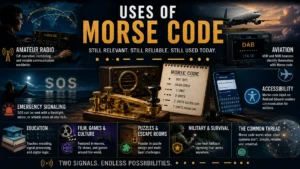
Rather than vanishing, Morse code migrated into the communities where its core strength, reliability in poor conditions; still mattered:
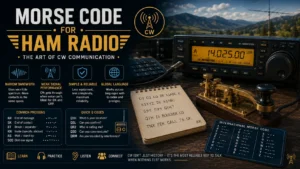
- Amateur radio, where CW (Continuous Wave) transmission remains prized because a single, narrow-bandwidth carrier wave at low power can complete a contact that voice or even some digital modes cannot, especially under weak-signal or high-interference conditions.
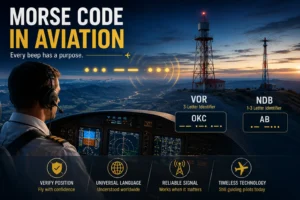
- Aviation, where VOR and NDB navigational beacons still identify themselves in Morse code so pilots can audibly verify they’ve tuned the correct station.
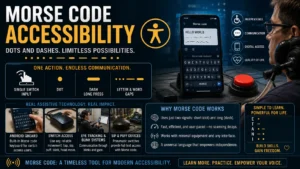
- Accessibility technology, where Morse code’s two-signal structure makes it one of the simplest possible text input methods for people with motor disabilities.
- Emergency signaling, where SOS can still be sent with nothing more than a flashlight, mirror, or whistle when every other communication system has failed.
- Education, where its binary logic remains a compelling entry point for teaching encoding theory and the fundamentals of digital communication.
Learn more about where Morse code is actively used today in our full guide to Morse code uses.
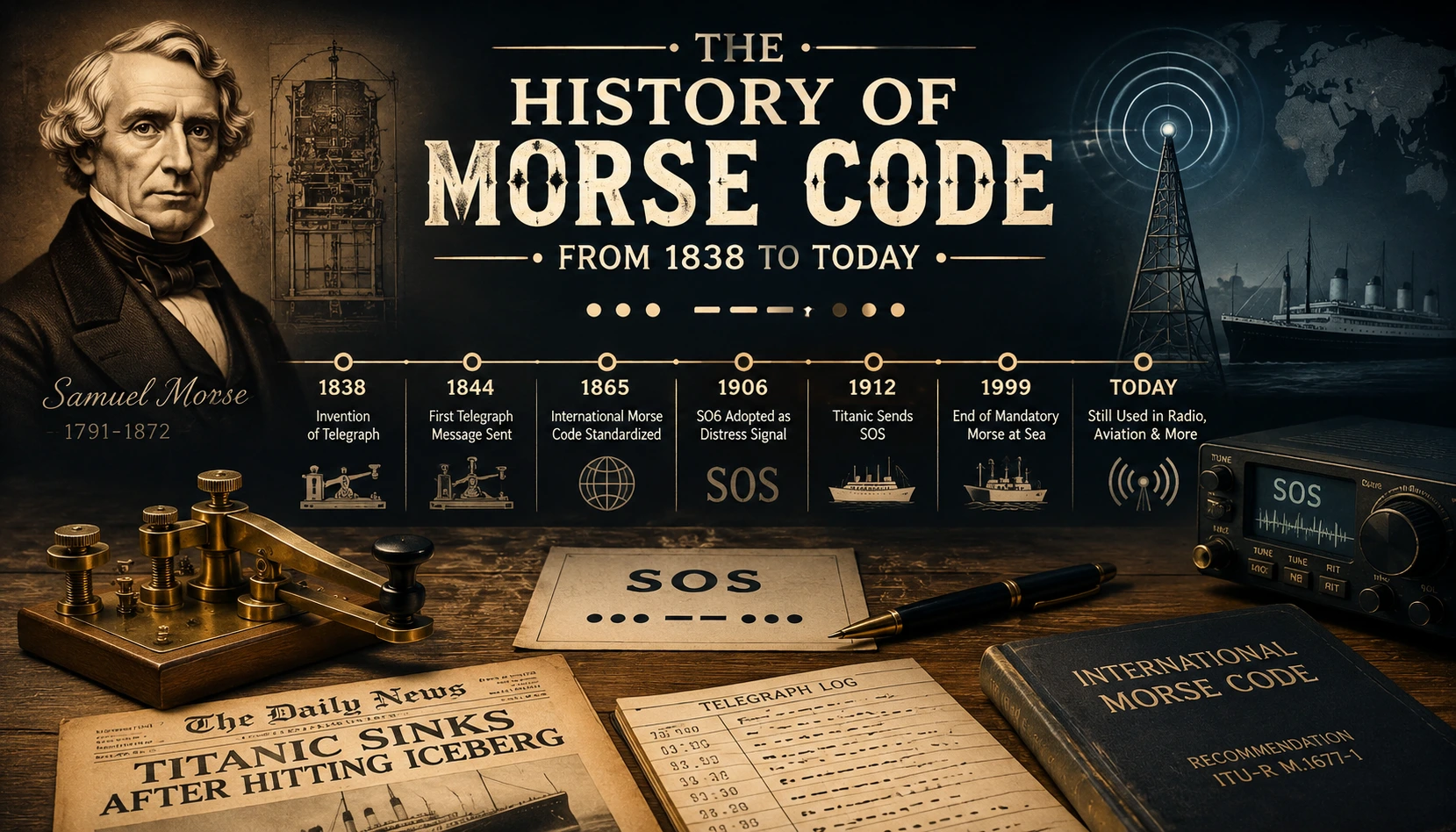
A Timeline at a Glance
| Year | Event |
|---|---|
| 1836-1844 | Samuel Morse and Alfred Vail develop the telegraph and original Morse code |
| 1844 | First public long-distance telegraph message sent (Washington D.C. to Baltimore) |
| 1865 | International Telegraph Conference in Paris standardizes International Morse Code |
| 1906 | SOS adopted as international radio distress signal |
| 1912 | RMS Titanic disaster — SOS enters widespread public consciousness |
| 1914-1945 | Morse code is essential military and diplomatic infrastructure through both World Wars |
| 1999 | GMDSS ends mandatory Morse code requirements for maritime vessels |
| Today | Morse code remains active in amateur radio, aviation, accessibility tech, and education |
Frequently Asked Questions
Who actually invented Morse code; Morse or Vail?
Both contributed. Samuel Morse conceived the electric telegraph project and secured funding and recognition; Alfred Vail is widely credited with refining the practical dot-dash letter assignments used in the original code. History has attached Morse’s name to the system, but it was a genuine collaboration.
Why does SOS mean “distress” if it doesn’t stand for anything?
SOS was chosen for its distinctive, symmetrical, hard-to-misread pattern, not as an acronym. “Save Our Souls” and “Save Our Ship” are popular backronyms that came after the fact.
Is Morse code still required for a ham radio license?
No. Morse code proficiency requirements were removed from amateur radio licensing in most countries, including the United States, in the mid-2000s. It remains popular by choice among operators, not by requirement.
What’s the difference between American and International Morse Code?
American Morse Code (the original Vail/Morse system) used two dash lengths and internal letter spacing. International Morse Code, standardized in 1865, simplified this to one dash length with no internal spacing; this is the version used worldwide today.
Hear History for Yourself
Type “SOS” into our Morse Code Translator and listen to the exact pattern the Titanic’s wireless operators sent in 1912, still instantly recognizable, more than a century later.