Nearly every self-taught Morse code learner hits the same wall: they can decode messages comfortably at 5-10 WPM, but the moment they try to push past 13 WPM, everything falls apart. This isn’t a coincidence, and it isn’t a lack of aptitude it’s the predictable result of learning with the wrong timing method. Farnsworth timing was specifically developed to fix this, and it’s now the standard recommended approach among CW instructors, the ARRL, and structured programs like CW Academy.
The Problem: Why Slow, Uniform Timing Creates a Speed Ceiling
The most intuitive way to learn Morse code seems obvious: start slow, and speed up gradually. So a beginner might start at 5 WPM, with every dot, dash, and gap stretched proportionally slower a dash still exactly three times a dot, gaps still following standard ratios, just everything uniformly stretched.
The problem is what this uniform slowness allows your brain to do: count. At 5 WPM, a dash lasts around 720 milliseconds long enough to consciously count “one-two-three” and mentally tally up dots and dashes into a letter, rather than actually recognizing the letter’s sound as a single unified pattern.
This counting strategy works right up until it doesn’t. Conscious counting has a hard physical ceiling, typically somewhere around 10-13 WPM, where the individual elements become too fast to count in real time. Learners who trained with slow uniform timing often hit this wall and plateau there for months or years, because the entire method they learned with stops functioning at exactly the speed where real conversational CW begins.
The Solution: Separate Character Speed From Overall Speed
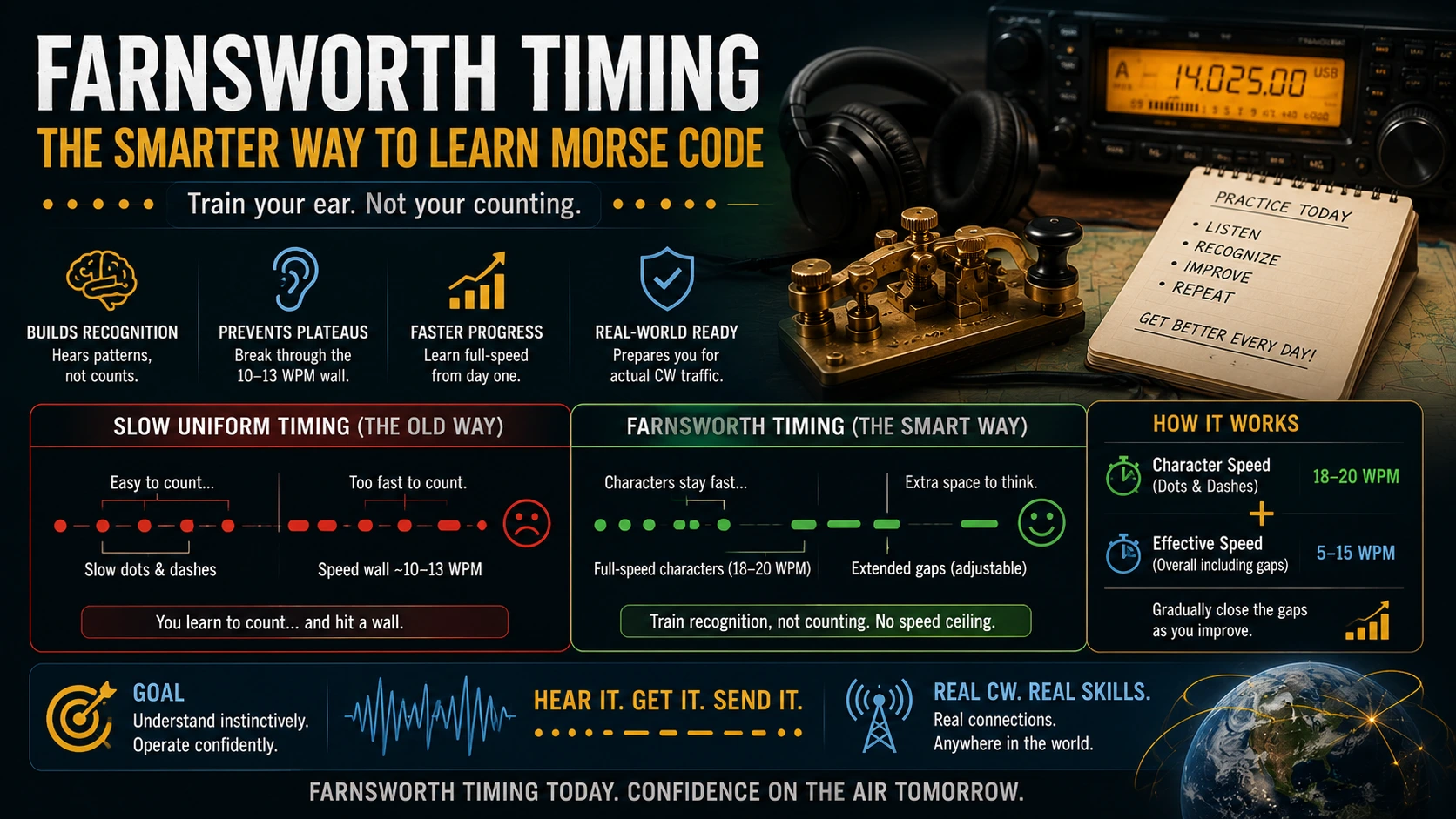
Farnsworth timing, developed by Peter Farnsworth in the 1950s, solves this with a deceptively simple change: send individual characters at a full, normal target speed around 18-20 WPM while stretching only the gaps between characters and words.
This means a learner hears each dot and dash at the same speed an experienced 20 WPM operator would send them never slow enough to count while still having generous thinking time between letters to process what they just heard. As the learner improves, the gaps are gradually shortened, until eventually the spacing matches true 20 WPM timing throughout.
| Timing Element | Slow Uniform Method | Farnsworth Method |
|---|---|---|
| Character speed (dots/dashes) | Matches overall WPM (slow) | Fixed at 18-20 WPM (fast) throughout |
| Gap between letters | Matches overall WPM (slow) | Extended, shrinks over time |
| Gap between words | Matches overall WPM (slow) | Extended, shrinks over time |
| Risk of learned counting habit | High | Low |
| Typical speed ceiling for self-taught learners | ~10-13 WPM | Not structurally limited |
Why This Works: Training Recognition, Not Counting
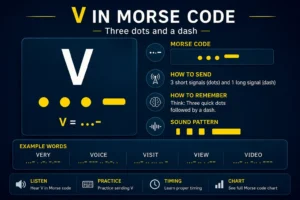
The entire goal of learning Morse code by ear is to reach a point where hearing “dit-dit-dit-dah” doesn’t require any conscious analysis it’s just instantly recognized as “V,” the same way a fluent English reader doesn’t sound out each letter of a familiar word. Farnsworth timing enforces this from day one, because the characters are simply too fast to count. The only viable strategy is genuine pattern recognition, built gradually as the extended gaps shrink and the learner’s recognition speed catches up.
This is why virtually every serious CW training program — CW Academy, Long Island CW Club, and the ARRL’s own recommended learning materials teaches Farnsworth timing rather than uniform slow speed, despite uniform slow speed feeling more intuitive to complete beginners.
How to Actually Practice With Farnsworth Timing
1. Choose a character speed and stick with it. 18-20 WPM character speed is the most commonly recommended starting point fast enough to prevent counting, not so fast that the individual letters become genuinely hard to distinguish while you’re still learning them.
2. Start with a slow effective speed. Your effective speed (accounting for the stretched gaps) might start around 5-8 WPM even though character speed is 18-20 WPM this is expected and correct.
3. Practice daily in short sessions. 15-20 minutes of focused daily practice consistently outperforms longer, less frequent sessions for this kind of pattern-recognition learning.
4. Gradually reduce the gap length. As you correctly recognize characters with less hesitation, shorten the gaps most structured courses do this incrementally, often without the learner needing to manually adjust anything.
5. Resist the urge to slow character speed down when struggling. This is the single most common mistake when a learner struggles, the intuitive fix is to slow everything down, which reintroduces the counting trap you’re trying to avoid. The correct fix is usually to extend the gaps further (giving more thinking time) while keeping character speed fixed.
Choosing Your Numbers: Character Speed vs. Effective Speed
Most Farnsworth-based training tools let you set two independent numbers:
- Character speed how fast individual dots and dashes are sent (commonly fixed at 18-20 WPM)
- Effective speed (sometimes called overall or Farnsworth speed) the practical speed accounting for extended gaps, which is what you gradually increase as you improve
A common beginner starting point is 20 WPM character speed with a 5 WPM effective speed meaning individual letters sound fast and clean, but you get generous pauses to process them. As proficiency builds, the effective speed climbs toward the character speed until eventually they match.
Farnsworth vs. Koch Method: How They Relate
Farnsworth timing is often used alongside the Koch method, a related but distinct approach that focuses on introducing new characters one at a time starting with just two letters sent at full speed, adding a new character only once the existing set is recognized reliably, and gradually building up to the full alphabet. The two methods solve different problems: Koch structures what you learn and when; Farnsworth structures how each character sounds while you’re learning it. Many structured courses, including CW Academy, combine both.
Frequently Asked Questions
What character speed should beginners start with?
18-20 WPM is the most commonly recommended starting character speed, even for complete beginners the extended gaps at low effective speed make this manageable despite the fast individual characters.
Is Farnsworth timing used in real-world CW radio traffic?
No real operators send at consistent, matched speeds without Farnsworth-style gap stretching. Farnsworth timing is specifically a training method, not an operating standard; it’s designed to build the recognition skill needed for real full-speed CW.
How long does it take to move from Farnsworth practice to real-speed CW?
This varies significantly by individual and practice consistency, but many learners following a structured Farnsworth-based course report reaching comfortable 13-15 WPM conversational ability within several months of consistent daily practice.
Can I switch to Farnsworth timing if I already learned with slow uniform timing?
Yes, and many self-taught learners who plateaued do exactly this it may require some deliberate retraining to break the counting habit, but Farnsworth timing remains an effective fix even for learners who started with the slower method.
Practice With Correct Farnsworth Timing
Our CW Generator lets you set independent character and effective speeds, so you can practice with genuine Farnsworth timing rather than the slow uniform method that creates a speed ceiling.