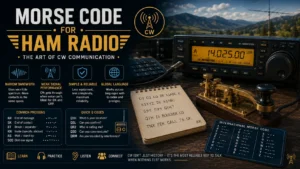
Ask amateur radio operators why they still use Morse code commonly called CW, short for Continuous Wave decades after it stopped being a licensing requirement, and you’ll hear a consistent answer: it works when nothing else does. CW remains one of the most active and respected operating modes in amateur radio, not because it’s required, but because it offers real, practical advantages that voice and even many digital modes can’t match.
What “CW” Actually Means
CW stands for Continuous Wave a reference to the unmodulated radio carrier wave that’s simply switched on and off to form dots and dashes. This is technically distinct from voice transmission (which modulates a carrier with audio) or digital modes (which encode data through frequency or phase shifts). CW’s simplicity is exactly its strength.
Why CW Still Matters: The Technical Advantages
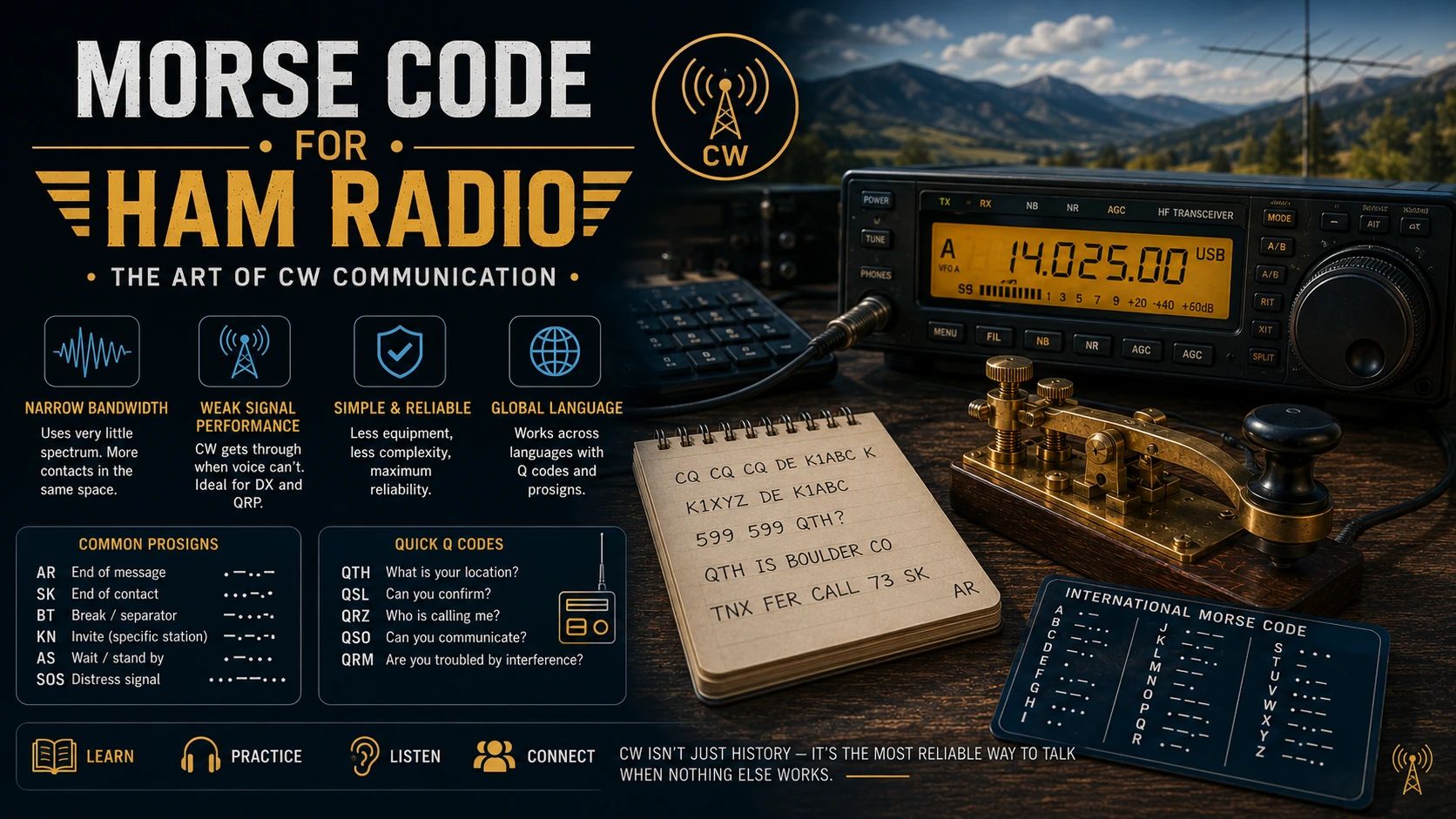
Narrow bandwidth. A CW signal occupies a tiny fraction of the bandwidth a voice signal requires often less than 150 Hz compared to several kHz for SSB voice. This lets far more CW stations fit into the same amount of radio spectrum, and concentrates transmitted power into a much narrower, stronger signal.
Superior weak-signal performance. Because CW concentrates all transmitted power into a narrow bandwidth, a CW signal can often be copied through noise and interference that would make a voice signal completely unreadable. This is why CW remains the mode of choice for extreme long-distance (“DX”) contacts and low-power (“QRP”) operating, where every watt of signal has to count.
Simple, reliable equipment. CW transmitters and receivers can be built with far simpler circuitry than voice or digital equipment, a meaningful advantage for emergency communication, portable operation, and homebrew radio building.
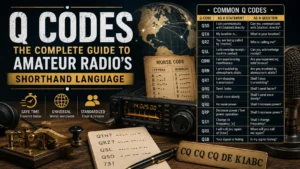
No language barrier. A CW contact between operators who share no spoken language works perfectly using standardized Q codes and abbreviations. See our Q Codes guide for the shorthand vocabulary that makes this possible.
Do You Need Morse Code for a Ham Radio License?
No; not anymore. Morse code proficiency requirements were removed from amateur radio licensing in the United States in 2007, and most other countries followed similar timelines in the mid-2000s. Every license class today can be earned through written exams alone. Operators who use CW today do so entirely by choice, which is itself telling: CW’s popularity has remained strong even without any licensing requirement forcing new operators to learn it.
Structure of a Basic CW Contact
Real CW contacts follow conventional patterns built around Q codes and prosigns:
CQ CQ CQ DE [your callsign] K— general call inviting any station to respond[your callsign] DE [their callsign] K— a station responds[their callsign] DE [your callsign] GE TNX FER CALL UR RST 599 QTH IS [location] BT NAME IS [name] BT HW? AR— greeting, thanks, signal report, location, name, invite reply[your callsign] DE [their callsign] R FB TNX QSO 73 SK— acknowledgment, compliment, thanks, farewell, end of contact
Even without prior exposure, you can probably follow the shape of this exchange: greeting, signal report, basic information exchange, farewell — the same structure any conversation follows, just compressed into standardized shorthand.
RST is a signal report format (Readability, Strength, Tone) — “599” means perfectly readable, maximum strength, perfect tone, the standard “everything’s great” report in casual contacts. 73 is CW shorthand for “best regards,” conventionally used as a sign-off.
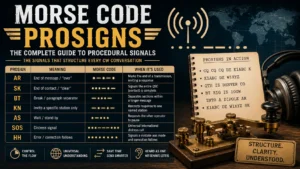
For the full prosign vocabulary (AR, SK, BT, KN) used throughout contacts like this, see our Morse Code Prosigns guide.
Learning CW: A Realistic Path
1. Learn the character set by sound, not sight. Visual memorization of dots and dashes doesn’t transfer well to real listening. From day one, train with audio.
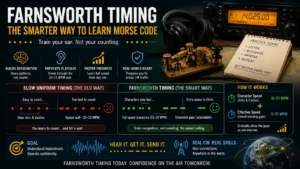
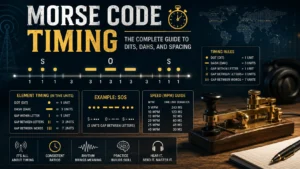
2. Use Farnsworth timing from the start. Send characters at a natural full speed while keeping extended gaps between them; this avoids the common trap of learning to count dots and dashes instead of recognizing their sound pattern, a habit that caps your speed permanently around 10-13 WPM. Full explanation in our Farnsworth Timing Guide.
3. Learn Q codes and prosigns alongside characters. Real CW traffic uses this shorthand constantly; waiting to learn it until after you know the alphabet just delays being able to follow an actual contact.
4. Practice copying before practicing sending. Most experienced CW operators recommend building solid receiving skill first; sending well is much easier once your ear already recognizes the target sound.
5. Join a structured program. Organized courses; like CW Academy, run by CWops, pair new learners with experienced mentors through a graduated curriculum, and consistently outperform self-study alone for reaching conversational CW speed.
Try our CW Academy Trainer for structured, lesson-based practice, or the CW Generator to create custom practice transmissions at your own target speed.
Common Operating Speeds
| Skill Level | Typical Speed |
|---|---|
| Beginner (learning characters) | 5-10 WPM |
| Conversational | 13-20 WPM |
| Experienced contest/DX operator | 25-35 WPM |
| Advanced/expert | 35+ WPM |
Most amateur operators find 20-25 WPM comfortable for casual conversational CW; enough for a smooth exchange without excessive speed pressure.
CW Contesting and Awards
Beyond casual contacts, CW is central to amateur radio contesting; timed competitive events where operators attempt to make as many valid contacts as possible, often across as many different countries or grid squares as they can reach. Major CW contests (like the ARRL DX Contest and CQ World Wide DX Contest) draw thousands of participants worldwide and are a significant driver of continued CW popularity, since contest scoring often rewards CW’s efficiency and weak-signal performance directly.
Award programs like DXCC (Worked All Countries) and WAS (Worked All States) are commonly pursued specifically via CW, since its propagation advantages make marginal, hard-to-reach contacts achievable that voice modes might miss entirely.
Frequently Asked Questions
Is CW harder to learn than voice operation?
It requires more upfront investment, learning an entirely new “language” of sound patterns; but many operators find that once learned, CW is less mentally taxing to operate than voice, since exchanges are highly standardized and predictable.
What speed do I need to reach to have a real conversation on CW?
Most casual ragchewing (extended conversation) happens comfortably starting around 15-18 WPM, though basic contest-style exchanges can be managed successfully at slower speeds like 10-13 WPM.
Do I need special equipment to operate CW?
Any HF transceiver capable of CW mode works, most modern radios include it standard. You’ll also want a code key (straight key, paddle with electronic keyer, or a keyboard-based interface) for sending.
Is CW popularity declining or growing?
Despite predictions of decline once licensing requirements were dropped, CW has remained one of the most consistently popular operating modes in amateur radio, with dedicated clubs and structured learning programs continuing to attract new operators.
Start Building Your CW Skills
Explore our Q Codes and Prosigns guides to learn the real shorthand vocabulary of CW conversation, or head straight to the Morse Code Translator to start training your ear.