Every conversation needs structure; a way to signal “I’m about to start,” “I’m done, your turn,” and “we’re finished here.” In spoken conversation, tone of voice and pauses handle this automatically. In Morse code, that structure comes from prosigns: special procedural signals sent as single, continuous characters that tell the receiving operator exactly what’s happening in the flow of a transmission.
If you’ve spent any time around real CW (Continuous Wave) traffic, you’ve heard prosigns even if you didn’t recognize them by name; they’re the signals that make a Morse exchange feel like an organized conversation instead of an uninterrupted stream of letters.
What Makes a Prosign Different From a Letter
The defining feature of a prosign is how it’s timed. Normal letters are sent with a standard gap (3 time units) between them. A prosign, by contrast, combines two or more letters into a single blended unit with no gap between the component letters; it’s transmitted and heard as one distinct character, not as separate letters in sequence.
This is why prosigns are conventionally written with an overline (like S̄K̄) or as two letters run together without a space in documentation, it signals that the letters are meant to be sent as one fused unit, not two separate characters with a normal pause between them.
The Essential Prosigns Table
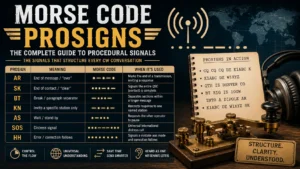
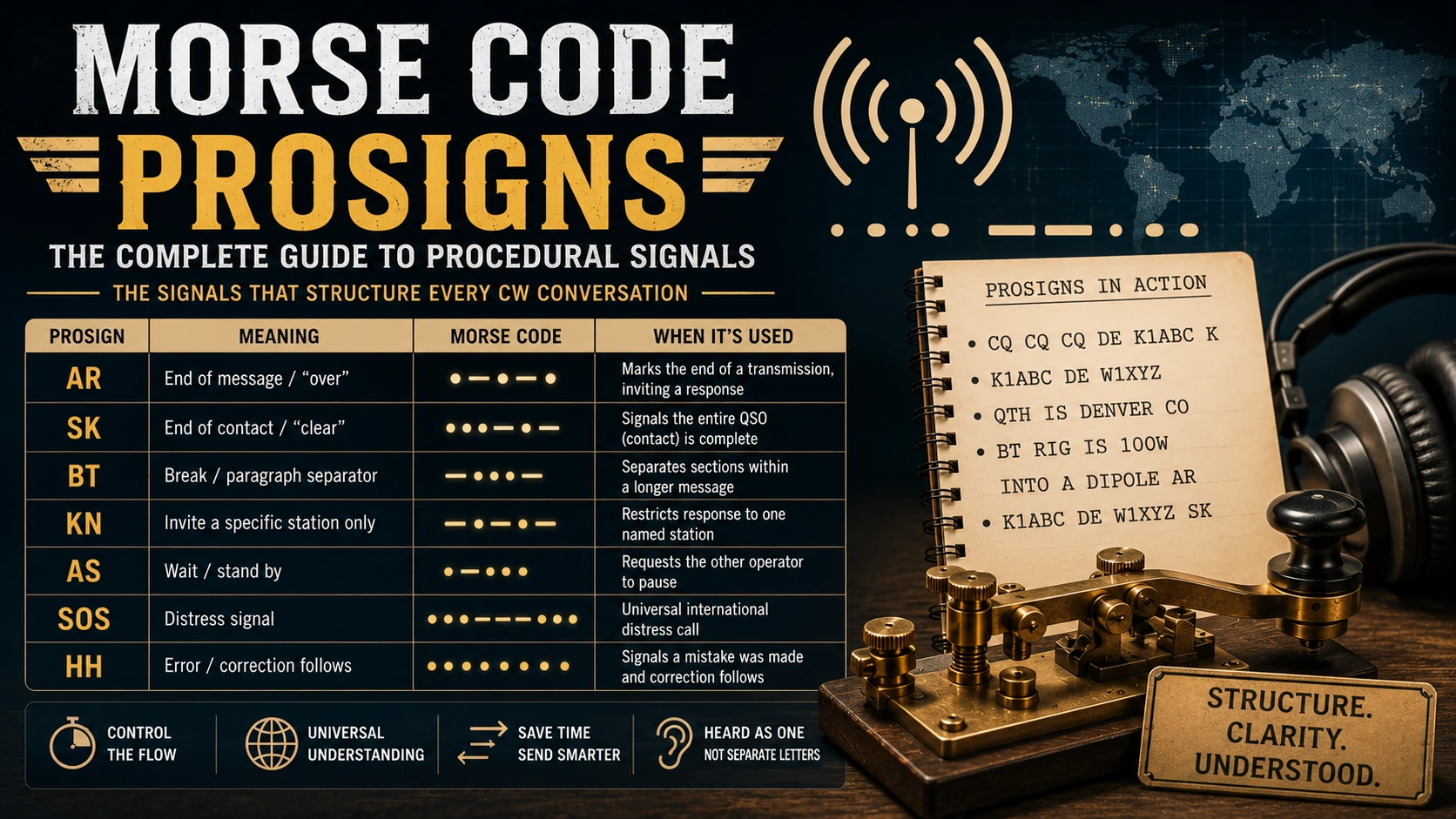
| Prosign | Meaning | Morse Code | When It’s Used |
|---|---|---|---|
| AR | End of message / “over” | .-.-. | Marks the end of a transmission, inviting a response |
| SK | End of contact / “clear” | …-.- | Signals the entire QSO (contact) is complete |
| BT | Break / paragraph separator | -…- | Separates sections within a longer message |
| KN | Invite a specific station only | -.-.- | Restricts response to one named station, excluding others |
| AS | Wait / stand by | .-… | Requests the other operator to pause |
| SOS | Distress signal | …—… | Universal international distress call |
| HH | Error / correction follows | …….. | Signals a mistake was made and correction follows |
AR — End of Message
AR marks the natural end of a transmitted message or turn, similar to saying “over” in voice radio procedure. It signals: I’ve finished what I meant to say, and I’m ready for a response. You’ll typically see it at the end of a formatted message, right before the operator’s callsign sign-off.
SK — End of Contact
SK is different from AR in an important way: while AR ends a single transmission (expecting a reply), SK ends the entire contact. When an operator sends SK, they’re signaling the conversation itself is over, no further reply is expected, and both stations are free to end the exchange or move to a new contact.
Mixing these up is a common beginner mistake: sending SK when you mean “your turn” can confuse the other operator into thinking the conversation has ended when you actually wanted a response.
BT — Break / Paragraph Separator
BT functions like a paragraph break in written text, a way to signal a shift between distinct sections of a longer message without ending the transmission entirely. It’s especially common in formal message traffic, where a message might have a preamble, body, and signature, each separated by BT.
KN — Invite a Specific Station
KN is a more restrictive version of “over.” While a plain AR simply signals the end of a transmission and invites any response, KN specifically invites only a named station to reply, useful in a busy frequency or net (organized group contact) where multiple stations might otherwise try to respond at once.
AS — Wait / Stand By
AS signals a brief pause is needed; the operator isn’t ending their transmission, just asking the other party to hold on. In practice this might mean they need to look something up, deal with an interruption, or reposition equipment before continuing.
SOS — The Distress Prosign
SOS deserves special mention because it’s simultaneously the most famous prosign and functionally different from all the others: it’s not a procedural signal about the flow of a conversation, but a fixed, universally recognized emergency call. Its structure; three dots, three dashes, three dots (...---...) — was deliberately chosen for how distinct and unmistakable it sounds under noisy conditions, not as an abbreviation of any phrase. Learn more about its origin in our history of Morse code.
HH — Error Signal
When an operator realizes they’ve made a sending error mid-transmission, HH (eight dots, sent as one blended unit) signals “disregard what I just sent, a correction follows.” It’s the CW equivalent of saying “sorry, let me restart that” out loud.
Prosigns vs. Q Codes: Don’t Confuse Them
It’s common for beginners to lump prosigns and Q codes together since both are compact, standardized shorthand used in CW operation, but they solve different problems:
- Prosigns control the structure and flow of a transmission (start, pause, end, error) and are sent as single fused characters.
- Q codes replace entire sentences of meaning (location, interference, confirmation) and are sent as three normally-spaced letters.
For the full breakdown of Q codes like QTH, QRZ, and QSL, see our dedicated Q Codes guide.
A Sample Exchange Using Prosigns
[callsign A] DE [callsign B] K(invitation to transmit, general)QTH IS DENVER CO BT RIG IS 100W INTO A DIPOLE AR(location, break, equipment details, end of message)[callsign A] DE [callsign B] SK(contact complete)
Notice how BT lets the operator cleanly separate two distinct pieces of information within a single transmission, and AR signals they’re done and awaiting reply while SK, sent later, closes out the entire contact.
Why Prosigns Matter Even If You Never Use a Radio
Even outside amateur radio, prosigns show up anywhere Morse code is used for structured communication military signaling, maritime distress procedure, and even puzzle design and escape rooms that want to reproduce authentic CW conventions. Recognizing SK, AR, and BT is part of reading Morse code accurately, not just an operator-specific skill.
Frequently Asked Questions
How do you type a prosign correctly?
Because prosigns are sent as single fused characters, when typing them into a Morse translator you generally combine the letters without an internal space (e.g., “AR” typed as a combined signal, not “A” then “R” separately), check your specific tool’s input conventions, since not all translators format prosigns identically.
What’s the difference between AR and SK?
AR ends a single transmission and invites a reply (“over”). SK ends the entire contact and signals no further reply is expected (“out”). Confusing the two is one of the most common beginner mistakes in CW procedure.
Is SOS a prosign or a Q code?
SOS is a prosign, it’s sent as a single fused unit but unlike procedural prosigns (AR, SK, BT), it isn’t about conversation flow. It’s a fixed emergency signal with one specific meaning: distress.
Do I need to memorize all prosigns to operate CW?
No. A working set of five or six; AR, SK, BT, KN, AS, and SOS covers the overwhelming majority of real-world amateur radio CW traffic.
Hear Prosigns for Yourself
Try our Morse Code Translator to hear how SOS, AR, and SK actually sound in real CW timing the fused, gapless rhythm is very different from ordinary letter-by-letter Morse code.