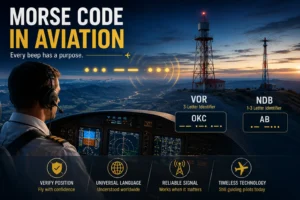
It’s a detail most people outside aviation never learn: every time an aircraft navigates using a ground-based radio beacon, there’s a real chance a Morse code signal is involved not sent by the pilot, but broadcast automatically by the beacon itself, so the pilot can confirm they’ve tuned the right one before trusting it.
The Core Problem Morse Identifiers Solve
Radio navigation beacons VOR (VHF Omnidirectional Range) and NDB (Non-Directional Beacon) stations transmit on specific frequencies that a pilot dials into their aircraft’s navigation receiver. But frequencies alone aren’t enough of a safety check: a pilot could mistype a frequency, a chart could be outdated, or a nearby station could interfere. Before trusting a navigation beacon to guide a flight especially in poor visibility, where the pilot may be relying entirely on instruments there needs to be a reliable way to confirm: is this actually the station I think it is?
The answer, built into aviation infrastructure since the early 20th century and still standard today, is a continuous, automatically repeating Morse code identifier broadcast by the station itself.
How VOR and NDB Identifiers Work
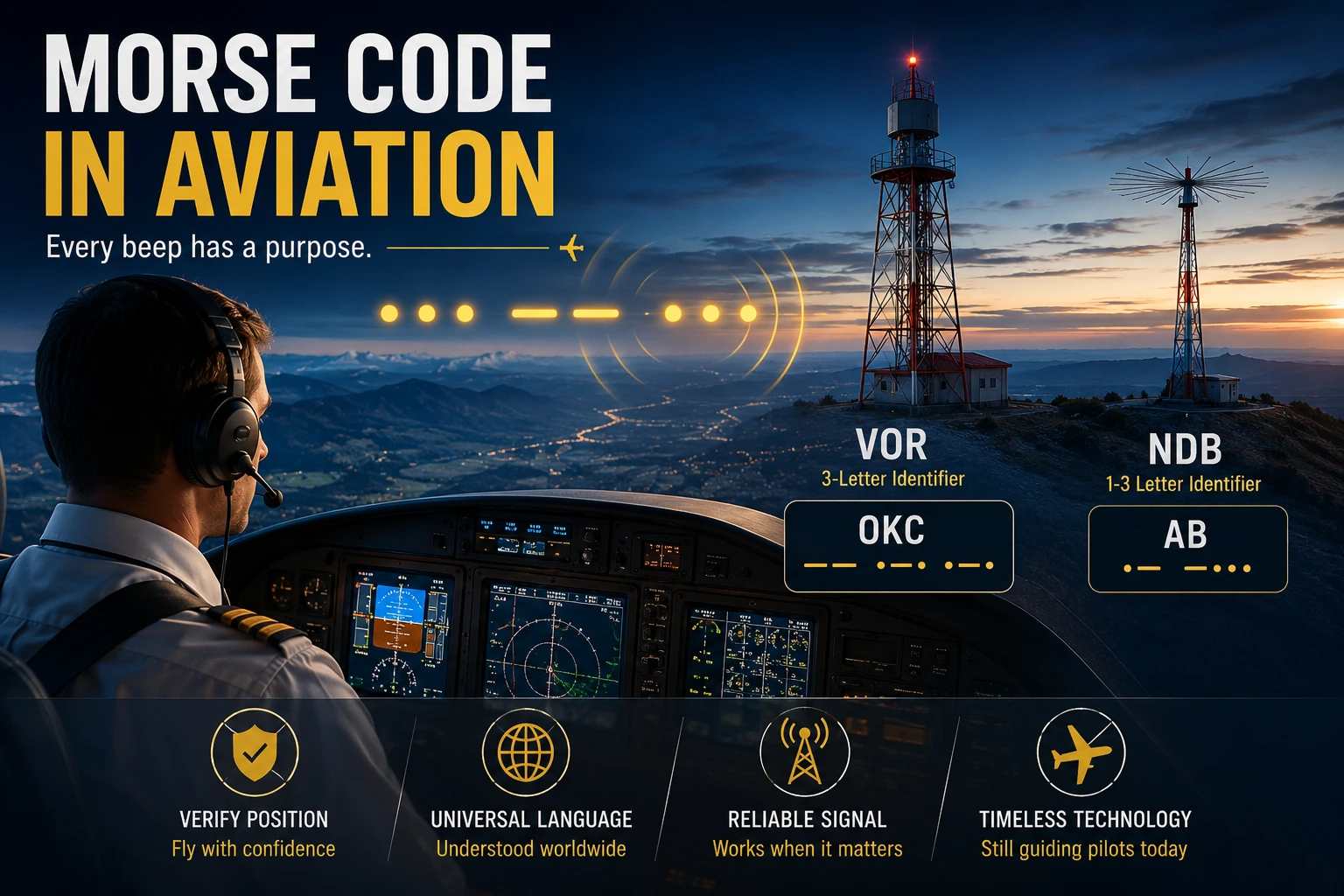
Every VOR and NDB station is assigned a short two- or three-letter identifier, unique within its region, and the station continuously transmits that identifier in Morse code typically repeating every few seconds, layered on top of (or alongside) the navigation signal itself.
A pilot tuning a VOR station listens for this identifier before relying on the navigation data. If the Morse identifier matches what’s printed on the chart for that frequency and location, the pilot has confirmed they’re receiving the correct station. If it doesn’t match wrong identifier, garbled signal, or no identifier at all standard procedure is to disregard the navigation indication, since something is wrong with the station, the tuning, or the equipment.
Example: A VOR station identified as “OKC” (Oklahoma City) would continuously transmit --- -.- -.-. in Morse code — dash-dash-dot, dash-dot, dash-dot-dash-dot — regardless of what voice communication, if any, is also present on the frequency.
Why Morse Code Specifically, Not Voice
It might seem outdated to use Morse code identifiers when voice or digital text could convey the same three letters. But the choice is deliberate and remains functionally justified:
Reliability under poor signal conditions. A Morse identifier a simple on/off tone degrades much more gracefully under weak signal or interference than a spoken voice identifier would. A pilot can often still make out a Morse identifier’s pattern in conditions where spoken audio would be unintelligible.
No language dependency. Aviation is international. A pilot flying in a country where they don’t speak the local language can still reliably identify a Morse code beacon identifier, since the character-to-code mapping is a universal standard, unlike spoken pronunciation.
Minimal bandwidth and equipment. Transmitting a Morse identifier requires far less complexity than encoding and transmitting clear spoken audio, keeping ground station equipment simpler and more reliable a meaningful advantage for beacons in remote locations that need to operate unattended for years.
Legacy infrastructure continuity. Aviation navigation systems are updated conservatively, given the safety stakes a system that has reliably worked for the better part of a century isn’t replaced without strong justification, and Morse identification has simply never presented a compelling reason to change.
What Pilots Actually Need to Know
Instrument-rated pilots aren’t expected to fluently read arbitrary Morse code messages the skill required is much narrower: recognizing the specific, short, memorized identifier for the stations relevant to a given flight, similar to recognizing a familiar face rather than reading unfamiliar text. Pilots learn to associate the sound pattern directly with the station identifier, often without consciously “decoding” dots and dashes letter by letter at all the same kind of fluent pattern recognition experienced CW radio operators develop.
Aeronautical charts print both the station’s identifier letters and, in many cases, the corresponding Morse pattern directly next to the frequency, so pilots have a visual reference to confirm against what they hear.
Where You’ll Encounter Aviation Morse Code
| System | Purpose | Identifier Format |
|---|---|---|
| VOR (VHF Omnidirectional Range) | En-route and approach navigation | 3-letter Morse identifier |
| NDB (Non-Directional Beacon) | Older-generation navigation, still active in many regions | 1-3 letter Morse identifier |
| DME (Distance Measuring Equipment) | Often paired with VOR, shares the same identifier | Shares VOR’s identifier |
| ILS (Instrument Landing System) | Precision approach guidance | 3-letter Morse identifier, often prefixed “I” |
Is This System Being Phased Out?
Satellite-based navigation (GPS and GNSS) has substantially reduced reliance on ground-based VOR and NDB navigation for primary guidance, and some countries have begun decommissioning portions of their older NDB networks specifically. But VOR stations remain a required backup navigation system in most airspace aviation regulators have deliberately preserved ground-based radio navigation as a resilient fallback in case satellite navigation is unavailable, jammed, or compromised. As long as VOR infrastructure exists in that backup role, Morse code identification remains part of active aviation safety procedure, not a historical footnote.
Frequently Asked Questions
Do pilots need to know the full Morse code alphabet?
No; the practical skill is recognizing specific, memorized station identifiers by sound pattern, not general Morse code fluency. Most pilots never learn to read arbitrary Morse text.
What happens if a VOR station’s Morse identifier doesn’t match the chart?
Standard procedure is to disregard the navigation indication from that station, since a mismatched or missing identifier suggests a problem with the station, the pilot’s tuning, or equipment malfunction and using an unverified station for navigation could be unsafe.
Are Morse code identifiers still used with modern GPS-based navigation?
GPS and satellite navigation don’t use Morse identifiers this system is specific to ground-based radio beacons (VOR, NDB, ILS). But since regulators require these systems to remain as a backup to satellite navigation, Morse identification remains active infrastructure.
How fast are aviation Morse code identifiers sent?
They’re typically sent slowly and clearly often around 7-10 WPM specifically to remain easily recognizable even under weak-signal conditions, rather than optimized for speed.
Hear an Aviation-Style Identifier
Try typing a three-letter airport or station code into our Morse Code Translator to hear how an identifier like this actually sounds in the cockpit.