When you translated a message and put it to a chat, your friend felt it was ridiculous. The formatting was incorrect most of the time, but the code was correct. A simple message could become unreadable if a phone silently replaces dashes, a crooked slash, or a blank space with complicated symbols.
This tutorial explains the proper way to write Morse code. The space guidelines, the purpose of the slash, the most common formatting errors, and how to proofread your work before sending it will all be covered. To test each example as you go, keep our free Morse code translator open in a separate tab.
The Brief Response
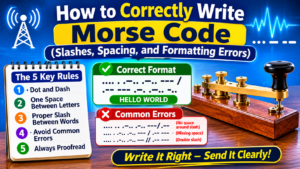
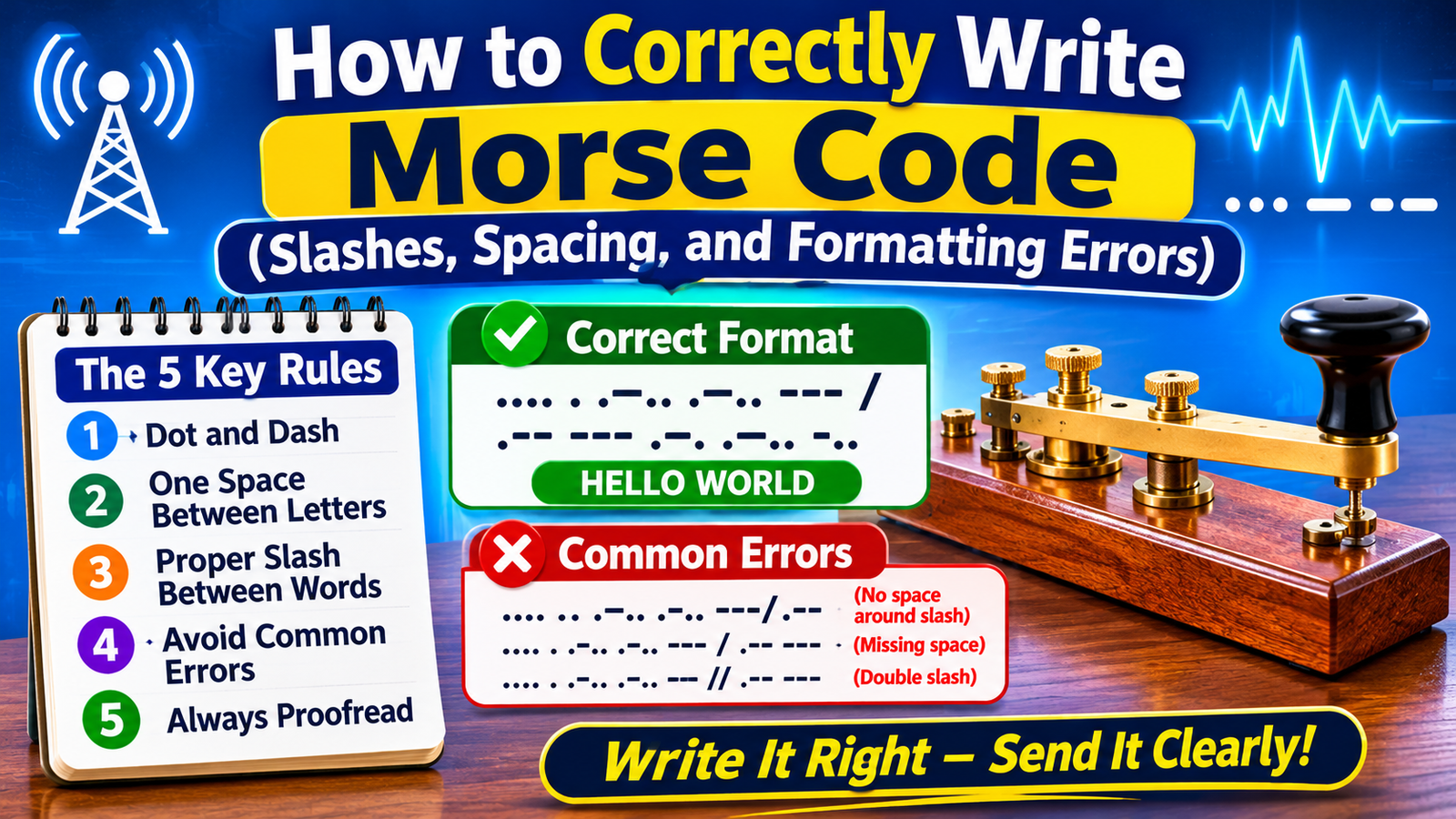
When writing Morse code on a screen, there are five basic rules to follow.
- Type a hyphen for each dash and a period for each dot.
- Write each letter in a cohesive, complete, and gap-free group.
- Letters should be separated by one space.
- Put a slash with a space on either side in between words.
- Before sending a message, decode it once.
Here is a complete example for the words HELLO WORLD.
…. . .-.. .-.. — / .– — .-. .-.. -..
Five letters, a slash and five more letters. That is the whole system. The remainder of this article outlines the rationale behind each rule as well as the consequences of breaking them.
The Two Symbols You Require
There are just two symbols used in written Morse code.
- Typed as a period, a dot is a brief signal.
- Typed as a single hyphen, a dash is a lengthy signal.
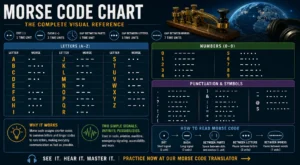
That’s all. There is no distinction between capital and tiny characters, no special mark for a stop, and no third symbol for a long dash. The letter A is .- whether you meant A or a. You can see every pattern in our Morse code chart.
One hyphen is precisely one dash. The letter is altered if you type two hyphens, which is equivalent to writing two dashes. This sounds obvious, but it is one of the most common causes of broken messages, and we will come back to it below.
The Three Spacing Rules Explained
Silence serves as the gap while sending Morse code by light or sound.Silence must be displayed on a screen using a divider and spaces. The mapping is simple.
| Where the gap is | How long it lasts when sent | How to write it |
| Between signals inside one letter | 1 unit | Nothing at all, no space |
| Between two letters | 3 units | One space |
| Between two words | 7 units | Space, slash, space |
A unit is the length of one dot. A dash lasts three units. If you want the full picture of how this works in real transmissions, read our guide to Morse code timing.
Why letter spaces matter so much
Morse code is not limited in length. The gap is the only way to determine where one letter finishes and the next begins because some letters are one signal long while others are four. When the gap is removed, the message becomes unclear.
When the letters A and N are written correctly, they appear like this.
.- -.
Now remove the space and you get this.
.–.
The letter P is that. The signals’ spacing is the sole thing that separates them. Because of this, every careful writer of Morse code views the gaps between letters as an essential component of the code rather than an ornamental feature.
Why the Slash Exists
Writers needed a mark to represent the extended break between words because silence cannot be depicted on paper. Due to its ease of typing and quick recognition, the slash has become the most popular option. The majority of translators, including ours, interpret a word break as a slash with a space on each side.
Two details are worth knowing.
To begin with, the slash is merely a writing convention. In a real transmission nobody sends a slash. The word gap is simply seven units of silence. The slash is how we draw that silence on a screen.
Second, the actual slash character, -..-., has a unique pattern in Morse code. When you really need to send a slash inside a message, such as in a date or web address, you employ that pattern. Don’t confuse the two. The word separator is a space, while the slash character is a symbol with its own pattern.
Other ways people separate words
The slash is the most common choice, but you will see other styles.
| Style | Example for I AM | Where you meet it |
| Slash with spaces | .. / .- — | Most online translators and tutorials |
| Three spaces | .. .- — | Some tools and printed charts |
| Vertical bar | .. | .- — | Programming examples and some apps |
| One word per line | .. then .- — on the next line | Handwritten practice and puzzles |
Choose one and stick with it throughout the entire speech, although any of these can work. Combining different styles is a mistake in and of itself.
A Comprehensive Guide to Composing a Message
To begin, let’s write “SEE YOU SOON.”
- When crafting the message, use capital letters. In Morse code, case is irrelevant, however using capital letters makes it simpler to verify each letter.
- Split it into words. SEE, YOU, SOON.
- Look up each letter. Make use of the translator or the Morse code chart.
- Write each letter with no spaces inside it. S is … and E is ..
- Put one space between letters. SEE becomes … . .
- Put a slash and spaces in between each word.
- Make sure nothing is missing by reading it again, word by letter.
This is how the final message appears.
… . . / -.– — ..- / … — — -.
Here is a second example with a number. The words MEET AT 5 become the following.
— . . – / .- – / …..
And a third with punctuation. This is the format for HELLO, followed by a period.
…. . .-.. .-.. — .-.-.-
Note that, like any other letter, the period has its own pattern and joins the message with a space preceding it. For more on digits, see numbers in Morse code.
10 Formatting Mistakes That Break Your Message
1. Putting spaces inside a letter
The letter A is .-. If you type it as . – the reader sees two separate letters, E and T. Keep every signal of a letter tightly together.
2. Leaving out the spaces between letters
We saw this with AN turning into P. Here is another case. The word HI should be …. .. but if the gap disappears you get ……, which could mean HI, SS, EEEEEE or several other things.
3. Forgetting the word separator
The words I AM should be .. / .- —. The reader only sees the word “IAM” when the slash is removed. This is exacerbated by short words because a missing separator can result in a new word that nevertheless seems believable.
4. Cramming the slash against the code
Some tools forgive ../.- — and some do not. Put a gap on both sides of the slash at all times. It costs nothing and removes the risk.
5. Using the wrong symbols
Sometimes individuals type a long dash, a bullet, a middle dot, an asterisk, or an underscore because they appear nicer. The majority of Morse tools do not recognize these, and computers handle each one as a separate character. Use your keyboard’s plain hyphen and plain period.
6. Allowing autocorrect to alter your message
Nearly everyone is caught by this one. Numerous phones, word processors, and chat programs attempt to automatically improve your typing.
- The letter S, which is made up of three consecutive periods, can be replaced with a single ellipsis symbol.
- A long dash can be used in place of the letter M, which has two hyphens in a row.
The message appears almost correct to the human eye even if the characters are no longer dots and hyphens. To prevent this, type in a plain text editor, use the copy button in a translation to preserve the original characters, or disable smart punctuation in your keyboard or app settings. After pasting, look for any dashes that seem longer than the others.
7. Writing prosigns as separate letters
Prosigns are special signals sent as one connected character. The distress signal SOS is a good example. Sent as three separate letters it is … — …, but as the connected prosign it is …—… with no gaps. The end of message signal AR is .-.-., while the two letters A and R written separately would be .- .-.. If you mean the prosign, write it as one group. Learn more in our guide to Morse code prosigns.
8. Mixing separator styles
The translator might interpret the message differently if you use a slash for the first three word breaks and a large space for the fourth. Pick one style and use it everyplace.
9. Morse code characters are not supported.
The worldwide standard has few symbols, emoticons, and accented letters. A character that our translator was unable to encode is indicated by a # in the result. You can either type it out in words or replace the character with a simple letter.
10. Extending the dash
A longer dash does not mean anything extra. Each dash in writing represents a hyphen. A dash drawn longer than usual could subtly transform a message from one letter to another since the character O is three dashes in a row, —.
Before and After Fixes
| What you meant | What was typed | What a reader sees | Correct version |
| A | . – | E then T | .- |
| AN | .–. | P | .- -. |
| HI | …… | Unclear | …. .. |
| I AM | .. .- — | IAM | .. / .- — |
| SOS prosign | … — … | Three separate letters | …—… |
Numbers, Punctuation and Prosigns in Writing
Numbers always use five signals, and each digit is written as one group. The year 2026 is as follows.
..— —– ..— -….
Punctuation follows the same rule as letters. A period is .-.-.-, a comma is –..– and a question mark is ..–... As you would before a letter, place a single space before each one.
Prosigns run together, as described above, so write them as a single group with no inner spaces.
For longer lists of special signals, see the Morse code chart and the page on Q codes.
Using Morse Code for Different Purposes
In an SMS or social media post. In the standard format, use a slash. Send the message as a code block or a snapshot, or have a friend verify that it arrived undamaged, if your program has a tendency to autocorrect.
On jewelry or a tattoo. The textual format is slightly changed when dots and dashes are transformed into forms. For the design to be readable, there must still be a distinct space between letters and a greater space between sentences. Our guides to Morse code bracelets and Morse code tattoo ideas cover this in detail.
In a note written by hand. Make the dots obviously little and the dashes obviously lengthy. Make sure there is a slash or even more space between words and a discernible spacing between letters.
in an escape room or puzzle room. Inform your players of the separator you employed. For a new term, a brief key like dot, dash, or slash eliminates any uncertainty.
in a spreadsheet or in code. Avoid using programs that change the typography of text cells; instead, store each message as plain text with the regular spaces and slashes.
A Brief Checklist Prior to Sending
- Are all dashes just hyphens and all dots just periods?
- Is every letter a separate group without any spaces between them?
- Are the letters separated by precisely one space?
- Are words separated by a slash with a space on both sides?
- Did you using the same divider style throughout?
- Have you changed your characters using any apps? Keep an eye out for ellipses and long dashes.
- Have you decoded the message once to make sure it expresses your intended meaning?
The last stage is the most economical and useful. Read the outcome after pasting the completed message into the translator. Our comprehensive guide to interpreting Morse code describes how to deconstruct a message into letters if you need assistance deciphering code that someone else has written.
Common Questions
How are words divided in Morse code?
The most common method is a slash with a space on each side. Some people use three spaces, a vertical bar, or a new line for each word. Throughout the entire statement, stick to one style.
Is the slash necessary?
Not exactly. The lengthy pause between words in an actual transmission is replaced by this writing convention.However, as most tools expect this approach, it is the safest choice.
What is the number of spaces between each letter?
Just one area. Certain technologies can interpret two or more spaces in a row as a word break.
Why does another app display my Morse code differently?
Your characters might have been replaced by the app.While computers and translators anticipate the hyphen and the period, humans are able to read any two unambiguous symbols. Use those two if you want software to understand you.
Can I substitute other symbols for the dashes and dots?
While computers and translators anticipate the hyphen and the period, humans are able to read any two unambiguous symbols. Use those two if you want software to understand you.
Does capitalization matter in Morse code?
No, the code for tiny and uppercase letters is the same.
Which punctuation is suitable for a sentence?
Each punctuation mark should be translated in accordance with its particular pattern and placed after the last letter with a space before it, just like any other character.
Concluding Words
Correct Morse code writing relies on a few minor habits. Maintain a single space between each letter, indicate word breaks with a spaced slash, and constantly monitor the changes made to your characters by your phone or app. Your communications will be decoded the first time if you follow those four steps.