Most people who struggle to read real Morse code don’t have a memorization problem; they have a timing problem. Knowing that “S” is three dots and “O” is three dashes doesn’t help if you can’t tell where one letter ends and the next begins. Timing is what turns a string of beeps into readable language, and it’s the single most misunderstood part of learning Morse code.
This guide breaks down exactly how Morse code timing works, why it’s built the way it is, and how to train your ear to hear it correctly.
The Foundation: The Time Unit
Every element of Morse code; every dot, dash, and silence, is a multiple of one base value called a time unit (sometimes called a “dit,” since it’s the duration of a single dot).
All standard timing under ITU-R Recommendation M.1677-1 is built from this one number:
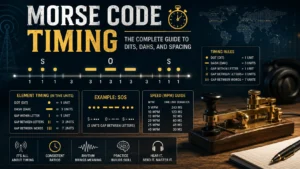
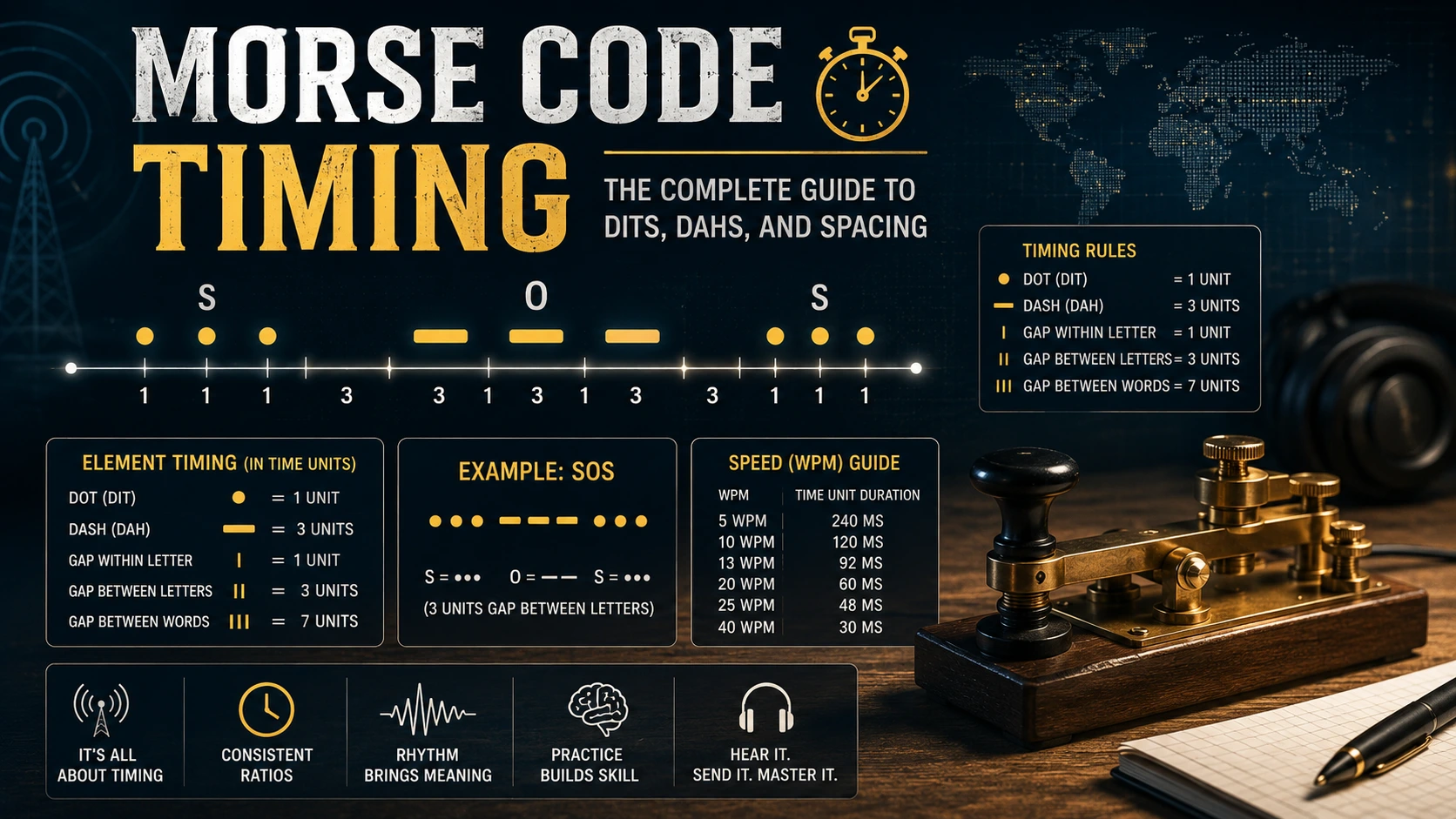
| Element | Duration (in time units) |
|---|---|
| Dot (dit) | 1 unit |
| Dash (dah) | 3 units |
| Gap between dots/dashes within one letter | 1 unit |
| Gap between letters | 3 units |
| Gap between words | 7 units |
Notice the relationships: a dash is exactly three dots long. The gap between letters is exactly the same length as a dash. The gap between words is more than double the letter gap. These aren’t arbitrary; they’re what makes Morse code decodable by ear without any visual aid. Break these ratios and the code becomes ambiguous or unreadable, even if every individual dot and dash is technically correct.
Worked Example: Timing “SOS”
SOS is three dots, three dashes, three dots: ... --- ...
At a fixed unit length, here’s what actually happens in time:
- Dot (1 unit) → gap (1 unit) → dot (1 unit) → gap (1 unit) → dot (1 unit)
- Letter gap (3 units)
- Dash (3 units) → gap (1 unit) → dash (3 units) → gap (1 unit) → dash (3 units)
- Letter gap (3 units)
- Dot → gap → dot → gap → dot (same as step 1)
The pause between the “S” and the “O” is three times longer than the pause between the individual dots inside the “S.” That’s the entire mechanism that lets your ear separate letters without it, ...---... would just sound like nine identical beeps.
What Is WPM (Words Per Minute)?
Morse code speed is measured in Words Per Minute, using a standardized reference word: PARIS. This word was chosen specifically because its ten time units of code plus the trailing word gap adds up to a mathematically clean benchmark.
At exactly 20 WPM, the word “PARIS” plus its trailing word-space takes exactly 3 seconds to transmit. From this, you can calculate the duration of a single time unit at any WPM:
Time unit (seconds) = 1.2 / WPM
So at 20 WPM, one time unit ≈ 60 milliseconds. At 5 WPM (a common beginner starting speed), one time unit ≈ 240 milliseconds, four times slower.
| Speed (WPM) | Time Unit Duration |
|---|---|
| 5 | 240 ms |
| 10 | 120 ms |
| 13 | ~92 ms |
| 20 | 60 ms |
| 25 | 48 ms |
| 40 | 30 ms |
Why Timing Ratios Matter More Than Speed
A beginner sending Morse code slowly but with correct 1:3:1:3:7 ratios will be perfectly readable to any operator, at any speed, anywhere in the world. A beginner sending at a “correct” WPM but with sloppy, inconsistent ratios will be unreadable even to an experienced listener. Timing consistency; not raw speed, is what makes code legible.
This is also why hand-sent Morse code (using a straight key) sounds distinctly different from computer-generated code: human timing naturally drifts slightly, and experienced operators learn to recognize individual “fists” (sending styles) the way you’d recognize someone’s handwriting.
The Beginner’s Timing Trap
Many self-taught learners start at very slow speeds; 5 WPM with every element proportionally stretched. This feels approachable, but it creates a serious long-term problem: at slow uniform speeds, it’s possible to consciously count out each element (“one-two-three, that’s a dash”). This counting habit feels like progress early on, but it creates a hard speed ceiling around 10-13 WPM, the point where conscious counting becomes physically impossible to sustain.
The fix is Farnsworth timing; sending individual characters at a normal, full speed while stretching only the gaps between letters and words. This trains genuine pattern recognition from day one instead of counting, and it’s the method recommended by CW Academy, ARRL, and most licensed Morse instructors. Read the full breakdown in our Farnsworth Timing Guide.
Common Timing Mistakes
Uneven dot-to-dash ratio. If your dashes aren’t consistently three times your dots, letters become ambiguous; is that a fast dash or a slow dot?
Compressed letter gaps. Rushing the pause between letters is the most common beginner error when sending by hand. It causes separate letters to blur into what sounds like a single, longer, unrecognizable character.
Inconsistent word gaps. If your word gap isn’t clearly longer than your letter gap, “HI MOM” can sound like one long garbled word instead of two clear ones.
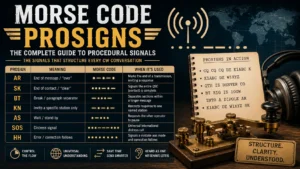
Ignoring prosign timing. Prosigns like AR, SK, and BT are sent as single blended characters with no internal letter gap; treating them like two separate letters with a normal gap makes them unrecognizable to real operators. See our prosigns guide for the full list.
How to Train Your Timing Ear
- Start with PARIS. Play it repeatedly at a fixed speed and just listen to the rhythm before trying to decode anything.
- Use Farnsworth from day one. Keep character speed high, stretch the gaps, don’t slow everything down uniformly.
- Practice with real words, not random strings. Random letter strings have no rhythm to anchor onto; real words like SOS, HI, and OK let your brain use context.
- Increase speed gradually. Move up in small WPM increments only once you’re decoding your current speed with near-zero errors.
- Use a tool that enforces correct ratios. Hand-typed practice can teach you bad timing habits; audio generated from precise ITU ratios won’t.
Our CW Generator lets you create and export custom Morse transmissions with precise, adjustable timing; including independent character and Farnsworth speeds, so you can hear correct ratios at any pace.
Frequently Asked Questions
What is the standard timing ratio for Morse code?
1:3 for dot-to-dash duration, with a 1-unit gap within letters, 3-unit gap between letters, and 7-unit gap between words; all defined by ITU-R Recommendation M.1677-1.
How long is a “dit” in seconds?
It depends on speed. The formula is 1.2 divided by the WPM value. At 20 WPM, one dit is approximately 60 milliseconds.
Why is PARIS used to measure Morse code speed?
PARIS was adopted as the international benchmark word because its total transmission time; including the trailing word gap divides cleanly into a standard time-unit calculation, making WPM measurement consistent across different operators and equipment.
Is Farnsworth timing “cheating”?
No; it’s the professionally recommended learning method. It trains the same end skill (recognizing full-speed characters) while avoiding the counting habit that slow uniform timing creates.
Does timing differ between countries?
No. International Morse Code (ITU-R M.1677-1) uses identical timing ratios worldwide. Only some regional variants; like the older American Morse Code; used different timing and character sets, and those are largely obsolete today.
Practice What You’ve Learned
Type any word or phrase into our Morse Code Translator and listen to it played at correct ITU timing ratios the same rhythm you’ll hear on real amateur radio bands.