Knowing the Morse code alphabet and being able to use it are two different skills, separated by one thing: practice. Most people who “learn” Morse code and then quit weren’t lacking aptitude — they were practicing the wrong way, in the wrong order, without a structure to build on. This guide lays out a practice approach that actually works, backed by how real CW instructors and structured programs like CW Academy teach it.
Why Most Self-Taught Practice Fails
The most common mistake is treating Morse code like a memorization task — staring at a chart, drilling flashcards, trying to recall “dot-dash-dot is R” the way you’d recall a vocabulary word. This approach has a hard ceiling: it teaches visual recall, not the auditory pattern recognition that real Morse code — heard over radio, played through a light, or tapped by hand — actually requires.
The second most common mistake is practicing at a slow, uniform speed and gradually speeding up. This feels intuitive, but it trains you to consciously count dots and dashes, a habit that caps your usable speed around 10-13 WPM — right around where real conversational CW begins. See our Farnsworth Timing Guide for the full explanation of why this happens and how to avoid it.
The Practice Framework That Actually Works
1. Train by ear, from day one. Even if you’re a complete beginner, start listening to real Morse code audio immediately — don’t spend weeks on visual charts first. Your ear needs the practice more than your eyes do.
2. Use Farnsworth timing. Characters played at full natural speed (18-20 WPM), with extended gaps between them that shrink as you improve. This builds genuine recognition instead of counting.
3. Learn a small character set first, and drill only that set. Don’t try to learn all 26 letters plus numbers plus punctuation simultaneously. The Koch method — used by most structured CW courses — starts with just two characters, adds one new character only once the current set is reliably recognized, and builds outward gradually.
4. Practice daily, in short sessions. 15-20 minutes of focused daily practice consistently outperforms longer, infrequent sessions. Pattern recognition — which is what you’re really building — responds better to frequent repetition than to marathon sessions.
5. Copy before you send. Receiving (decoding what you hear) is a different skill from sending, and most instructors recommend building solid receiving ability first — sending becomes much easier once your ear already knows what correct code should sound like.
6. Practice with real words, not random letters. Random character strings have no internal pattern to help you — your brain has nothing to anchor to. Real, short, common words (HI, SOS, KEY, YES) let context reinforce what you’re hearing.
A Sample Weekly Practice Structure
| Day | Focus |
|---|---|
| Day 1-3 | Learn and drill the first 4-5 highest-frequency letters (E, T, A, N, I) by ear only |
| Day 4-7 | Add 3-4 new characters; drill the full set with short real-word combinations |
| Week 2 | Continue adding characters in small batches; introduce numbers |
| Week 3 | Full alphabet and numbers; begin timed copying of short sentences |
| Week 4+ | Increase effective speed gradually; introduce punctuation and common prosigns |
This pace is a reasonable default, not a rigid rule — some learners move faster, some need more repetition on certain characters. The structure matters more than the exact timeline: small increments, daily repetition, audio-first.
Practice Drills Worth Doing
The alphabet scramble. Once you know your current character set, listen to it in random order (not alphabetical) and identify each letter as fast as you can. Alphabetical order teaches sequence memorization, not recognition — scrambled order forces genuine pattern recognition.
Word copying. Listen to short real words at your current speed and write down what you hear before checking. Start with 2-3 letter words, build up to longer ones as your character set grows.
Speed pyramid. Practice a short phrase at a comfortable speed, then increase by 2 WPM and repeat, then increase again — until you hit a speed where you start missing characters. This tells you exactly where your current ceiling is, which is more useful than guessing.
Callsign copying. For ham radio-focused learners, practicing with random amateur radio callsigns (letter-number-letter combinations) builds the specific skill of copying mixed alphanumeric strings under real operating conditions.
Send-back practice. Once comfortable receiving, try sending back what you just heard using a practice key or keyboard input — this reinforces the character-to-sound mapping from both directions.
How to Track Real Progress
Speed (WPM) is the most obvious metric, but it’s not the only one worth tracking:
- Accuracy at your current speed — practicing faster than you can accurately copy reinforces guessing, not recognition. It’s better to be highly accurate at a slower speed and increase gradually than to push speed while accuracy suffers.
- Recognition delay — how long after hearing a character before you identify it. This naturally shrinks with practice and is a good sign of genuine fluency developing, even before WPM numbers move much.
- Consistency across sessions — a single great session doesn’t mean much; steady performance across a week is the real signal you’re progressing.
Common Practice Mistakes to Avoid
Slowing down when frustrated. The instinct when struggling is to reduce speed — but with Farnsworth-based practice, the fix is usually to extend the gaps (more thinking time), not slow the characters themselves, which reintroduces the counting trap.
Practicing inconsistently. Three long weekend sessions are less effective than daily 15-minute sessions — pattern recognition benefits from frequency and consistency more than raw hours.
Skipping numbers and punctuation. Many learners master letters and stop, only to be confused later when numbers or basic punctuation appear in real messages. Building these in gradually, even before you feel “ready,” pays off.
Ignoring timing fundamentals. Understanding why dashes are three units, why letter gaps are three units, and why word gaps are seven matters more than it seems — see our Morse Code Timing guide if this still feels fuzzy.
Tools to Support Your Practice
A structured practice routine benefits enormously from tools that enforce correct timing automatically, rather than relying on your own hand-sent code (which can teach bad timing habits early on):
- Our CW Generator lets you create custom Morse audio at your chosen character and effective speed — ideal for building your own drill sets around specific words or callsigns.
- Structured lesson-based practice, like our CW Academy Trainer, paces character introduction the way the Koch method recommends, rather than throwing the full alphabet at you immediately.
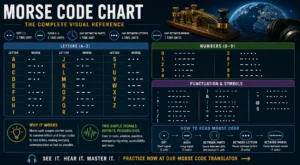
- A printable reference chart nearby during early practice sessions reduces frustration without becoming a crutch, as long as you’re primarily practicing by ear.
Frequently Asked Questions
How long does it take to get good at Morse code?
With consistent daily practice (15-20 minutes), many learners reach comfortable 10-13 WPM copying within 4-8 weeks, and conversational 18-20 WPM within several months. Progress varies significantly by individual and practice consistency.
Should I learn to send or receive first?
Most instructors recommend building receiving (copying) skill first. Sending becomes much easier once your ear already has a clear reference for what correct, well-timed code sounds like.
Is it better to practice with real radio traffic or generated practice audio?
Generated practice audio with controlled speed and clean timing is better for building foundational skill. Real radio traffic — with variable sending styles, static, and interference — is valuable later, once your basic recognition is solid.
What’s the biggest factor in whether someone sticks with learning Morse code?
Consistency of practice and using a method (like Farnsworth timing and gradual character introduction) that avoids the early speed-ceiling trap. Learners who hit a hard wall around 10-13 WPM using slow uniform-speed methods are the most likely to give up.
Start Practicing
Head to the Morse Code Translator to hear any word played back, or try our CW Generator to build custom practice drills at your own target speed — or use the practice tool below to start a structured session right now.