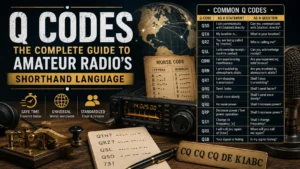
If you’ve ever listened to ham radio CW traffic and heard operators exchange strings like “QRZ?” or “QTH?” without ever switching to plain language, you’ve encountered Q codes; a compact three-letter shorthand that lets operators communicate complex, standardized questions and statements in a fraction of the time plain English would take.
Q codes were built for exactly the environment Morse code operates in: slow transmission speed, unreliable signal conditions, and operators who may not share a spoken language. They remain in daily use across amateur radio worldwide.
What Are Q Codes?
A Q code is a fixed three-letter code, always beginning with the letter Q, that stands in for a complete question or statement. Each code has two readings, depending on context:
- Sent as a statement, it conveys information (“My location is…”)
- Sent as a question (often with a question mark appended), it asks for the same information (“What is your location?”)
This dual-use design means a single three-letter code replaces what would otherwise be a full sentence sent in plain text, a significant speed advantage in Morse code, where every extra letter costs real transmission time.
Where Q Codes Came From
Q codes originated in the early 20th century as an international standard for maritime and commercial radiotelegraphy, adopted specifically because they work identically regardless of the operators’ native language. A three-letter Q code sent by a German operator means exactly the same thing to a Japanese operator receiving it, no translation required. This is precisely why they survived the transition from commercial and maritime service into amateur radio, where the same cross-language advantage still applies.
The Most Common Q Codes in Amateur Radio
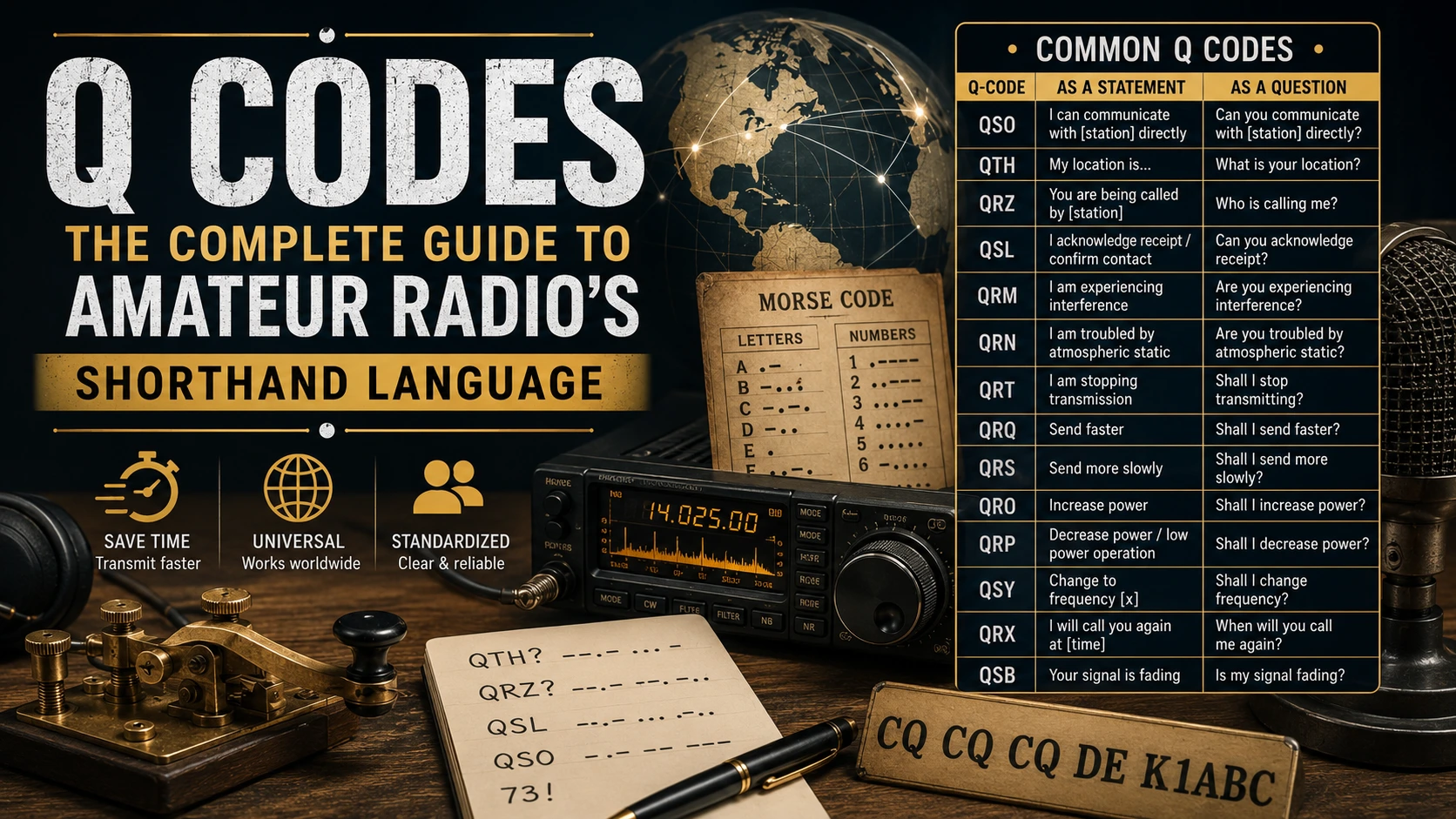
| Q-Code | As a Statement | As a Question |
|---|---|---|
| QSO | I can communicate with [station] directly | Can you communicate with [station] directly? |
| QTH | My location is… | What is your location? |
| QRM | I am experiencing interference from other stations | Are you experiencing interference from other stations? |
| QRN | I am troubled by atmospheric static | Are you troubled by atmospheric static? |
| QRZ | You are being called by [station] | Who is calling me? |
| QSL | I acknowledge receipt / confirm contact | Can you acknowledge receipt? |
| QRT | I am stopping transmission | Shall I stop transmitting? |
| QRQ | Send faster | Shall I send faster? |
| QRS | Send more slowly | Shall I send more slowly? |
| QRO | Increase transmitter power | Shall I increase power? |
| QRP | Decrease power (also refers to low-power operating) | Shall I decrease power? |
| QRX | I will call you again at [time] | When will you call me again? |
| QSY | Change to frequency [x] | Shall I change frequency? |
| QRP | Operating with low power | — |
| QSB | Your signal is fading | Is my signal fading? |
Q Codes in Everyday Ham Radio Conversation
Here’s a simplified real-world exchange, using Q codes the way operators actually do:
Operator A:
CQ CQ CQ DE [callsign](general call to any station) Operator B:[callsign] DE [callsign] QRZ?(who’s calling?) Operator A:QTH IS DALLAS TX QSL?(my location is Dallas, Texas — did you copy?) Operator B:QSL FB QSO(confirmed, good contact)
Notice that entire sentences; location, confirmation, and a compliment on signal quality (“FB” = fine business, a separate CW abbreviation) get compressed into a handful of characters. This is the entire purpose of Q codes: minimizing transmission time without losing meaning.
Q Codes vs. Prosigns: What’s the Difference?
It’s easy to conflate Q codes with prosigns, but they serve different functions:
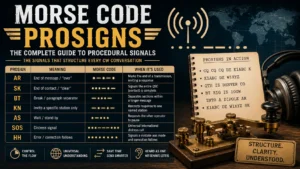
- Prosigns (like AR, SK, BT) are procedural signals; they control the structure of a transmission (start, end, break) and are sent as single blended characters with no internal letter gap.
- Q codes (like QTH, QRZ, QSL) are content shorthand; they replace entire sentences of meaning and are sent as three normal, separately-spaced letters, just like any other word.
Both exist to save time in a slow, character-by-character medium, but they solve different problems. See our full Morse Prosigns guide for the procedural signal set.
Why Q Codes Still Matter Today
Even though most ham radio operators today are fluent in plain-language voice communication, Q codes persist on CW (Morse code) bands for practical reasons:
- Speed. QTH takes a fraction of the time “what is your location” takes to send in Morse.
- Language independence. A DX (long-distance, often international) contact between operators with no shared spoken language still works perfectly using standardized Q codes.
- Tradition and community. Q codes are part of amateur radio’s operating culture, using them correctly is often treated as a marker of a properly trained operator, similar to correct radio voice procedure.
Learning Q Codes: Where to Start
You don’t need to memorize all Q codes at once. In practice, a working set of roughly 10-15 codes covers the overwhelming majority of real CW contacts:
Learn first: QTH, QSL, QRZ, QSO, QRM, QRN, QSY, QRP, QRO, QRS, QRQ
Learn next: QRT, QRX, QSB, QRK (signal readability)
Once these are second nature, expanding to the full 100+ code Q-code list (originally standardized for maritime radiotelegraphy, many of which are now rarely used in amateur practice) becomes straightforward.
Frequently Asked Questions
Do I need to know Q codes to get a ham radio license?
Requirements vary by country and license class, but most licensing exams test at least the most common Q codes (QTH, QSL, QRZ, QRM). They’re less commonly tested in depth than they were decades ago, but remain part of standard operating knowledge.
Are Q codes only used in Morse code?
No; Q codes are used in voice communication too, though less commonly, since voice doesn’t have the same time-per-character cost that makes shorthand valuable. They’re most heavily used on CW bands specifically because of the speed advantage.
How many Q codes are there in total?
The original international radiotelegraph Q code list included well over 100 codes, most developed for commercial and maritime use. Amateur radio operators today typically use a working set of 15-25 codes regularly, with the rest largely historical or rarely invoked.
What does “QRP” mean exactly?
Sent as a statement, QRP traditionally means “decrease transmitter power,” but in modern amateur radio it’s also become shorthand for an entire operating discipline, intentionally operating at very low power (often 5 watts or less) as a technical challenge.
Practice Sending Q Codes
Try encoding a Q code exchange yourself using our Morse Code Translator type “QTH QSL QRZ” to hear how these compact codes sound in real CW timing, or explore structured lessons in our CW Academy Trainer.