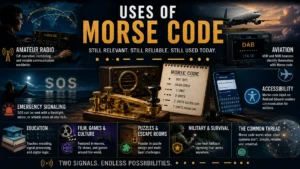
Morse code is nearly 200 years old, and it’s tempting to assume it’s a historical curiosity; something you’d only encounter in a museum or an old movie. It isn’t. Morse code is in active, functional use across a surprising number of fields today, for a simple reason: it’s one of the most reliable, low-bandwidth communication systems ever devised, and it works in conditions where more sophisticated systems fail.
Here’s exactly where you’ll still find it in the modern world.
Amateur (Ham) Radio
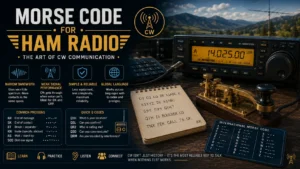
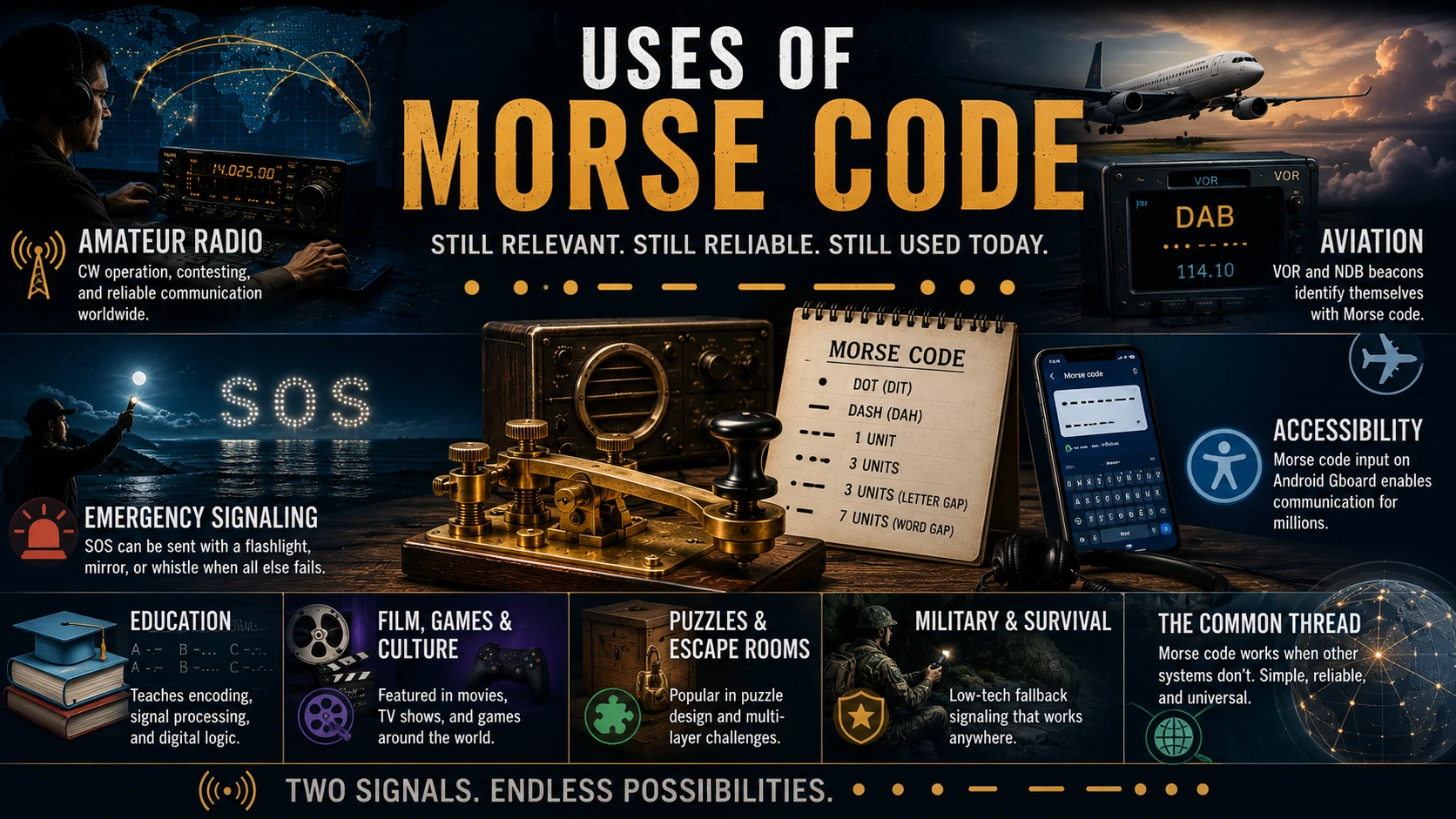
The largest active Morse code community by far is amateur radio, where CW (Continuous Wave) transmission remains a popular operating mode, not because it’s required, but because operators genuinely prefer it. A single, narrow-bandwidth CW signal can complete a contact under weak-signal or high-interference conditions that would defeat voice communication entirely. Organizations including the CW Academy, the Long Island CW Club, and SKCC (Straight Key Century Club) have tens of thousands of members actively practicing and contesting in Morse code today.
Full breakdown: Morse Code for Ham Radio
Aviation Navigation
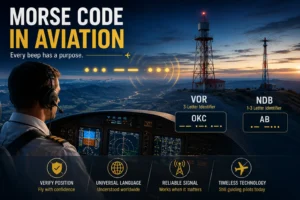
Every VOR (VHF Omnidirectional Range) and NDB (Non-Directional Beacon) navigational aid continuously broadcasts its two- or three-letter identifier in Morse code, so pilots can audibly confirm they’ve tuned the correct beacon before relying on it for navigation. This isn’t legacy or decorative; it’s an active, functioning part of aviation safety infrastructure, printed on charts and taught to every instrument-rated pilot.
Full breakdown: Morse Code in Aviation
Maritime and Emergency Signaling
Morse code no longer carries mandatory maritime status; that requirement ended with the 1999 transition to GMDSS (Global Maritime Distress and Safety System). But its core emergency use hasn’t disappeared: SOS can still be sent with a flashlight, mirror, signal lamp, or whistle, requiring no equipment beyond the ability to produce two distinguishable signals. Military survival training continues to include Morse code specifically because it works when voice, radio, and digital systems have all failed.
Accessibility Technology
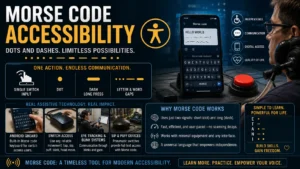
Morse code’s fundamental structure, every character built from just two distinguishable signals, makes it one of the most efficient low-barrier text input methods ever designed. Google added native Morse code input to Android’s Gboard keyboard in 2018, allowing anyone who can reliably produce a single switch input, through head movement, sip-and-puff control, or eye blinks, to type full text.
Full breakdown: Morse Code Accessibility
Education and Scouting
Morse code remains a merit badge subject for Scouts organizations worldwide, and a common classroom tool for teaching signal encoding, information theory, and the foundations of digital communication. Its binary structure; exactly two signal types encoding an entire alphabet, makes it an unusually intuitive entry point into concepts that otherwise feel abstract, like bandwidth, encoding efficiency, and error tolerance.
Film, Games, and Popular Culture
Morse code shows up constantly in movies, television, and games; Interstellar, Stranger Things, and LOST have all built plot points around it, and it’s a recurring mechanic in games like Call of Duty. This cultural persistence is part of why so many people encounter Morse code for the first time not through radio or aviation, but through entertainment and then come looking for a way to actually decode what they heard.
Puzzle and Escape Room Design
Morse code is a favorite mechanic among escape room and puzzle designers precisely because it rewards real knowledge while remaining learnable in minutes. A well-designed Morse puzzle can be layered with other cipher systems; Morse combined with Wingdings translation or a secondary substitution cipher, for example to create multi-step challenges.
Full breakdown: Morse Code Puzzles
Military and Government Use
While digital encrypted communication has replaced Morse code for most modern military operations, it retains a niche but real role: as a low-tech fallback in electronic warfare conditions, in some signals intelligence training programs, and as part of survival training curricula precisely because it requires no equipment that can fail, be jammed, or run out of battery in the way digital systems can.
Why It Persists: The Common Thread
Every surviving use case above shares one property: Morse code works when more sophisticated systems don’t. It requires minimal bandwidth, minimal equipment, and can be produced through almost any medium capable of two distinguishable states; sound, light, radio waves, electrical pulses, touch, or physical movement. No other communication encoding system shares that universality, which is precisely why it has outlived the telegraph, the teletype, and analog radio, and continues finding new relevance in accessibility technology nearly 200 years after its invention.
Quick Reference: Where Morse Code Is Used Today
| Field | Primary Use |
|---|---|
| Amateur radio | CW operating mode, contesting, weak-signal contacts |
| Aviation | VOR/NDB beacon identification |
| Emergency signaling | SOS via flashlight, mirror, or whistle |
| Accessibility | Switch-based text input (e.g., Android Gboard) |
| Education | Teaching encoding theory and signal processing |
| Entertainment | Puzzles, film and TV plot devices, games |
| Escape rooms | Puzzle mechanics and multi-layer ciphers |
| Military/survival | Low-tech fallback signaling |
Frequently Asked Questions
Is Morse code required to get a ham radio license?
No. Morse code proficiency requirements were removed from amateur radio licensing in the United States and most other countries in the mid-2000s. Many operators still learn and use it by choice.
Do pilots still need to know Morse code?
Pilots don’t need to send Morse code, but recognizing the short identifier codes broadcast by VOR and NDB navigational beacons remains part of standard instrument training, since it’s how a pilot audibly confirms they’ve tuned the correct station.
Is Morse code used in the military today?
Modern militaries rely primarily on encrypted digital communication, but Morse code retains a role in survival training and as a low-tech fallback option precisely because it doesn’t depend on equipment that can be jammed or fail.
Why do escape rooms use Morse code so often?
Because it strikes a rare balance: genuinely educational and rooted in real history, but learnable by a first-time player in minutes with the right reference material; making it satisfying to solve without requiring specialized prior knowledge.
Try It Yourself
See how Morse code sounds and looks in real time, type any message into our Morse Code Translator and hear it played back as authentic CW audio.