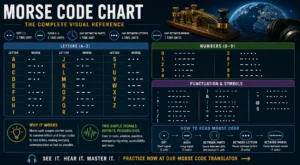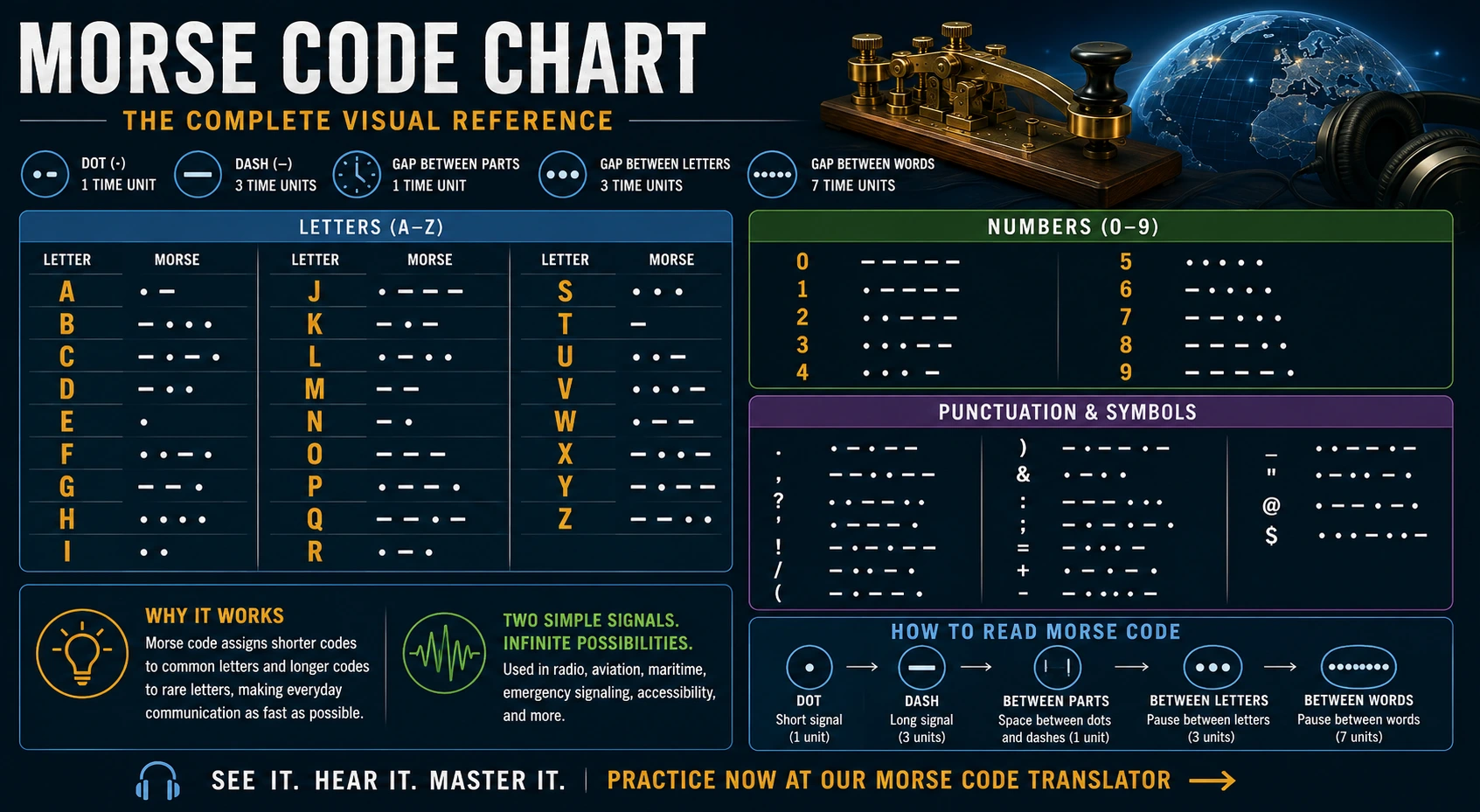
A Morse code chart is the fastest way to see the entire system at once; every letter, number, and symbol mapped to its dot-dash pattern in a single glance. This page organizes the International Morse Code standard (ITU-R M.1677-1) into a clean visual reference you can study, print, or use side-by-side with our translator.
How to Read This Chart
Each cell shows a character and its corresponding sequence of dots (·) and dashes (—). Reading left to right, the sequence tells you exactly what to send or expect to hear:
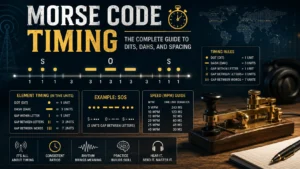
- A dot (.) is a short signal — one time unit.
- A dash (-) is a long signal — three time units, exactly three times the length of a dot.
- A space between symbols within one letter’s code isn’t written here, but in transmission it’s a one-unit pause.
To actually use this chart for reading real Morse code; audio, light, or written dots and dashes — you need to understand the gaps between letters and words too. See our full timing guide for those ratios.
Why the Chart Is Organized This Way
Morse code isn’t random. Samuel Morse and Alfred Vail built the system around English letter frequency in the 1830s and 40s: the most common letters got the shortest codes so that everyday messages could be sent as fast as possible.
- E — the most common letter in English — is a single dot.
- T — the second most common — is a single dash.
- Letters like Q, X, Z, J — rare in English — get the longest codes, because their infrequency means the extra transmission time barely matters in practice.
This is the same design principle behind modern data compression: assign short codes to common symbols, long codes to rare ones.
Chart vs. Cheat Sheet vs. Trainer; Which Do You Need?
- This chart; best for looking something up quickly or studying the full character set visually.
- Cheat Sheet; best if you want a printable, downloadable reference plus memorization tips.
- Morse Machine; best when you’re ready to actually practice sending and receiving, with accuracy tracking.
- CW Academy Trainer; best for structured, lesson-by-lesson learning using the Koch method.
Frequently Asked Questions
Is there a difference between a “Morse code chart” and a “Morse code alphabet”?
Not really; both terms describe the same underlying reference: the mapping of characters to dot-dash sequences. “Chart” usually implies a visual table like this one; “alphabet” refers to the character set itself.
Does this chart include international characters?
This chart covers the standard ITU-R M.1677-1 character set (A-Z, 0-9, and standard punctuation). Some accented Latin characters (Á, Ä, É, Ñ, Ö, Ü) have extended Morse mappings used in certain European countries; not included here, as they fall outside the core international standard.
What about Russian or Japanese Morse code?
Those use entirely different character mappings, since they encode different alphabets (Cyrillic and Katakana respectively). See our dedicated Russian Morse Code Translator and Japanese Morse Code Translator.
How do I memorize this chart?
Most people find visual memorization alone slow and unreliable. Pair this chart with audio; type words into the translator and listen while you look at the pattern, so you’re building sound recognition, not just visual recall.
Start Practicing
Once you’re familiar with the chart, put it into action. Head to the Morse Code Translator to convert your own text and hear it played back at your chosen speed.