Russian Morse code is an interesting combination of two communication systems: Morse code and the Cyrillic alphabet. While many people first learn Morse code through English letters, Morse can also represent Russian Cyrillic characters.
Understanding the Russian Morse Code alphabet is useful for language learners, radio enthusiasts, historians, puzzle creators, and anyone interested in coded communication. It also makes it easier to understand how a Russian Morse Translator or Russian Morse Code Converter transforms Cyrillic text into dots and dashes.
This guide explains the basic concept of Russian Morse code, how Cyrillic characters are represented, and how online conversion tools can help with encoding and decoding.
What Is the Russian Morse Code Alphabet?
The Russian Morse code alphabet is a system for representing Russian Cyrillic characters using combinations of dots and dashes.
The fundamental concept is the same as other Morse systems:
- A dot represents a short signal.
- A dash represents a longer signal.
- Different combinations represent different characters.
- Separators distinguish characters and words.
The important difference is the character set. Russian uses Cyrillic rather than the Latin alphabet, so a Russian Morse system needs mappings appropriate for Cyrillic characters.
This allows a Russian sentence to be transmitted as a sequence of Morse signals and later reconstructed as Russian text.
Why Does Russian Morse Code Matter?
Morse code became an important technology for long-distance communication because information could be represented as simple signals and transmitted through telegraph and radio systems.
For Russian-language communication, a system capable of representing Cyrillic characters was necessary.
Today, Russian Morse code remains interesting for several reasons:
- It provides insight into communication history.
- It can be used for Morse practice.
- It supports Russian-language coding exercises.
- It can be incorporated into puzzles and games.
- It provides a way to explore Cyrillic characters.
- It can be used with online Russian Morse converters.
Russian Morse Code and the Cyrillic Alphabet
Russian is written using the Cyrillic alphabet, which contains characters that do not appear in English.
A Cyrillic Morse Code Translator therefore needs to recognize Russian characters and associate them with the appropriate Morse patterns.
This is an important distinction when using online tools. A basic English Morse converter may be designed around the Latin alphabet and may not recognize Russian Cyrillic input.
A dedicated Russian Morse tool is better suited to tasks involving original Russian text.
How Russian Morse Code Is Organized
A Russian Morse message can be thought of as a sequence of encoded characters.
The process begins with Russian text:
Russian Cyrillic text
↓
Individual Cyrillic characters
↓
Russian Morse mappings
↓
Dots and dashes
The receiving side performs the reverse operation:
Dots and dashes
↓
Morse character groups
↓
Cyrillic characters
↓
Russian text
This is the basic principle behind a Russian Morse Code Translator.
Russian Letters in Morse Code
Each supported Russian Cyrillic character has a corresponding Morse representation.
When studying the alphabet, it is useful to learn the character patterns rather than trying to memorize complete Russian sentences immediately.
A learner can begin with a few characters, practice identifying their dot-and-dash combinations, and gradually expand their knowledge.
An online Russian Morse Code Converter can also be used to check whether a manually created sequence matches the intended Cyrillic text.
Russian Morse Code for Beginners
If you are new to Russian Morse code, avoid starting with long paragraphs.
A better approach is to begin with:
- Individual Cyrillic characters
- Short Russian words
- Simple phrases
- Short sentences
- Longer messages
This progression allows you to become familiar with both the Morse patterns and the Cyrillic alphabet.
For example, you can write a short Russian word, convert it into Morse, hide the original word, and then attempt to decode it.
This creates a practical exercise that combines Russian reading skills with Morse recognition.
Russian Morse Translator vs. Morse Code Chart
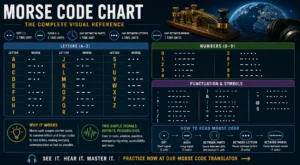
A Morse code chart is useful when you want to study the individual mappings manually.
A Russian Morse Translator, on the other hand, performs the conversion automatically.
A chart is particularly useful for:
- Memorization
- Classroom exercises
- Manual decoding
- Reference work
- Learning individual characters
A translator is more convenient for:
- Long Russian messages
- Quick conversion
- Testing your work
- Reverse decoding
- Generating practice material
The two resources complement each other rather than replacing one another.
Russian Morse Code Converter
A Russian Morse Code Converter can perform either of two basic operations.
Russian Text to Morse
The tool accepts Russian Cyrillic text and generates the corresponding Morse representation.
Russian text → Morse
Morse to Russian Text
The tool accepts Morse sequences and generates Russian Cyrillic characters.
Morse → Russian text
Some online tools offer both functions in one interface, making them useful for checking conversions in both directions.
Why Character Separation Matters
Morse code relies on more than just dots and dashes. The boundaries between characters and words are important.
Consider a sequence of Morse patterns representing several Cyrillic characters. If all the patterns are placed together without separators, the decoder may not know where one character ends and the next begins.
Therefore, when creating or copying Russian Morse messages, preserve the original formatting.
This becomes particularly important when using a Russian Morse Code Translator Online to decode a long message.
Numbers in Russian Morse Code
Numbers can also be represented using Morse code.
This is useful when a Russian message contains:
- Dates
- Years
- Quantities
- Addresses
- Measurements
- Identification numbers
Number support can vary in how a particular online translator presents its output, so users working with technical messages should check the tool’s supported character set.
Punctuation and Symbols
Russian text may include punctuation marks and other symbols in addition to Cyrillic letters.
Depending on the converter, supported symbols may include:
- Periods
- Commas
- Question marks
- Parentheses
- Hyphens
- Colons
- Numbers
Not every online translator handles every symbol identically. If punctuation is important to your message, verify the generated output.
Russian Morse Code and International Morse
Russian Morse code should not simply be assumed to be identical to International Morse.
International Morse is widely associated with the Latin alphabet, while Russian Morse accommodates Cyrillic characters.
The underlying communication principle remains the same: information is encoded using short and long signals. However, the character mapping needs to correspond to the writing system being represented.
This is why a Russian Morse Code Converter is useful when working with original Russian text.
Russian Morse Code in Historical Communication
Morse code played an important role in the development of long-distance communication.
Telegraph networks made it possible to transmit messages across significant distances without physically transporting written documents. Later, Morse-based signaling became associated with radio communication as well.
Russian-language communication required ways to represent Cyrillic writing within these systems.
Studying Russian Morse code therefore provides an interesting perspective on the relationship between language, technology, and communication.
Using Russian Morse Code for Radio Practice
Morse enthusiasts can use Russian text as an alternative to conventional English practice material.
Instead of repeatedly practicing Latin-alphabet words, a learner can generate Russian phrases and encode them using a Cyrillic-compatible Morse system.
A useful exercise is:
Write Russian text → convert to Morse → practice sending → decode the result
This allows learners to practice both transmission and reception.
Russian Morse Code for Puzzles
Russian Morse can also be useful for puzzle design.
A puzzle creator might encode a Russian phrase and give participants only the Morse sequence. Participants then need to identify the Morse characters and reconstruct the Cyrillic message.
This can create multiple levels of challenge:
- Recognize Morse code.
- Identify the appropriate character system.
- Decode individual characters.
- Read the resulting Cyrillic text.
- Interpret the Russian message.
This makes Russian Morse particularly suitable for educational puzzles and language-themed games.
How to Learn Russian Morse Code
Learning Russian Morse code does not require memorizing an entire alphabet in one session.
A practical method is to divide the learning process into small groups.
Start With Familiar Characters
Learn a few Cyrillic characters and their Morse patterns.
Practice Short Words
Use an online Russian Morse Translator to create short examples.
Decode Without Looking
Hide the original Russian word and try to reconstruct it from Morse.
Increase the Difficulty
Move from individual words to phrases and then sentences.
Practice Both Directions
Do not only encode Russian text. Practice decoding Morse back into Cyrillic.
This two-way approach gives you a better understanding of the system.
Common Mistakes When Studying Russian Morse Code
Using an English-Only Morse Chart
An English Morse chart may not provide the Russian Cyrillic mappings you need.
Confusing Transliteration With Cyrillic
Russian can be transliterated into Latin characters, but transliterated text is not the same as original Cyrillic text.
Ignoring Separators
Incorrect spacing can make an otherwise correct Morse sequence difficult to decode.
Trying to Memorize Everything Immediately
Learning small groups of characters is usually easier than attempting to memorize the complete system at once.
Failing to Verify Conversions
When creating an important message, use a translator or reverse conversion to check your work.
How an Online Russian Morse Translator Helps
An online Russian Morse Translator can serve as both a conversion tool and a learning aid.
You can use it to:
- Test individual Cyrillic characters
- Convert Russian words
- Generate practice messages
- Decode Morse sequences
- Check manually created Morse
- Experiment with numbers and punctuation
For beginners, this reduces the amount of manual lookup required while still allowing them to study the underlying alphabet.
Frequently Asked Questions
What is Russian Morse code?
Russian Morse code is a system that represents Russian Cyrillic characters through combinations of dots and dashes.
Is Russian Morse code different from English Morse code?
Yes. Both use the same basic concept of short and long signals, but the character mappings for Russian Cyrillic and English Latin characters differ.
What is a Cyrillic Morse Code Translator?
It is a tool that converts Cyrillic characters into Morse code and, depending on the tool, can decode Morse back into Cyrillic text.
Can I convert Russian text into Morse online?
Yes. A compatible Russian Morse Code Translator Online can convert supported Russian Cyrillic text into Morse code.
Can Russian Morse code be decoded back into Russian?
Yes. A compatible decoder can convert properly formatted Russian Morse sequences back into Cyrillic text.
Is Russian Morse useful today?
Although modern digital communication has replaced Morse for most everyday purposes, Russian Morse remains useful for education, historical research, hobby projects, Morse practice, and puzzles.
Final Thoughts
The Russian Morse Code alphabet demonstrates how a classic signaling system can be adapted to a different writing system. By representing Cyrillic characters with dots and dashes, Russian-language messages can be encoded, transmitted, and decoded using Morse principles.
Whether your goal is to study the Cyrillic alphabet, practice Morse, research communication history, or create a coded message, understanding the Russian Morse system provides a useful foundation.
For practical conversion, a Russian Morse Code Converter can handle the repetitive work, while a Russian Morse alphabet reference can help you understand and verify individual character mappings. Combining both resources is an effective way to learn how Russian Cyrillic text becomes Morse—and how Morse can ultimately become readable Russian again.