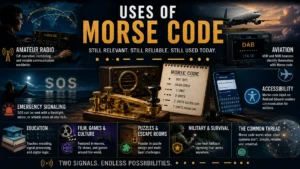
The letter M is one of the easiest letters to learn in the Morse code alphabet because it follows a simple and memorable pattern. Morse code is a communication method that uses dots and dashes to represent letters, numbers, and punctuation. Although it was originally developed for telegraph systems, Morse code is still used in amateur radio, emergency communication, military training, and educational activities around the world.
Learning M in Morse code is valuable because the letter appears in many common words, names, and messages. Understanding Morse code for M also helps learners become familiar with dash-based patterns, which are essential for mastering the complete Morse code alphabet. Whether you are a beginner or expanding your Morse code knowledge, M is an important letter to practice regularly.
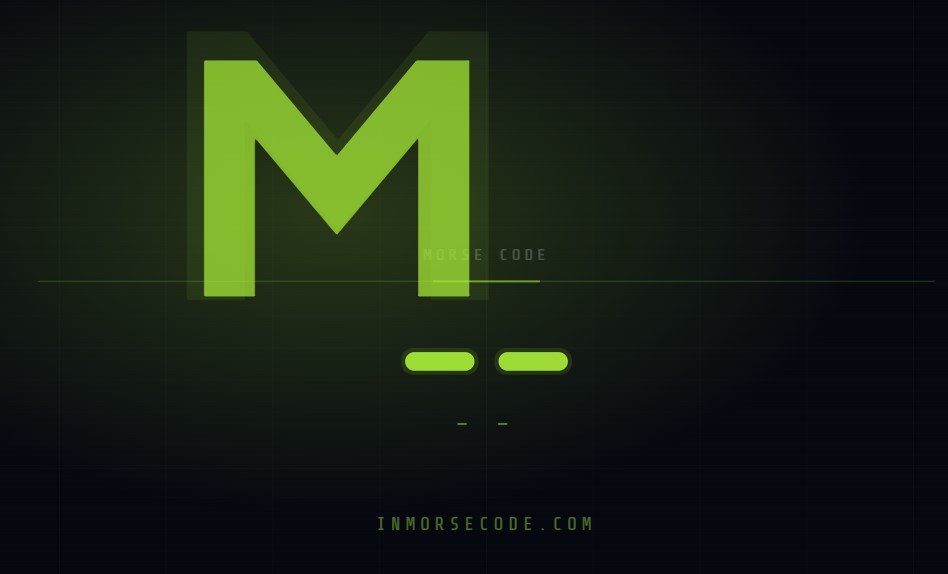
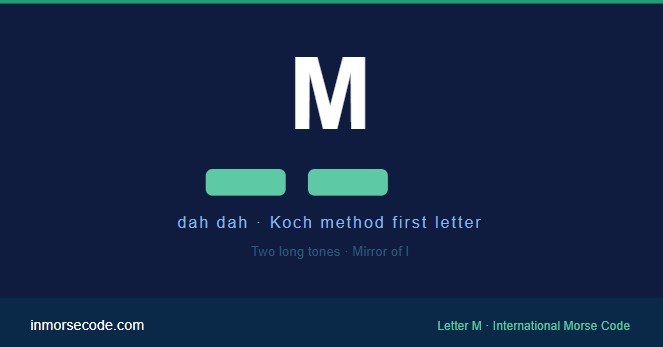
M in Morse code is two dashes: − −. Spoken as “dah dah”, it is one of four 2-element letters alongside A, I, and N. M stands out because both its elements are dashes making it acoustically heavier and distinctly different from the lighter dot-based characters nearby in the alphabet.
M is one of the first letters introduced in the Koch method of Morse learning, often paired with K as the starting pair. Its double-dash sound is easy to recognise from the very first session, which is why experienced instructors and training software begin with M before introducing more complex patterns.
What Is M in Morse Code?
| M − − |
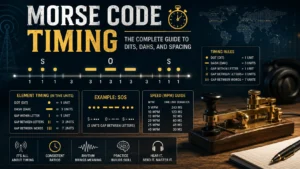
Two dashes. Two equal long tones. At 20 WPM: each dash lasts 180 ms with 60 ms between them. Total duration approximately 420 milliseconds; noticeably longer than the 2-dot I character, which makes the two characters acoustically very distinct.
M and I: The 2-Element Contrast Pair
| Letter/Item | Morse Code | Sound / Note |
| I | · · | dit dit; two short beeps (light) |
| M | − − | dah dah; two long tones (heavy) |
| One of the most effective beginner drills: Alternate I and M rapidly: I M I M I M. Two short beeps vs two long tones. This contrast is fundamental; if your ear can reliably distinguish dit-dit from dah-dah, you have mastered the core dot/dash discrimination that all other characters build on. |
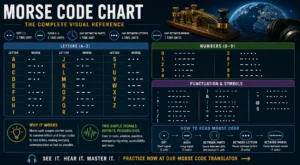
Morse Code Chart
| Item | Value |
|---|---|
| Letter | M |
| Morse Code Symbol | — |
| Dot-Dash Display | − − |
| Length | 2 Signals |
| Difficulty | Easy |
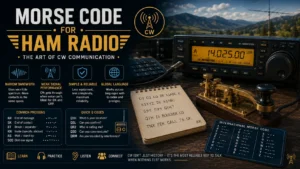
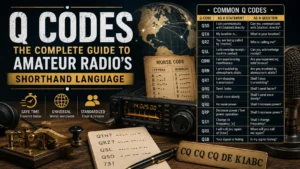
M in Ham Radio: CQ and Common Abbreviations
M is among the most transmitted characters in ham radio CW. It appears in:
- CQ; the universal calling sign (−·−· −−·−) contains no M, but QRM (interference) and QSM (repeat message) are frequently used Q-codes containing M
- OM; Old Man the standard ham radio greeting for a fellow male operator
- 73; best regards appears in almost every contact, and the transmission sequence often includes DE (from) and TU/TNX; all containing M in practice text
Common Words Starting With M in Morse Code
| Letter/Item | Morse Code | Sound / Note |
| ME | −− · | M + E |
| MY | −− −·−− | M + Y |
| MORE | −− −−− ·−· · | M + O + R + E |
| MORSE | −− −−− ·−· ··· · | M O R S E |
| MAKE | −− ·− −·− · | M + A + K + E |
Common Names Starting With M in Morse Code
- Mia: − − / · · / · − → M I A
- Max: − − / · − / − · · − → M A X
- Maya: − − / · − / − · − − / · − → M A Y A
- Mason: − − / · − / · · · / − − − / − · → M A S O N
Memory Trick
A simple memory trick for M is:
“Mountain Massive”
Imagine two large mountain peaks standing side by side. Each mountain represents a dash, helping you remember the pattern:
M = Dash Dash
Another easy reminder is:
M starts and stays strong.
Both signals are long dashes.
Real World Uses
The letter M appears frequently in everyday communication and is useful in many Morse code situations.
Examples include:
- Messages
- Maps
- Meetings
- Mobile communication
- Maritime communication
In amateur radio operations, M is often transmitted when exchanging names, locations, and call signs. Because of its simple pattern, it is also commonly included in beginner Morse code lessons and practice drills.
The letter M is especially easy to hear because two long dashes create a distinct sound that stands out from many other Morse code letters.
Words Using M
Words Starting With M
- Message
- Mobile
- Market
- Music
- Mountain
Words Containing M
- Communication
- Time
- Example
- Signalman
- Emergency
These words help learners recognize M in various positions within a word.
Practice M in Morse Code
Try sending the letter M five times:
—
—
—
—
—
Now practice these simple words:
- ME
- MOM
- MAP
- MESSAGE
- MOBILE
Focus on making both dashes clear and equal in length.
For listening practice, repeat:
dah-dah
Listen to the sound several times until you can immediately associate it with the letter M.
Quick Facts
- Position in alphabet: 13th
- Morse code pattern: —
- Signal count: 2
- Learning difficulty: Easy
- Commonly used: Yes
- Beginner friendly: Very high
Related Morse Code Letters
After learning M, study these related letters:
T (-)
A single dash and the foundation of many dash-based letters.
N (-.)
Adds a dot to the M pattern and helps build recognition skills.
O (—)
Extends the M pattern with a third dash and creates another easy-to-remember letter.
Learning these letters together improves your understanding of Morse code timing and structure.
Continue Learning Morse Code
Want to practice beyond a single letter?
Visit the Morse Code Translator
Explore more lessons in the learning hub
Try the Morse Code Translator tool to practice converting letters, words, and complete messages.
Frequently Asked Questions: M in Morse Code
What is M in Morse code?
M in Morse code is − − — two dashes. Spoken as “dah dah”.
How is M different from O in Morse code?
M is − − (2 dashes) and O is − − − (3 dashes). At speed, O sounds heavier and slightly longer. This is one of the key 2-vs-3 dash distinctions beginners must nail. Drill them side by side: M M M O O O; until the length difference is instantly clear.
Why is M used as the first letter in Koch method training?
The Koch method traditionally starts with K and M because they are acoustically distinctive (K = −·−, M = −−) and share a heavy dash character that trains the ear to handle long tones from the first session. Starting with simple, contrasting pairs prevents beginners from counting instead of recognising.
Conclusion
Learning M in Morse code is a simple but important step in mastering the Morse code alphabet. Its straightforward dash-dash pattern makes it easy to remember, easy to transmit, and easy to recognize. Because M appears in many common words and names, becoming comfortable with this letter will improve your overall Morse code skills.
Practice M regularly, combine it with other letters you have learned, and use the Morse Code Translator tool to strengthen your speed and accuracy. With consistent practice, you’ll quickly become more confident in Morse code communication.