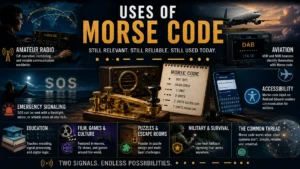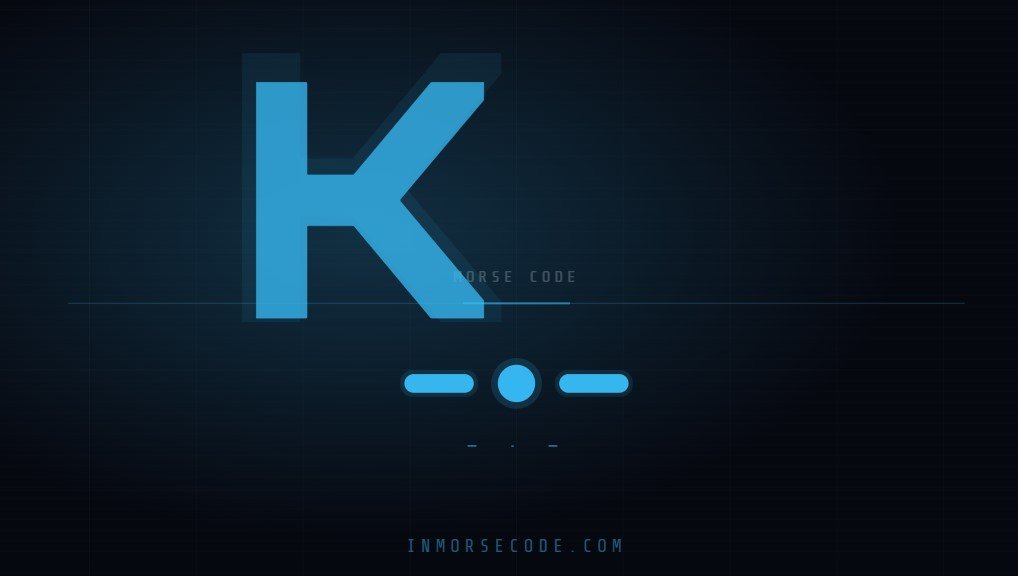
The letter K is an important character in the Morse code alphabet and is especially well known in radio communication. Morse code is a system that represents letters, numbers, and symbols using combinations of dots and dashes. Created for telegraph communication, Morse code remains popular among amateur radio operators, emergency communicators, and people interested in learning alternative communication methods.
Learning K in Morse code is useful because it introduces an alternating dash-dot-dash pattern that helps develop rhythm recognition and timing skills. The letter K appears in many names, places, and common words, making it a valuable addition to your Morse code knowledge. Understanding Morse code for K will help you communicate more effectively and improve your overall familiarity with the Morse code alphabet.
K in Morse code is − · −. Spoken as “dah dit dah”, it has a distinctive symmetrical structure; long, short, long that makes it one of the most recognizable characters in the alphabet. K is also significant beyond its letter value: it is the first character introduced in the Koch method of Morse code learning, and it serves as the CW radio prosing meaning “go ahead” or “any station reply”.
What Is K in Morse Code?
| K − · − |
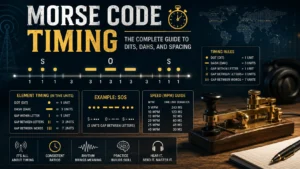
Dash, dot, dash. The symmetrical dah-dit-dah pattern at 20 WPM lasts approximately 480 milliseconds. Like R (· − ·), K is symmetrical; but where R begins and ends with dots, K begins and ends with dashes. The heavier-weighted K pattern is unmistakable in any transmission.
K in the Koch Method
The Koch method; the most widely recommended technique for learning Morse code, begins with exactly two characters: K and M. These were chosen by German psychologist Ludwig Koch because:
- K (− · −) and M (− −) both contain dashes, training the ear for long tones from session one
- They are acoustically distinct enough that a beginner can immediately distinguish them
- Both appear frequently in ham radio CW practice text, so learning them first has immediate practical value
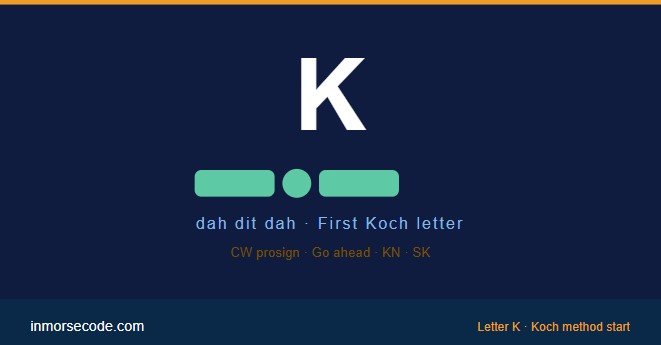
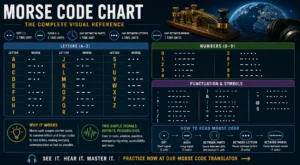
Morse Code Chart
| Item | Value |
|---|---|
| Letter | K |
| Morse Code Symbol | -.- |
| Dot-Dash Display | − · − |
| Length | 3 Signals |
| Difficulty | Medium |
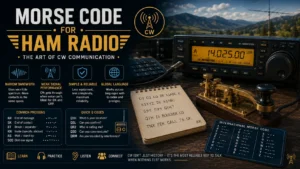
K as a Prosign in Ham Radio
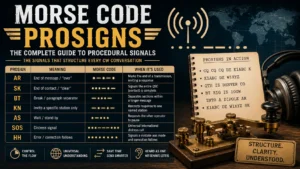
In CW (Continuous Wave) radio operation, K serves as an important prosign:
| Letter/Item | Morse Code | Sound / Note |
| K | − · − | “Go ahead” — any station may reply |
| KN | −·− −· | “Go ahead specific station” — named station only |
| SK | ··· −·− | “End of contact” — closing the QSO |
| CQ | −·−· −−·− | Calling any station (contains K in Q position) |
Common Words Containing K in Morse Code
| Letter/Item | Morse Code | Sound / Note |
| OK | −−− −·− | O + K — common acknowledgement |
| KNOW | −·− −·− −·−− · − −− | K + N + O + W |
| KEEP | −·− · · ·−·· | K + E + E + P |
| MAKE | −− ·− −·− · | M + A + K + E |
Common Names Containing K in Morse Code
- Kate: − · − / · − / − / · → K A T E
- Kyle: − · − / − · − − / · − · · / · → K Y L E
- Karen: − · − / · − / · − · / · / − · → K A R E N
What Is the Morse Code for K?
The Morse code for K is:
-.-
Visual form:
− · −
This pattern begins with a dash, followed by a dot, and ends with another dash. The alternating structure creates a unique rhythm that is easy to identify after some practice.
When sending K in Morse code, the rhythm sounds like:
dah-dit-dah
The first and last signals are long dashes, while the middle signal is a short dot. This balanced pattern helps learners improve their control of Morse code timing.
If you are practicing how to write K in Morse code, focus on making the dashes clearly longer than the dot and maintaining even spacing between signals.
Memory Trick
A simple memory trick for K is:
“Kick and Kick”
Imagine kicking a ball with one foot, taking a quick step, and then kicking again.
Pattern:
Long → Short → Long
The two strong kicks represent the dashes, while the quick step represents the dot.
This visualization makes the Morse code for K easier to remember.
Real World Uses
The letter K has a special place in radio communication. In many radio procedures, K is used as a signal meaning “go ahead” or “invite another station to transmit.”
Examples of common words containing K include:
- Key
- Keep
- Kind
- Knowledge
- Keyboard
Because K is widely recognized among radio operators, learning it can provide insight into practical Morse code communication and operating procedures.
The letter also appears frequently in personal names, business names, and technical terminology.
Words Using K
Words Starting With K
- Key
- Keep
- Kind
- Kingdom
- Keyboard
Words Containing K
- Signal Key
- Market
- Skill
- Working
- Network
Practicing these words helps learners recognize K in both the beginning and middle of messages.
Practice K in Morse Code
Try sending the letter K five times:
-.-
-.-
-.-
-.-
-.-
Now practice with these simple words:
- KEY
- KEEP
- KIND
- KITE
- KEYBOARD
Listen carefully to the rhythm:
dah-dit-dah
Repeat it until you can recognize the pattern immediately without looking at the Morse code chart.
For additional practice, compare K with R (.-.) to hear the difference between similar three-signal letters.
Quick Facts
- Position in alphabet: 11th
- Morse code pattern: -.-
- Signal count: 3
- Learning difficulty: Medium
- Commonly used: Yes
- Beginner friendly: Moderate
Related Morse Code Letters
After learning K, consider studying these related letters:
N (-.)
The first two signals of K begin similarly to N.
R (.-.)
A three-signal letter with a different dot-dash arrangement.
Studying these letters together improves pattern recognition and Morse code listening skills.
Continue Learning Morse Code
Want to practice beyond a single letter?
Visit the Morse Code Translator
Explore more lessons in the learning hub
Try the Morse Code Translator tool to practice converting letters, words, and complete messages.
Frequently Asked Questions: K in Morse Code
What is K in Morse code?
K in Morse code is − · − — dash dot dash. Spoken as “dah dit dah”.
Why is K the first letter in Koch method Morse training?
K was chosen along with M by Ludwig Koch as the first pair because both contain dashes (training the ear for long tones), they are acoustically distinct from each other, and K appears frequently in CW practice, particularly as the “go ahead” prosign at the end of every CQ call.
What does K mean at the end of a ham radio CW transmission?
A standalone K at the end of a transmission means “go ahead, any station”, an invitation for any listening station to reply. KN means “go ahead, specific station only”. Most beginners learn to send K as their first prosign in CW operating practice.
Conclusion
Learning K in Morse code is an excellent way to strengthen your understanding of alternating dot-and-dash patterns. Its dash-dot-dash sequence is distinctive, useful in radio communication, and common enough to appear in many everyday words. By practicing K regularly and using it in real examples, you can improve both your Morse code sending and recognition skills.
Keep practicing daily, explore related letters, and use the Morse Code Translator tool to reinforce your learning. Consistent effort will help you become more confident and accurate in Morse code communication.