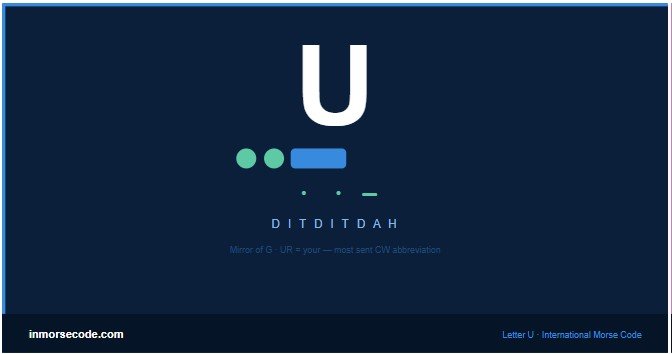
U in Morse code is two dots followed by a dash; the mirror of G (−−·). U appears in the word SOS adjacent context and in the critically important ham radio abbreviation UR (your), one of the most transmitted 2-letter sequences in CW operation.
What Is U in Morse Code?
| U · · − |
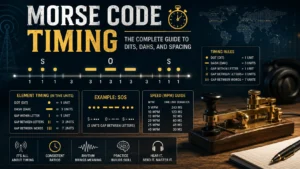
· · −. Spoken as “dit dit dah”. At 20 WPM this character is transmitted in approximately 300 milliseconds, with each dot lasting 60 ms and each dash lasting 180 ms.
The letter U is an important part of the Morse code alphabet and is commonly used in English words, names, and everyday communication. Morse code is a system that represents letters, numbers, and symbols using combinations of dots and dashes. Developed for telegraph communication, Morse code remains a valuable skill for amateur radio operators, emergency communicators, and anyone interested in learning a unique method of communication.
Learning U in Morse code helps beginners understand patterns that combine both dots and dashes. The letter U appears in many common words and is easy to recognize once its rhythm becomes familiar. By mastering Morse code for U, you’ll strengthen your listening skills, improve timing accuracy, and move one step closer to understanding the complete Morse code alphabet.
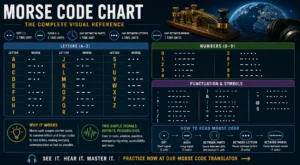
Morse Code Chart
| Item | Value |
|---|---|
| Letter | U |
| Morse Code Symbol | ..- |
| Dot-Dash Display | · · − |
| Length | 3 Signals |
| Difficulty | Easy |
U vs Similar Morse Characters
| Letter/Item | Morse Code | Sound / Note |
| G | − − · | dah dah dit — mirror of U |
| U | · · − | dit dit dah — mirror of G |
| I | · · | dit dit — U without the final dash |
| W | · − − | dit dah dah — related family |
U (· · −) and G (− − ·) are perfect mirrors. Learning them as a pair is one of the most efficient drills for 3-element characters. Every time you practice one, practice the other immediately after.
Common Words Containing U in Morse Code
| Letter/Item | Morse Code | Sound / Note |
| UR | ··− ·−· | your — most common ham CW abbreviation |
| UP | ··− ·−−· | U + P |
| USE | ··− ··· · | U S E |
| UNDER | ··− −· −·· · ·−· | U N D E R |
| URGENT | ··− ·−· −−· · −· − | U R G E N T |
Common Names Containing U in Morse Code
- Uma: → Type into the InMorseCode.com translator to see and hear the full pattern
- Ursula: → Type into the InMorseCode.com translator to see and hear the full pattern
- Unique: → Type into the InMorseCode.com translator to see and hear the full pattern
U in Ham Radio and Real-World Use
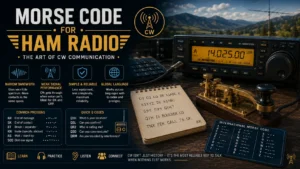
UR is one of the most transmitted abbreviations in all of ham radio CW. Every contact includes it; UR RST 599 (your signal report is 599), UR NAME (your name is), UR QTH (your location is). An operator who can send and receive U instantly is equipped for the most common exchanges on the air. U also appears in TNX (thanks) when spelled out, and in the phonetic alphabet as Uniform.
How to Practise the Letter U
- Type the letter U repeatedly into the InMorseCode Morse Translator and click Play. Listen to the sound pattern without looking at the screen.
- Practice U in short common words (see table above). Context helps the brain retain the pattern faster than isolated letters.
- Use the Advance Morse Code Machine at 20 WPM character speed / 5 WPM effective speed for Farnsworth practice.
- Contrast U with its most similar character (see comparison table). Drilling two adjacent characters together is the most efficient precision drill.
Memory Trick
A simple memory trick for U is:
“Up, Up, Away!”
Imagine a balloon rising with two small lifts and then soaring into the sky.
Pattern:
Short → Short → Long
The two quick lifts represent the dots, while the long upward movement represents the dash.
This visual association makes the Morse code for U easier to remember.
Real World Uses
The letter U appears frequently in everyday communication and many common English words.
Examples include:
- Use
- Unit
- User
- Update
- Unique
In amateur radio and Morse code training exercises, U is often introduced early because its pattern is simple and easy to hear. It also appears regularly in names, technical terms, and communication-related vocabulary.
Because U is used so often in written and spoken English, learning to recognize it quickly can improve your overall Morse code reading speed.
Words Using U
Words Starting With U
- Use
- User
- Unit
- Update
- Unique
Words Containing U
- Communication
- Signal
- Radio
- Computer
- Message
Practicing these words helps reinforce recognition of U in different positions within a message.
Practice U in Morse Code
Try sending the letter U five times:
..-
..-
..-
..-
..-
Now practice with these simple words:
- UP
- USE
- UNIT
- USER
- UNIQUE
Listen carefully to the rhythm:
dit-dit-dah
Repeat it several times until you can instantly recognize the sound without looking at the pattern.
For extra practice, compare U (..-) with I (..) and V (…-) to hear how additional signals change the rhythm.
Quick Facts
- Position in alphabet: 21st
- Morse code pattern: ..-
- Signal count: 3
- Learning difficulty: Easy
- Commonly used: Yes
- Beginner friendly: High
Related Morse Code Letters
After learning U, consider studying these related letters:
I (..)
The first two dots of U form the Morse code for I.
E (.)
Builds on the U pattern by adding another dot at the end.
Learning these letters together helps improve Morse code pattern recognition and listening skills.
Continue Learning Morse Code
Want to practice beyond a single letter?
Visit the Morse Code Translator
Explore more lessons in the learning hub
Try the Morse Code Translator tool to practice converting letters, words, and complete messages.
Frequently Asked Questions: U in Morse Code
What is U in Morse code?
U in Morse code is · · − — two dots followed by a dash. Spoken as “dit dit dah”.
What does UR mean in Morse code?
UR (··− ·−·) is the ham radio CW abbreviation for “your”. It appears in virtually every amateur radio contact: “UR RST 599” means your signal report is 599. It is among the most transmitted 2-letter sequences on CW frequencies.
How is U different from W in Morse code?
U is · · − (2 dots + 1 dash) and W is · − − (1 dot + 2 dashes). Both end with a dash but differ in the dot count. U sounds like two quick taps before the long tone; W is a single tap before two long tones.
Conclusion
Learning U in Morse code is a valuable step in understanding the Morse code alphabet. Its simple two-dot-one-dash pattern is easy to remember and appears frequently in everyday communication. By practicing U regularly and using it in common words, you can improve both your Morse code sending and receiving abilities.
Continue learning new letters, review patterns you’ve already mastered, and use the Morse Code Translator tool to reinforce your skills. Consistent practice will help you become more confident and accurate in Morse code communication.