The letter H is one of the most recognizable patterns in the Morse code alphabet because it consists entirely of dots. Morse code is a communication system that uses short and long signals, known as dots and dashes, to represent letters, numbers, and symbols. Originally developed for telegraph communication, Morse code continues to be used by amateur radio operators, emergency communicators, and Morse code enthusiasts worldwide.
Learning H in Morse code is useful because the letter appears frequently in common English words, names, and greetings. The simple repeating pattern makes it easy for beginners to learn and remember. By mastering Morse code for H, you’ll strengthen your understanding of Morse code timing and improve your ability to recognize longer dot-based sequences.
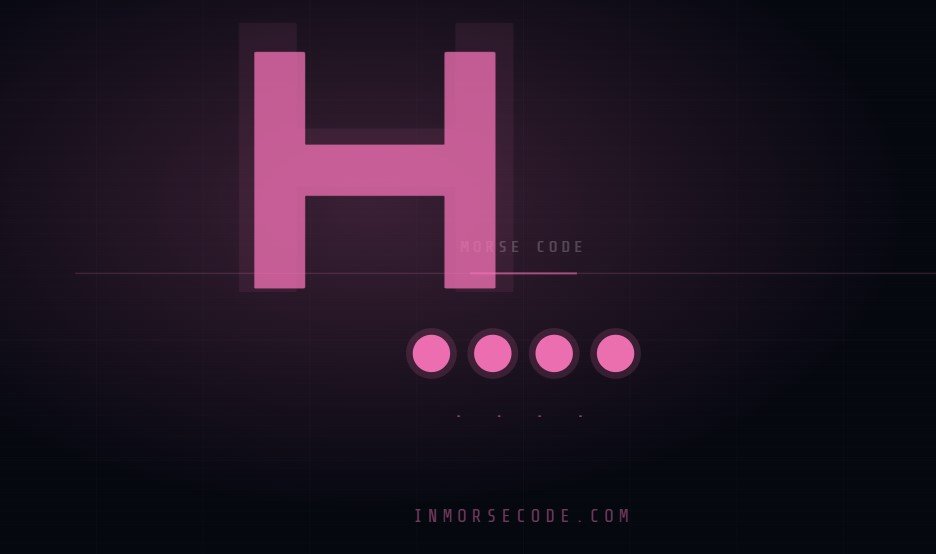
H in Morse code is four dots: · · · ·. Spoken as “dit dit dit dit”, it is the longest all-dot character in common use; one more dot than S (· · ·) and two more than I (· ·). Its four-dot pattern is both a useful learning milestone and a character that requires careful attention to distinguish from its 3-dot counterpart S.
What Is H in Morse Code?
| H · · · · |
Four dots. Four equal rapid beeps. At 20 WPM, total duration approximately 420 milliseconds; the same as R and M but with a completely different character of sound: rapid machine-gun dots rather than any long tones.
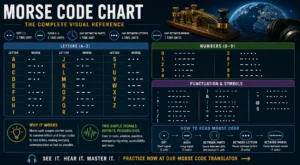
Morse Code Chart
| Item | Value |
|---|---|
| Letter | H |
| Morse Code Symbol | …. |
| Dot-Dash Display | · · · · |
| Length | 4 Signals |
| Difficulty | Easy |

The All-Dot Family: E, I, S, H
| Letter/Item | Morse Code | Sound / Note |
| E | · | 1 dot |
| I | · · | 2 dots |
| S | · · · | 3 dots |
| H | · · · · | 4 dots |
| Drill tip, counting dots: Practice the all-dot family as a group: E I S H — one two three four. At 20 WPM, each additional dot adds only 120 ms to the character. The difference is subtle but learnable. Record yourself saying ‘dit · dit dit · dit dit dit · dit dit dit dit’ and play it back until each count is automatic. |
H vs V: A Common Confusion
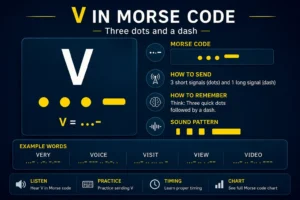
H (· · · ·) and V (· · · −) both begin with three dots. The difference is the fourth element: H ends with a dot, V ends with a dash. This makes them one of the trickiest adjacent pairs in the alphabet for beginners.
| Letter/Item | Morse Code | Sound / Note |
| H | · · · · | dit dit dit dit — four identical dots |
| V | · · · − | dit dit dit dah — three dots then a DASH |
V’s final dash creates a distinctive rising-then-falling rhythm. H flows flat throughout. Drill them as a pair; H H H V V V, until the ending dash of V is immediately noticeable.
Common Words Containing H in Morse Code
| Letter/Item | Morse Code | Sound / Note |
| HELP | ···· · ·−·· ·−·· | H + E + L + P |
| HERE | ···· · ·−· · | H + E + R + E |
| HOME | ···· −−− −− · | H + O + M + E |
| HAVE | ···· ·− ···− · | H + A + V + E |
| HELLO | ···· · ·−·· ·−·· −−− | H + E + L + L + O |
Popular Names Starting With H in Morse Code
- Hannah: · · · · / · − / − · / − · / · − / · · · · → H A N N A H
- Henry: · · · · / · / − · / · − · / − · − − → H E N R Y
- Harry: · · · · / · − / · − · / · − · / − · − − → H A R R Y
- Holly: · · · · / − − − / · − · · / · − · · / − · − − → H O L L Y
What Is the Morse Code for H?
The Morse code for H is:
….
Visual form:
· · · ·
This pattern consists of four dots transmitted in sequence. Since there are no dashes, H produces a fast and consistent rhythm that is easy to identify once practiced.
When sending H in Morse code, each dot should have the same short duration with equal spacing between signals. The rhythm sounds like:
dit-dit-dit-dit
Because all four signals are identical, H is often one of the first longer Morse code patterns that beginners learn.
If you’re practicing how to write H in Morse code, focus on keeping the timing steady and making each dot clear and distinct.
Memory Trick
A simple memory trick for H is:
“Four Happy Hops”
Imagine a rabbit making four quick hops across a field. Each hop represents one dot.
Pattern:
Hop Hop Hop Hop
The repeated movement mirrors the four-dot Morse code sequence for H and makes it easier to remember.
Real World Uses
The letter H appears in many everyday words and is commonly used in communication.
Examples include:
- Hello
- Help
- Home
- Human
- Hope
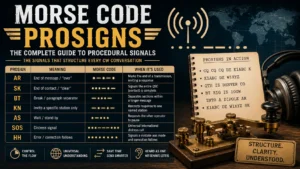
One of the most famous uses of H in Morse code is its appearance in the internationally recognized distress signal:
Although H itself is not part of SOS, learning dot-based patterns like H helps build the skills needed to recognize emergency signals.
In amateur radio and Morse code training, H is frequently included in beginner exercises because of its simple structure.
Words Using H
Words Starting With H
- Hello
- Help
- Home
- Human
- History
Words Containing H
- Machine
- Signal
- Teacher
- Weather
- Communication
These examples help learners recognize H in different positions within words and messages.
Practice H in Morse Code
Try sending the letter H five times:
….
….
….
….
….
Now practice with these simple words:
- HI
- HELLO
- HELP
- HOME
- HOPE
Listen carefully to the rhythm:
dit-dit-dit-dit
Repeat it until you can immediately recognize the pattern by sound alone.
For extra practice, compare H with E (.) and S (…) to hear how adding dots changes the rhythm.
Quick Facts
- Position in alphabet: 8th
- Morse code pattern: ….
- Signal count: 4
- Learning difficulty: Easy
- Commonly used: Yes
- Beginner friendly: Very high
Related Morse Code Letters
After learning H, consider studying these related letters:
E (.)
The simplest dot-based Morse code letter.
I (..)
Uses two dots and helps build recognition of short patterns.
S (…)
Uses three dots and is one signal shorter than H.
Learning these letters together helps you understand how Morse code patterns expand through additional dots.
Continue Learning Morse Code
Want to practice beyond a single letter?
Visit the Morse Code Translator
Explore more lessons in the learning hub
Try the Morse Code Translator tool to practice converting letters, words, and complete messages.
Frequently Asked Questions: H in Morse Code
What is H in Morse code?
H in Morse code is · · · · — four dots. Spoken as “dit dit dit dit”.
How do I distinguish H from S at speed?
S = 3 dots, H = 4 dots. The extra dot in H makes it slightly longer. At 20 WPM the difference is 120 ms. Practice saying “dit dit dit” for S and “dit dit dit dit” for H until the count difference is instinctive.
What is H used for in ham radio?
H appears in HELLO (the standard greeting), in QSH (can you change frequency?), in HR (here, or hours), and frequently in callsign exchanges. It is also part of HI; the Morse code equivalent of laughter, sent as · · · · · ·.
Conclusion
Learning H in Morse code is a great way to strengthen your understanding of dot-based signal patterns. Its four-dot sequence is easy to remember, simple to transmit, and common in everyday communication. Because H appears in many frequently used words, mastering it can improve both your Morse code sending and recognition skills.
Practice H regularly, listen to its rhythm, and combine it with other Morse code letters to build confidence. Consistent daily practice and the Morse Code Translator tool will help you progress toward fluency in Morse code communication.